The Great Space Age: Interplanetary Technology Diffusion
The Great Space Age · Third Overview Essay | November 2026

Cover | The Seeds of Civilization
Introduction: Civilization Will Not Relive Its Childhood on Another Planet
Humanity took long ages to master fire, make tools and build roads, and later to develop mechanical power, electricity, aviation, computers and artificial intelligence. Each technology emerged under particular environmental, historical and practical conditions. Roads preceded automobiles, cities preceded subways, and widespread ground transport long preceded aviation. These sequences describe the history of civilization on its home world. They need not define the future of other worlds.
When humans reach another celestial body, they can begin with modern engineering knowledge. Even without local roads, factories or cities, explorers can draw on autonomous navigation, automatic control and underground engineering in mission design. Local energy supplies, equipment maintenance and industrial manufacturing capabilities must nevertheless be built gradually. The gap between these two starting points determines which technologies can be used early and which capabilities must be established from scratch.
This does not allow physical laws to be bypassed or mature terrestrial equipment to be transferred unchanged. It carries a deeper implication. The history of technological development cannot be dispensed with, but the history of technological adoption need not be repeated.
Interplanetary technology diffusion is the process through which the technological inheritance of the home world crosses spatial boundaries and is selected, adapted, combined and further developed in different environments. The Chinese term used here refers broadly to civilization extending beyond Earth. In the foreseeable phase, its main practical expression will remain within the solar system.
1. Technological Inheritance: Civilizational Expansion and Historical Beginnings
Technology is more than an isolated artifact. An aircraft embodies materials science, fluid mechanics, propulsion, control theory and industrial manufacturing. A subway depends on geological surveying, tunneling machinery, structural engineering, ventilation, electricity and organizational management. An apparently individual product contains many bodies of knowledge and the relationships that connect them.
Technology diffusion therefore begins with the spread of knowledge and capabilities, as well as the transport of equipment. A distant base may be unable to manufacture every terrestrial machine, yet apply modern engineering principles from its initial design. It may lack a complete industrial supply chain, yet use automatic control and digital tools to organize limited productive resources.
On Earth, many technologies emerged only as populations, markets and infrastructure accumulated. Off-world development may bring mature capabilities from different historical periods to the same undeveloped location at once. Accumulated technological history thus becomes an initial endowment for civilizational expansion.
Inheritance, however, does not confer independence. Knowledge can arrive first, while materials, energy, maintenance and manufacturing capabilities take time to establish. Early off-world bases may depend heavily on supplies from Earth. The depth of diffusion ultimately depends on their ability to turn imported knowledge into sustained operation, maintenance and the capacity to reproduce equipment and systems.
2. Crossing Development Paths: New Worlds Can Follow Different Sequences
The order of events in terrestrial technological history is often mistaken for an inevitable ladder. Many sequences arose from the energy, materials, knowledge, population and economic organization available at the time. As conditions change, appropriate development paths may change as well.
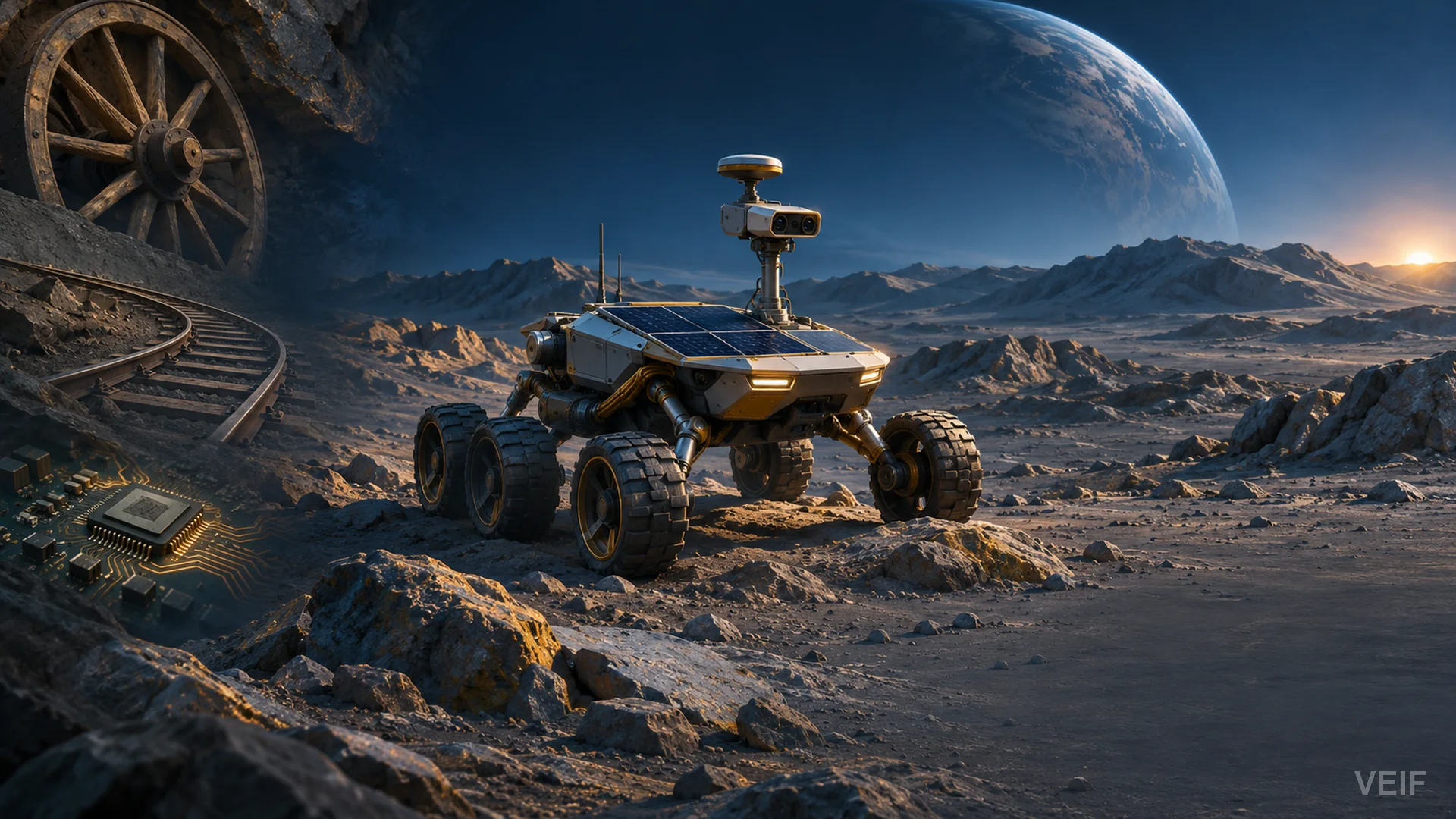
Figure 1 | History Is Not a Blueprint. Autonomous exploration can enter off-world missions before infrastructure such as roads is built. Concept illustration.
NASA’s Ingenuity helicopter completed 72 flights on Mars and served as an aerial scout for Perseverance. This demonstrates that aerial scouting can become part of a mission before a local road network exists.[1] Dragonfly, a planned flying exploration mission to Titan, is designed to take advantage of its low gravity and dense atmosphere.[2] The tasks best suited to aircraft or ground vehicles still depend on range, payload, energy, terrain and maintenance costs.
Terrestrial cities generally grew on the surface before extending transport and utilities underground. Off-world settlements may face radiation protection, temperature control and life-support requirements from the outset, giving planners reason to assess regolith shielding and underground spaces early. Lunar regolith has been studied as radiation shielding, and the International Space Station has demonstrated high water recovery in its life-support system.[3][4] These findings provide a basis for assessment. Construction order still depends on local conditions and the costs of building, sealing, inspection and emergency evacuation.
Off-world development can bypass historically contingent stages of adoption, such as waiting for roads to form a network before deploying aerial scouts. Energy, control and maintenance capabilities must still be provided. Some solutions that are now uncommon on Earth may become useful again because they are reliable, energy-efficient or easy to inspect and repair.
Civilization can inherit the paths already traveled without retracing the same route on every new world.
3. Environmental Selection: The Value of Technology Has No Permanent Ranking
A technology’s merits depend on its environment and task. Solutions that work on Earth may be unsuitable for low gravity, thin atmospheres, intense radiation or long day-night cycles. Solutions that are too costly or have limited uses on Earth may become critical off-world infrastructure.
The environment changes technological constraints. Gravity and atmosphere affect mobility, radiation and temperature affect building form, communication delays affect control architecture, and transport costs affect the value of repair, recycling and local manufacturing. Assessments must ask how many resources a system consumes, how much resupply it requires and whether it can be maintained over the long term.
Technological value is consequently reordered. Underground space may become a priority in some off-world settlements. Autonomous robots may become essential to production where humans cannot remain continuously. Recycling may become a basic requirement for survival and economic viability. The International Space Station achieved 98% water recovery in an engineering demonstration.[4] NASA’s in-situ resource utilization research explores local resources to reduce dependence on supplies from Earth.[5]
The same task may face different dominant constraints on different celestial bodies. For mobility, atmospheric conditions determine whether aerodynamic lift is usable, while terrain affects the cost of ground travel. Different off-world technological paths may therefore grow from a shared knowledge base.
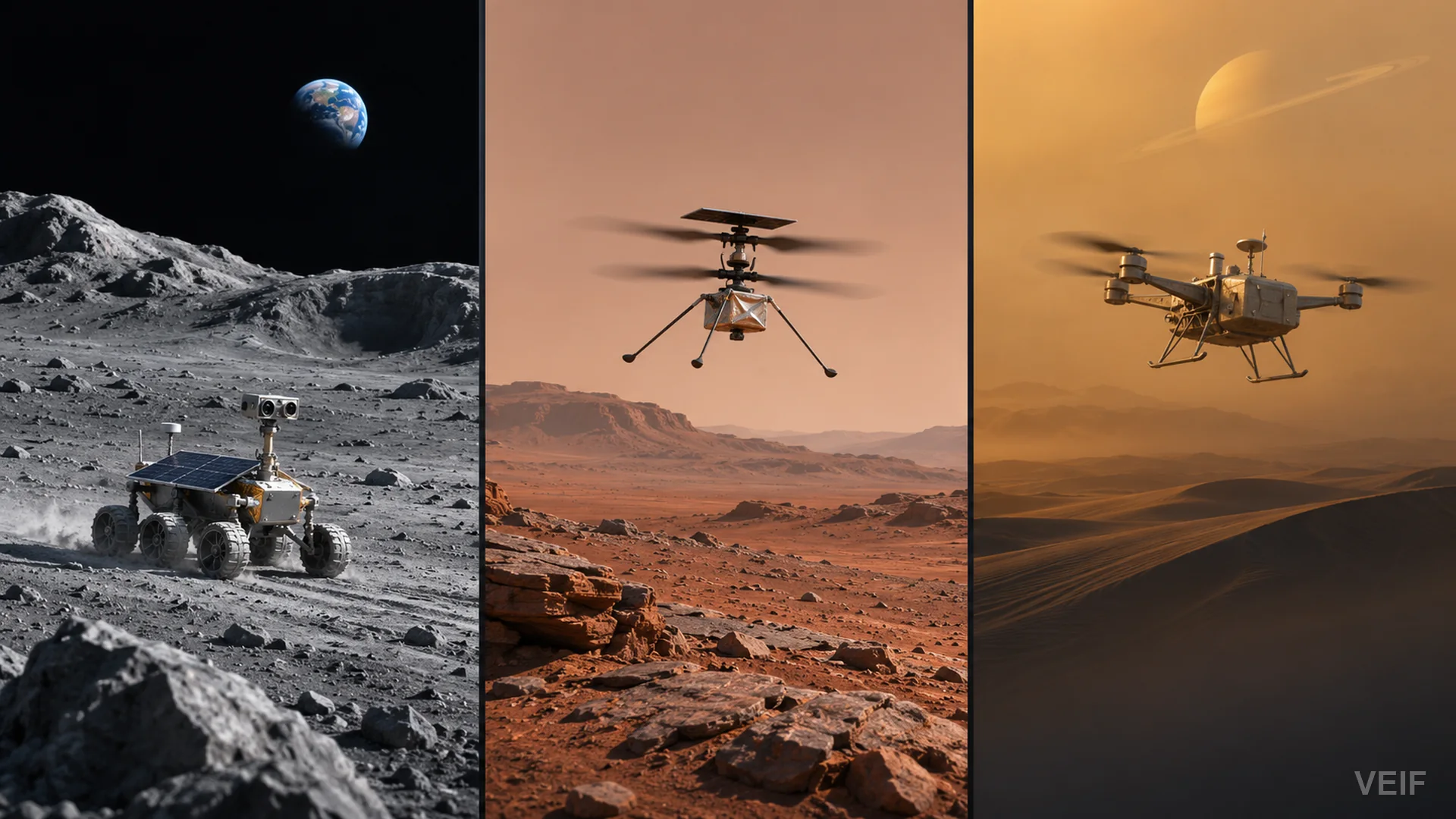
Figure 2 | Technology Shaped by Its Environment. A shared scouting task may call for different solutions. Ingenuity has demonstrated rotorcraft scouting on Mars. The Titan scene depicts a planned mission concept, and the lunar scene is illustrative. See [1] and [2].
Interplanetary diffusion thus produces differentiated technological evolution from the accumulated knowledge of a common civilization.
4. Technological Recombination: From Individual Tools to New Systems
When technologies leave their original social and industrial settings, their boundaries may also change.
On Earth, transport, construction, energy, manufacturing, communications and environmental control often belong to separate industries with relatively independent facilities and operating systems. In early off-world development, limited populations, equipment and resources make system interdependence especially important. One facility may support transport, protection, energy distribution and maintenance. One group of robots may perform surveying, construction, inspection and cargo handling.
Off-world societies will still have divisions of labor, but early arrangements may follow different boundaries from terrestrial industries. Technologies may be combined before mature markets form, and systems integration may precede specialized industrial expansion.
As artificial intelligence, autonomous control, communication networks and robotics combine, diffusion can extend the transfer of tools into the transfer of capabilities. People can observe, assess and act in places they have never physically reached. Machines can extend perception, memory and action into distant environments.
This recalls Odin’s two ravens in Norse mythology, which fly across the world and return with their observations. Future autonomous exploration systems may become humanity’s sensory and cognitive extensions beyond Earth. Some capabilities strengthened through warfare, industry and civilian activity on the home world may, through redesign, serve scientific discovery, resource surveys and infrastructure construction. A technology’s origins need not determine the civilizational purposes it ultimately serves.
The changes discussed in Sections 2–4 can be grouped into four mechanisms. Leapfrogging diffusion changes the sequence in which technologies enter missions, as with aerial scouts deployed before road networks. Adaptive diffusion changes implementation, as with aircraft redesigned for thin atmospheres. Value-reordering diffusion changes evaluation priorities, as when difficult resupply makes repairability more valuable than peak performance. Integrative diffusion combines previously separate capabilities, as when surveying, construction and inspection share a robotic operating system.
All four mechanisms may act on the same mission. Assessment can ask which stages can be omitted, which designs must change, which performance characteristics merit investment and which capabilities must be deployed together. Once engineering feasibility has been demonstrated, mission benefits must still justify long-term deployment, resupply and maintenance costs.
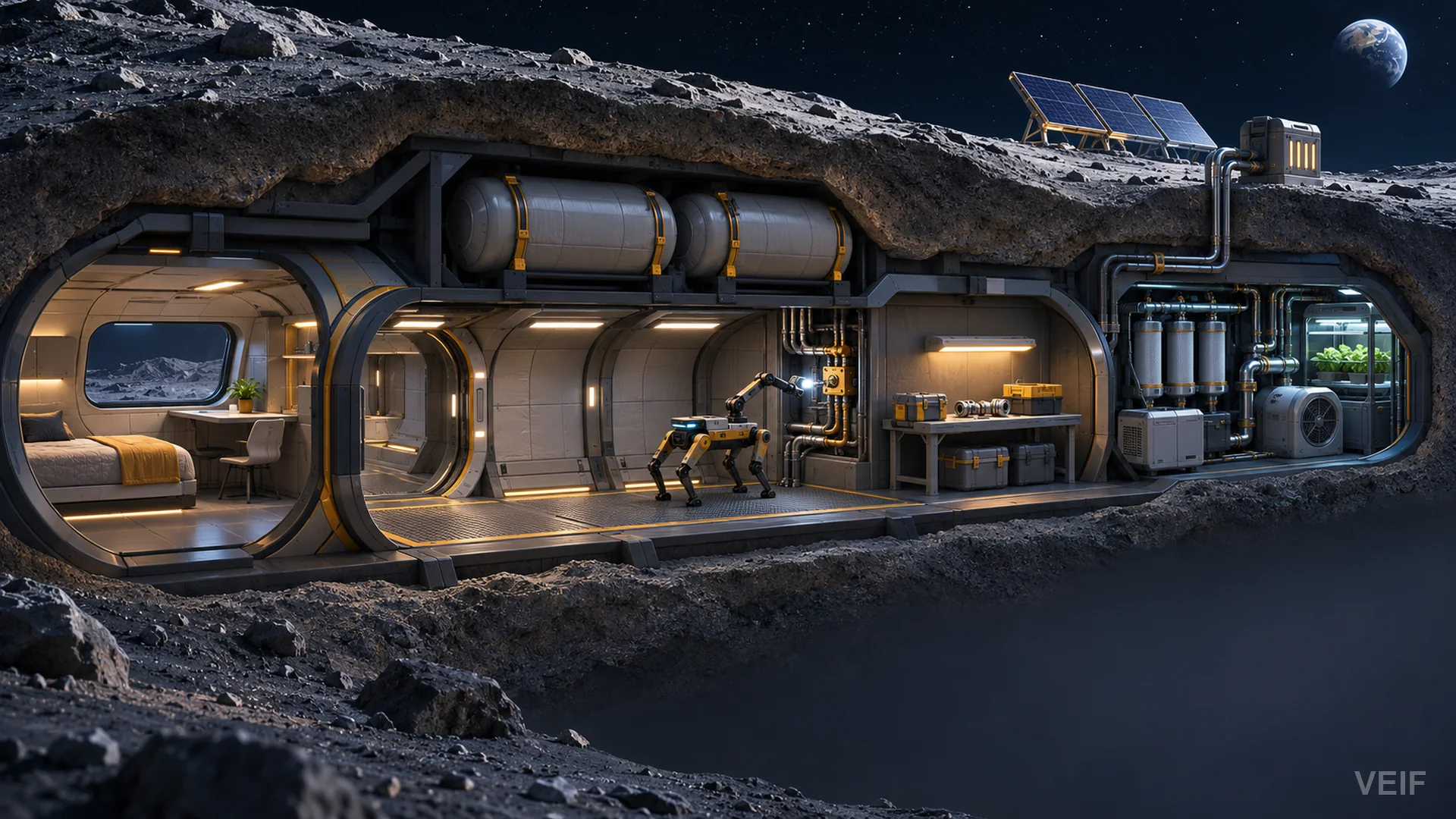
Figure 3 | Technology Reassembled. Regolith protection, life support and equipment maintenance can be planned together in early facilities. Engineering scenario.
5. The Pace of Diffusion: From Dependence on Earth to Local Capabilities
Interplanetary diffusion may deepen gradually over time.
Initially, off-world activity depends mainly on Earth for equipment, energy systems, components and expertise. Local facilities focus on survival, exploration and continued operation. As resource knowledge, energy supplies and engineering capabilities improve, some repair, processing, manufacturing and infrastructure construction may move locally. Only when these capabilities support and renew one another can off-world systems gradually reduce their dependence on individual transport missions.
This evolution need not follow uniform stages. Localization rates will differ greatly. Information and design knowledge can be transmitted relatively easily, while precision manufacturing, complex materials and large industrial facilities may remain dependent on Earth for a long time. Partial autonomy and overall dependence may coexist for years.
Progress should therefore be judged by the emergence of capabilities for sustained operation, maintenance, improvement and reproduction. A machine’s first successful operation on another world matters, but a technological system’s long-term continuity matters more.
6. Feedback from Diffusion: How New Worlds Advance Technology
Interplanetary diffusion extends the application of inherited capabilities. It also opens further technological evolution. Problems encountered in new environments, together with their material and experimental conditions, can become starting points for another round of progress.
Mature technologies usually rely on relatively stable design conditions. Beyond Earth, low gravity may change fluid behavior, vacuum changes heat dissipation, radiation and temperature differences test electronics and structures, and communication delays limit real-time intervention. A NASA technical report estimates that one-way delays during crewed Mars missions can reach about 22 minutes.[6] For tasks requiring prompt responses, local fault diagnosis and handling become design requirements. When several constraints arise together, redesign can itself generate new knowledge.
New experimental conditions can also produce knowledge. Microgravity experiments on the International Space Station reduce buoyancy-driven convection and sedimentation, helping researchers examine how heat and mass transfer affect solidification and microstructure formation.[7] Different gravity, vacuum and local materials on extraterrestrial surfaces may likewise provide research opportunities. Their value must be assessed through reproducible experiments.
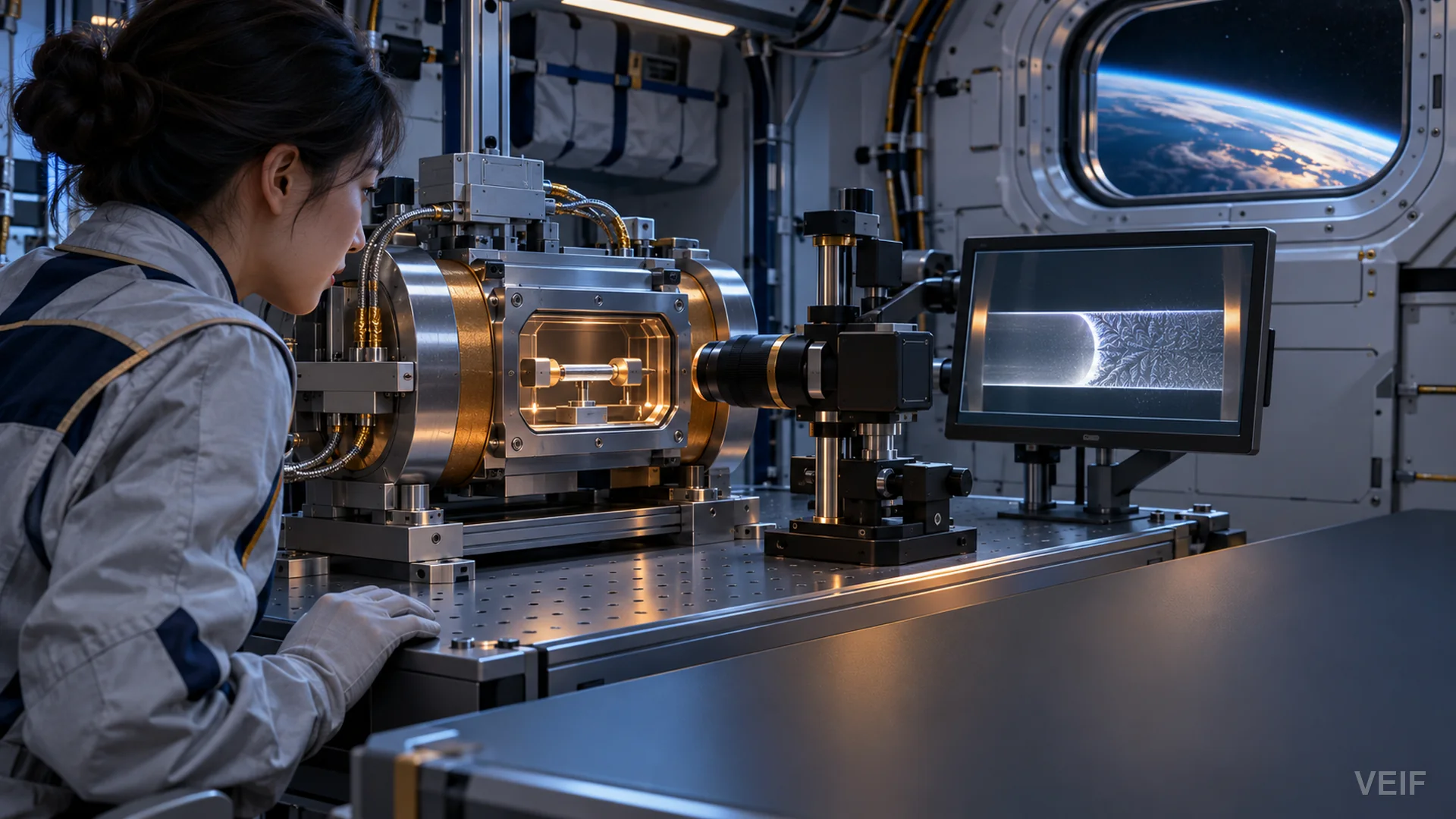
Figure 4 | Innovation Through New Frontiers. Orbital microgravity provides different experimental conditions for studying alloy solidification. Illustrative laboratory scene. See [7].
Harsh off-world environments may also accelerate the integration of previously separate technologies. Energy, robotics, materials, manufacturing, communications and life support must work together with limited resources. Improvements to individual components must be tested against the whole system. Resulting methods may create value in reliability, resource cycling, autonomy and integration beyond any single space mission.
Existing technologies enable entry into new environments, which in turn provide problems and experimental conditions for further progress. Sustaining this feedback requires energy, maintenance and experimental capacity sufficient for repeated verification.
7. From One-Way Transfer to Multidirectional Evolution
Early technological flows beyond Earth run mainly outward from the home world, reflecting its established research, industrial, demographic and capital base.
Whether new knowledge returns to Earth or reaches other off-world nodes depends on similar problems at the receiving end, reproducible results and acceptable adaptation and deployment costs. Microgravity materials experiments on the International Space Station have already contributed to improved predictive models for terrestrial materials processing, offering a concrete example of knowledge flowing back.[7]
Transferring engineering methods requires further validation. Local diagnostic methods designed for communication delays may, for example, help remote terrestrial facilities with unreliable communications. Adoption requires assessment of compatibility with existing equipment, field performance and whether inspection savings cover deployment and maintenance. Other off-world nodes would likewise need to reassess the method against their own communication, energy and maintenance conditions.
If several off-world nodes can consistently solve engineering problems and exchange documented, reproducible results, technology exchange may develop into co-evolution among Earth and multiple off-world locations. Stable long-term communications, operational capabilities and application demand are prerequisites for this distant scenario.
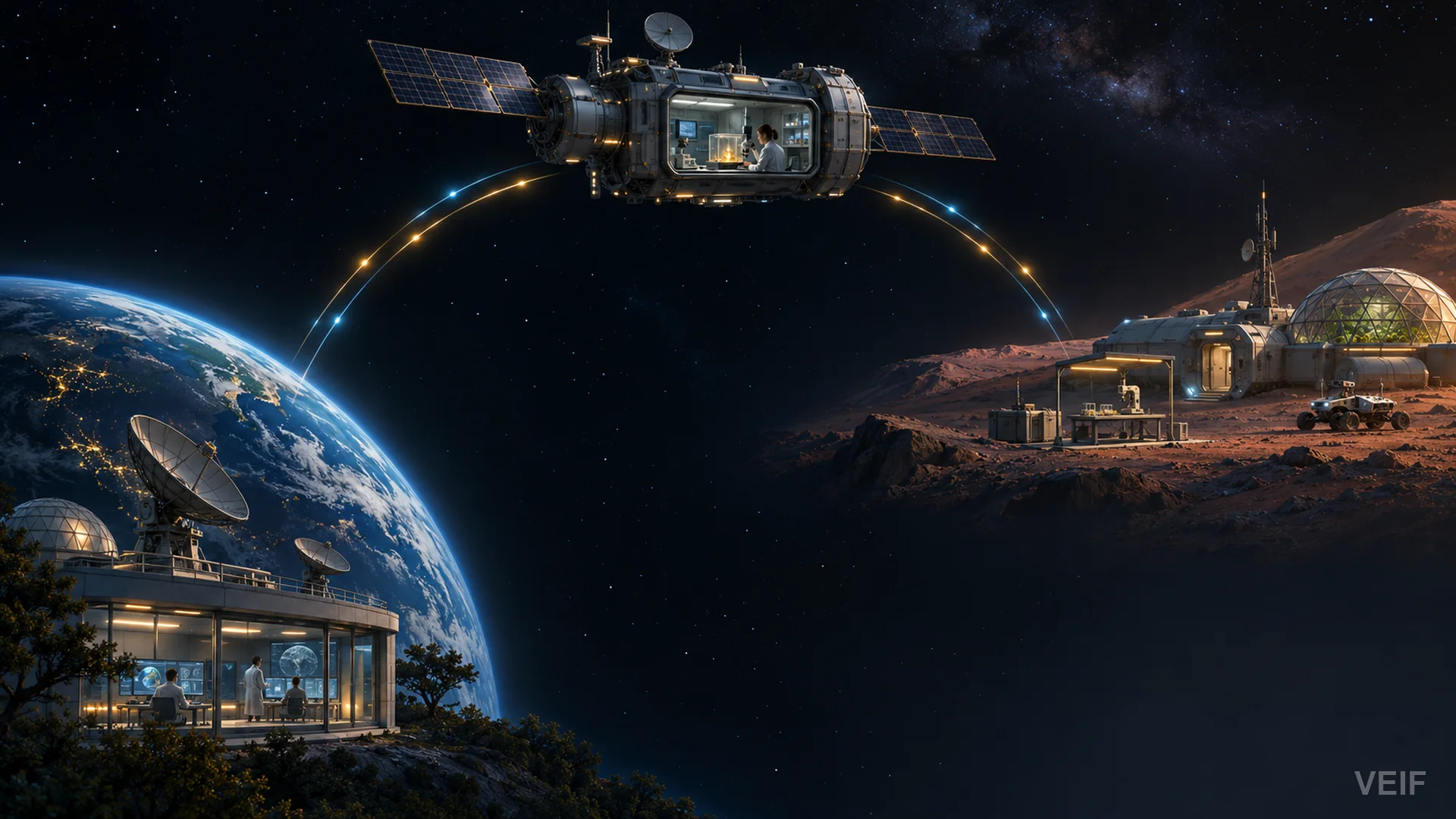
Figure 5 | A Civilization of Many Worlds. Exchange may gradually become reciprocal as different nodes verify and adopt one another’s results. Long-term scenario.
8. Civilizational Significance: Inheriting Without Repeating
Interplanetary diffusion first changes how we understand expansion into space.
Traditional frontier narratives often imagine new worlds as empty land, with construction progressing from roads, houses and farms. Humanity instead brings deeply accumulated modern knowledge to natural conditions markedly different from Earth’s. Their encounter may produce a development order unlike historical experience.
It also changes how technological value is assessed. The long-term significance of an enterprise, engineering discipline or production method may extend beyond its present industry. Mature, ordinary terrestrial capabilities may become critical in new spatial conditions. Technologies serving competition or warfare today may support exploration and construction tomorrow. Their civilizational value depends on what they can do and what humanity chooses to do with them.
It further changes how people participate in expansion. Civilization’s reach need not coincide with the places where human bodies can live for long periods. Autonomous machines may explore, build and maintain first. Knowledge and operational capabilities may reach new worlds before large-scale migration. The frontier may initially consist of sensing, communication and production capabilities, followed later by human settlement.
Conclusion: Let History Become a Starting Point
Civilization continues beyond Earth by turning existing knowledge into locally operable systems and passing new practical knowledge to later explorers.
Humanity need not reinvent the wheel on another planet or extend every terrestrial road toward the stars.
What we carry into space is a civilization capable of continually understanding the world, reshaping its tools and reorganizing its capabilities in new environments.
Interplanetary technology diffusion gives human civilization the capacity to keep growing across different worlds.
References
These sources support specific engineering facts and scientific context. The essay’s arguments about development paths, diffusion mechanisms and multi-node co-evolution are the author’s synthesis and extrapolation from that evidence.
- NASA Science (2024). The Legacy of Ingenuity: The Frontier of Extraterrestrial Flight. Ingenuity’s 72 Mars flights and aerial scouting.
- NASA Science. Dragonfly Spacecraft and Instruments. The Titan flying exploration concept.
- Adams, J. H., Jr. & Bhattacharya, M. (2005). Space Radiation and Lunar Regolith. Conference abstract on regolith radiation shielding.
- NASA (2023). NASA Achieves Water Recovery Milestone on International Space Station. Water recovery demonstration.
- NASA. Overview: In-Situ Resource Utilization. Local resources to reduce Earth resupply.
- McBrayer, K. T., Chai, P. R. & Judd, E. L. (2022). Communication Delays, Disruptions, and Blackouts for Crewed Mars Missions. One-way communication-delay analysis.
- NASA. A Researcher's Guide to: Microgravity Materials Research. Solidification experiments and contributions to terrestrial processing models.
Sources checked in November 2026.
VEIF · The Great Space Age Series | Third Overview Essay
Read this series · The Great Space Age
- The Great Space Age: Humanity’s Second Great Expansion
- The Great Space Age: On the Expansion of Civilizational Frontiers
- The Great Space Age: Interplanetary Technology Diffusion