The Great Space Age: On the Expansion of Civilizational Frontiers
The Great Space Age · Second Overview Essay
Overarching essay: The Great Space Age: Humanity's Second Expansion into Space
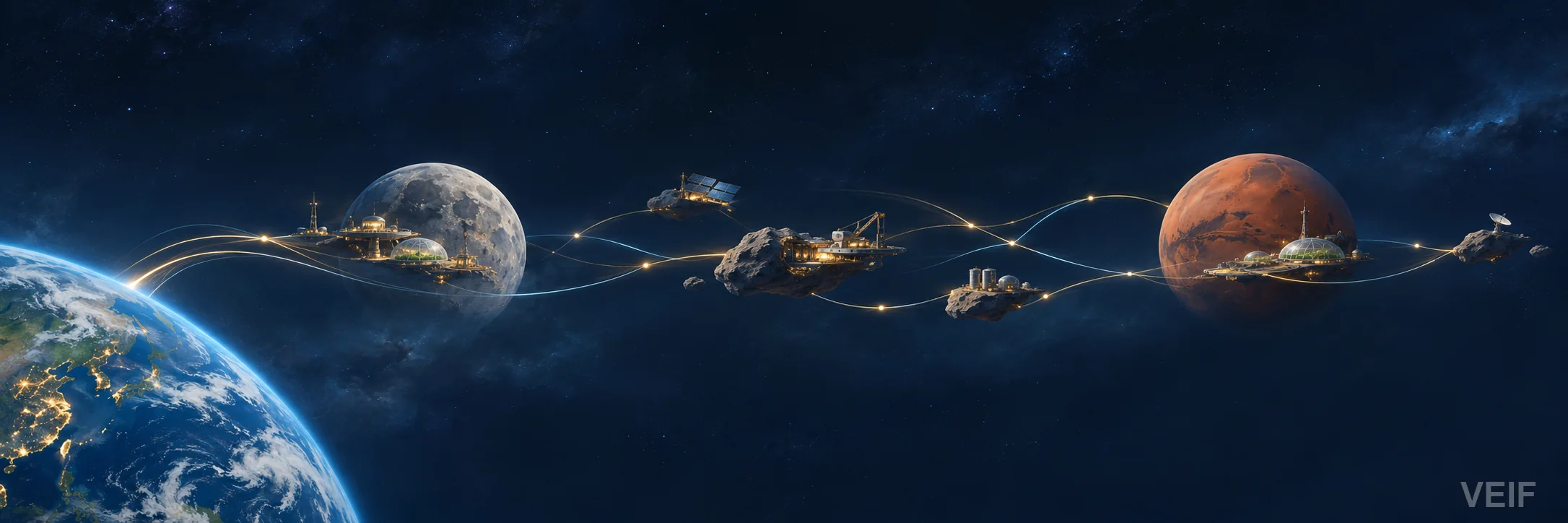
Civilization's expansion into space extends not only its reach, but also the scope of what it can sustain. Artistic concept, not to scale.
Opening Proposition
A civilization's frontier is not the farthest place it has ever reached. It is a place where it can endure, continue to create, and set out once again.
Humanity once moved beyond its original habitats, migrating and exploring across continents, seas, and islands, gradually establishing connections among civilizations across regions. Today, the Great Space Age is opening humanity's second major expansion into space. Yet the universe is more than an enlarged version of terrestrial geography: distances are greater, environments harsher, and the basic conditions for survival and production harder to obtain locally.
The more fundamental question, then, goes beyond where humanity can reach: At what cost do we get there, and can the new frontier become a foundation for the next departure?
Sustainable civilizational expansion means safeguarding civilization's existing foundations for survival and continuity while gradually developing enduring, renewable capabilities in new places, and preserving resources and choices for future exploration. On this basis, this essay asks what kinds of spatial expansion can establish lasting civilizational frontiers, and proposes basic principles for planning a spacefaring civilization.
I. The Civilizational Frontier: From Arrival to Sustained Operation
Spatial expansion has always changed more than the extent of human activity. It also changes resource allocation, the spread of knowledge, the division of labor, and the ways civilization organizes itself. Expansion can create new room for development, but it can also bring conflict, depletion, and burdens that cannot be sustained.
In the Great Space Age, three kinds of frontier should be distinguished:
- The frontier of knowledge: space that humanity can observe, understand, and investigate;
- The frontier of activity: space that people or equipment can reach and carry out missions in;
- The civilizational frontier: space where the conditions for production or survival can be maintained over the long term, knowledge passed on, and capabilities for further development established.
These frontiers need not advance together. A probe reaching a distant celestial body can extend the frontier of knowledge. A base able to carry out missions, but not yet equipped for sustained operation, can extend the frontier of activity. An extraterrestrial node begins to constitute a civilizational frontier when, drawing on its own capabilities and a cooperative network, it can sustain operations, maintain and renew its systems, and support new missions. Such a node need not host a large settled population; it might instead be a space industrial facility with production and maintenance capabilities.
Self-maintenance here does not require every node to possess a complete production system of its own. It requires nodes and their cooperative networks to keep obtaining critical supplies, maintain their facilities, and cope with disruptions, gradually reducing the vulnerability that comes from relying on the home planet as the sole source of support.
Arrival discovers a frontier; sustained operation establishes it.
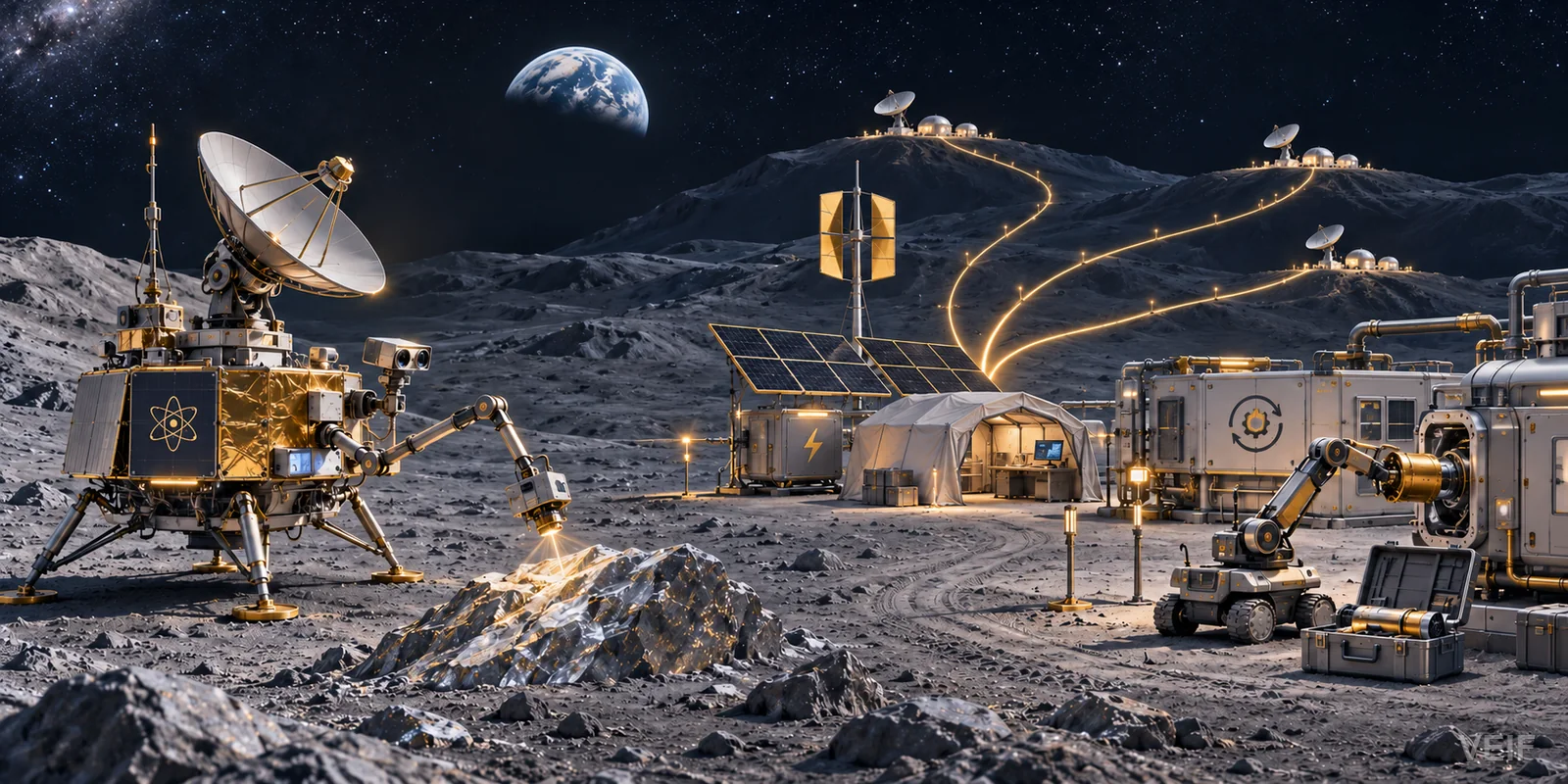
Arrival is an achievement; sustained operation requires capabilities that can be maintained, renewed, and carried forward. Artistic concept, not to scale.
II. Support from the Home Planet: The Initial Constraint on Expansion
Early exploration toward an extraterrestrial civilization must draw on the home planet's existing systems of research, energy, industry, education, and organization. Although spacecraft, bases, and transport networks operate far from Earth, their critical equipment, technological upgrades, and maintenance capabilities may continue to depend on Earth for a long time.
The burden on the home planet extends beyond money or minerals. Energy supplies, industrial capacity, engineering talent, ecological carrying capacity, and the ability to cooperate socially can each become a bottleneck. Assessing whether these commitments are sustainable requires asking whether they weaken Earth's capacity to sustain basic living conditions, renew its production systems, and preserve knowledge, and whether the burden can be borne over the long term.
Expansion on extremely long timescales and at very large scales may also raise questions about the home planet's material balance. The scale of any effects and the need for compensation require separate study; these possibilities do not establish significant present-day risks.
The principle is this: The home planet is not an inexhaustible starting point for expansion. Any lasting endeavor in space must recognize and bear its real costs to civilization's place of origin.
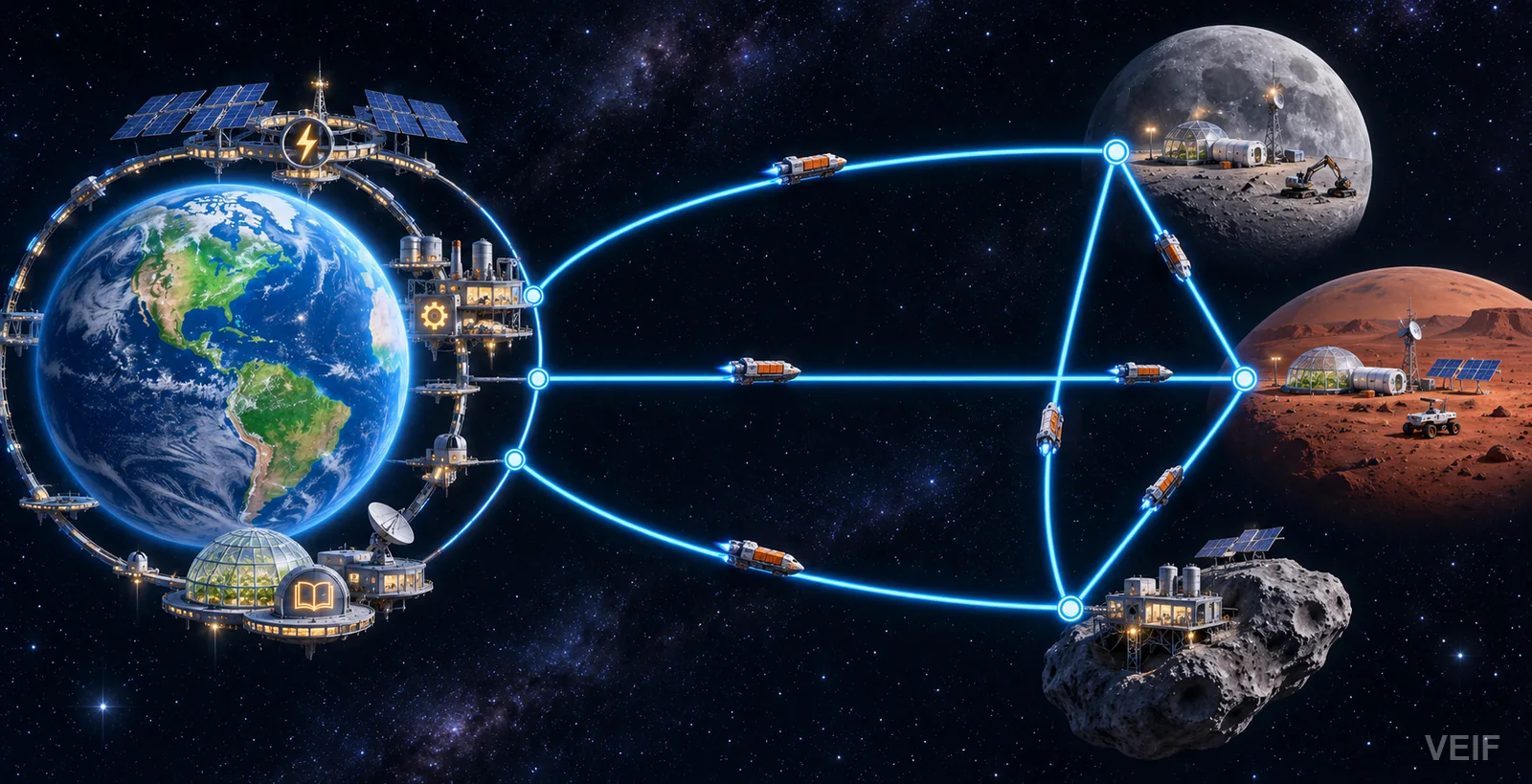
Early extraterrestrial operations draw on the home planet's existing capabilities for production, knowledge, and organization. Artistic concept, not to scale.
III. The Limits of Expansion: Resources, Time, and Windows of Opportunity
Exploration requires investment in advance, while its results often emerge much later. Some results can become energy, materials, or industrial capacity; others take the form of knowledge, technical experience, and future choices. Exploration should not be dismissed merely because it brings no immediate material return. Nor should visions of distant success obscure present resource constraints.
A civilization must attend to two timelines at once: the time needed to develop critical technologies and extraterrestrial capabilities for production, maintenance, and renewal; and the period over which the necessary commitments can be sustained while protecting the home planet's essential capabilities. The expansion window in this essay refers to the relationship between the time needed to build capabilities and the period over which the required commitments remain affordable in this broader sense.
Facilities that continue to depend on the home planet are not necessarily a problem, provided their burdens are manageable and their value clear. The danger arises when additional facilities create continuing obligations of support that cannot be sustained by the resources the home planet can commit, the value those facilities deliver, and the new capabilities developed beyond Earth. Existing expansion may then crowd out the resources needed to maintain civilization's foundations and pursue further exploration. This is the interstellar expansion trap discussed here: a civilization seeks to overcome resource limits through expansion, yet first erodes the foundations of its own continued development.
An expansion window does not imply a universal, fixed countdown for civilization. Resources can be renewed, technology can change costs, and societies can reorder their priorities. Missions also differ in value and in the time needed to develop their capabilities. Planning must therefore address the scale and pace of exploration, the scope for experimentation, and the degree of failure that can be absorbed, continually revising judgments as conditions change.
Expansion must preserve the possibility of further expansion, rather than stake every hope on a single distant arrival.
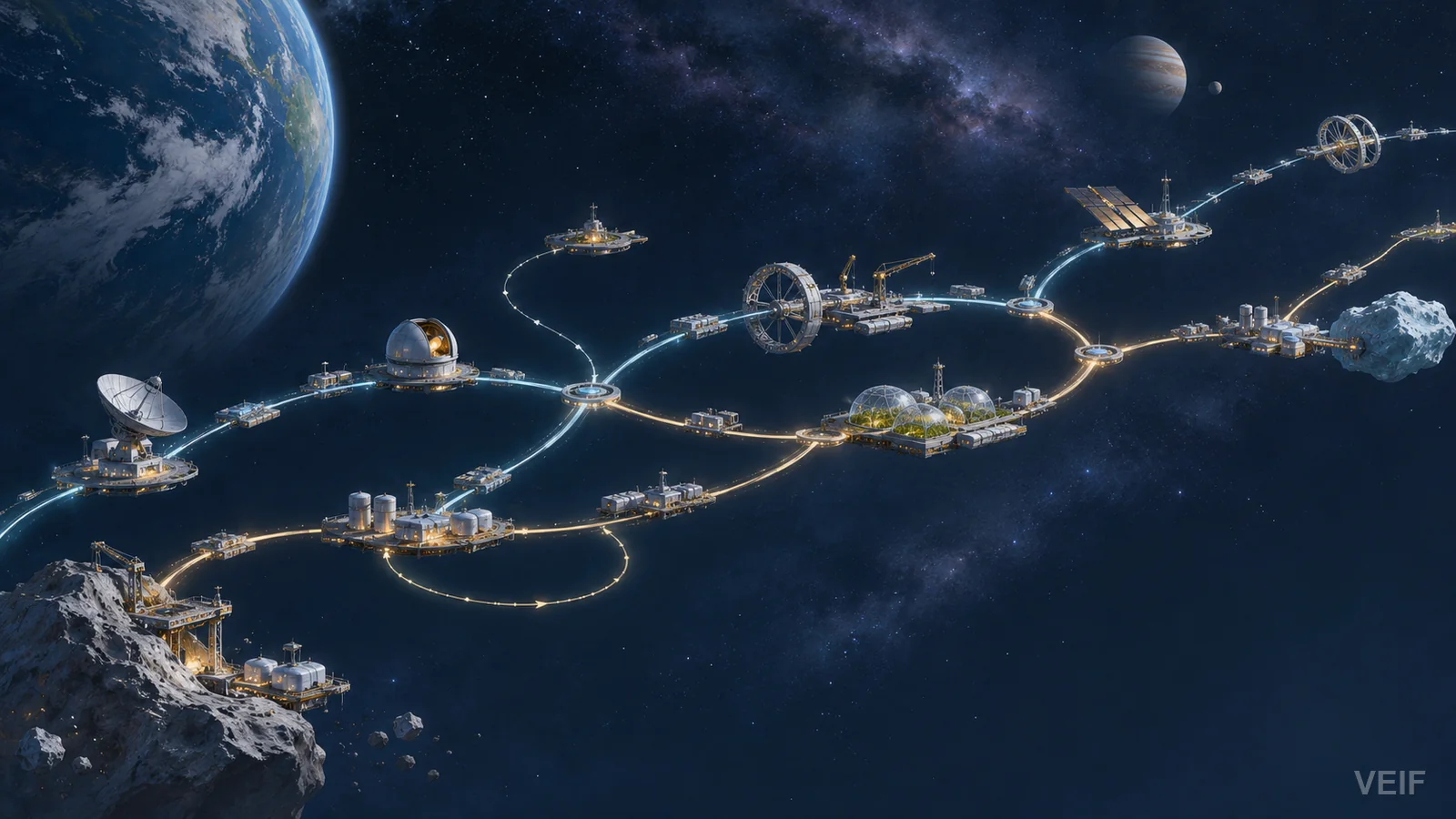
The pace of expansion must be adjusted as capabilities accumulate and the capacity to sustain commitments changes. Artistic concept, not to scale.
IV. The Evolution of Civilization: From Exploration to Self-Maintenance
Activity in the Great Space Age may take the form of exploration, resource use, extraterrestrial industry, or sustained civilizational operation. These forms can overlap; they are not fixed steps that must be crossed in sequence.
Observation and investigation open new possibilities. Resource use reduces some supplies from Earth. Industrial systems gradually enable extraterrestrial facilities to repair, produce, and renew their equipment. Sustained operation further requires continuity in knowledge, organization, and the ability to respond to risk.
The most consequential transition is from completing individual missions toward sustaining production, maintenance, and renewal with support from a cooperative network, while leaving reusable capabilities for new exploration.
A landing, a mining operation, or the completion of a base can mark the beginning of this transition. These achievements gradually become foundations for lasting operations only when equipment can be maintained, experience accumulated and passed on, and critical capabilities renewed.
Civilizational advancement therefore cannot be assessed solely by distance explored, launch counts, or the scale of bases. What matters is whether new space activities expand civilization's ability to obtain resources sustainably, accumulate knowledge, organize production, and withstand risk.
A civilization may reach far and remain fragile. It may also remain within its present reach for a time while building solid foundations for its next advance.
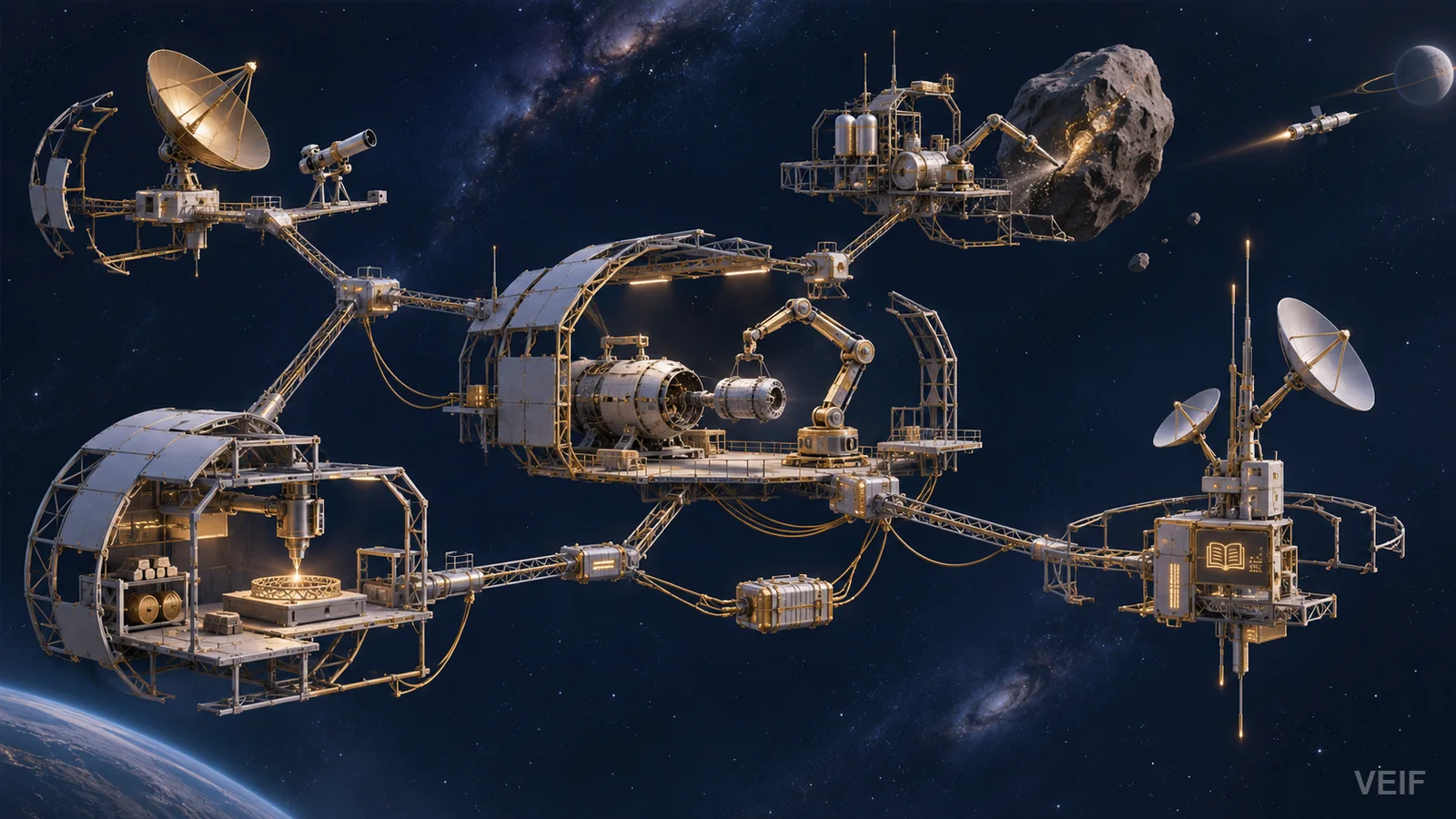
When mission results can be maintained, renewed, and reused, exploration begins to build the foundations of lasting operations. Artistic concept, not to scale.
V. Order at the Frontier: Planning and Responsibility Across Generations
Civilizational expansion over the long term cannot rely entirely on competition without boundaries, nor can a rigid unified plan eliminate every alternative route of exploration. Civilization needs principles that can be continually revised as technology and circumstances change, rather than a single path prescribed centuries in advance.
First, protect the home planet. Earth's ecology, essential production, and capacity to carry civilization forward are foundations that expansion must not lightly compromise.
Second, accumulate capabilities. Give particular weight to technologies and infrastructure that can be reused and serve multiple missions, so that exploration leaves more than a singular feat.
Third, expand incrementally while preserving room for experimentation. Adjust commitments in light of intermediate results, allow basic science to pursue long horizons, and prevent repeated failures from becoming irreversible systemic burdens.
On this basis, assessing a long-term expansion proposal requires answers to at least four questions:
- Which irreplaceable capabilities of the home planet does it depend on, and can the associated burdens be sustained?
- Which reusable, renewable capabilities will the investment leave behind?
- If critical assumptions fail, can the endeavor be scaled down, adjusted, or exited without endangering civilization's essential capabilities?
- Which resources and choices does it preserve for future generations?
These questions provide a common starting point for planning. Specific indicators and methods of judgment still need to be tested through focused studies.
The costs and benefits of extraterrestrial exploration may also span generations. Today's explorers have a right to seek distant horizons, but must also recognize the right of those who come later to survive, choose, and explore. States, companies, and research organizations can play different roles; the interests of any one actor do not necessarily coincide with civilization's long-term interests as a whole.
The responsibility of civilizational planning is not to decide every aspect of the future for our descendants, but to leave them enough possible futures.
VI. Civilization's Roots: From a Single Seed to a Forest
The growth of a seed offers a useful metaphor for civilizational expansion.
A seed falls into soil, takes root beneath itself, draws nourishment, and grows into a tree. A mature tree produces new seeds, and new life takes root farther away. A forest can keep spreading because new life obtains resources in new environments, sustains itself, and reproduces—not because the original seed holds an endless store of nourishment.
This metaphor directs attention to a change in the structure of expansion. New frontiers gradually become new starting points for growth, and civilization develops from a system continually supplied outward from the home planet into a network of specialized nodes that support one another and enable further exploration.
Nodes can perform different functions and share transport, energy, manufacturing, and knowledge resources. Yet adding nodes does not automatically make civilization more resilient. If every node still depends on the same critical supply, the original vulnerability may simply travel outward with them. A network can strengthen civilization's ability to withstand risk only as it develops alternative supplies, necessary redundancy, and the capacity to cope with disruptions.
This is the Rooted Expansion Principle: every frontier expansion intended for lasting operation should accumulate enduring, renewable capabilities and, through specialization and mutual support among nodes, gradually reduce the entire expansion system's vulnerable dependence on the home planet as its sole source of support.
This does not require every space activity to take root at each successive stop. Distant probes, experiments that leap beyond existing infrastructure, and basic scientific research retain independent value. The seed-and-forest metaphor suggests that a civilization seeking lasting operations needs more places that can obtain resources, carry capabilities forward, and support one another's growth.
Civilization must learn not only to travel far, but also to take root far from home and nurture the next journey there.
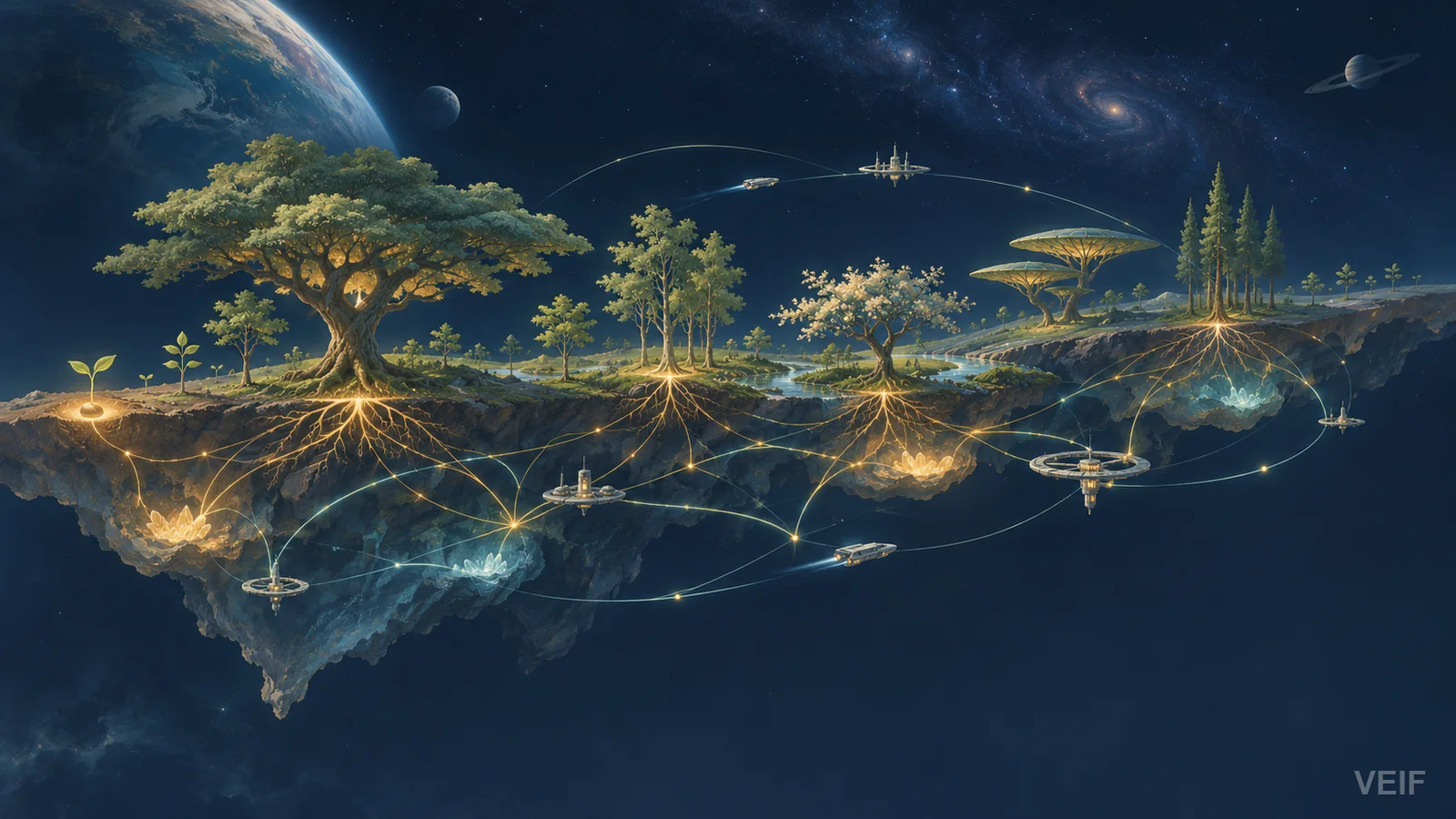
By taking root in new places and supporting one another, new frontiers together build the capacity for the next departure. Artistic concept, not to scale.
Conclusion: Let New Frontiers Become Starting Points for the Next Departure
The vastness of the universe does not prove that every expansion is worthwhile. The limits of the home planet should not become a reason never to depart. The real challenge of the Great Space Age is to find a path that can keep moving forward while balancing the ambition to explore with civilization's capacity to bear its costs.
Space transport determines where humanity can reach. Resource use broadens what it can operate and develop. New capabilities for production, maintenance, and continuity determine whether civilization can move from one frontier to the next.
Civilizational advancement means continually increasing the capacity to endure and set out again through new spaces, new knowledge, and new modes of production, rather than spreading the home planet's finite capabilities ever more thinly.
This is the direction that the expansion of civilizational frontiers should follow: protect civilization's place of origin while cultivating new places across the wider universe that can continue to grow and support one another.
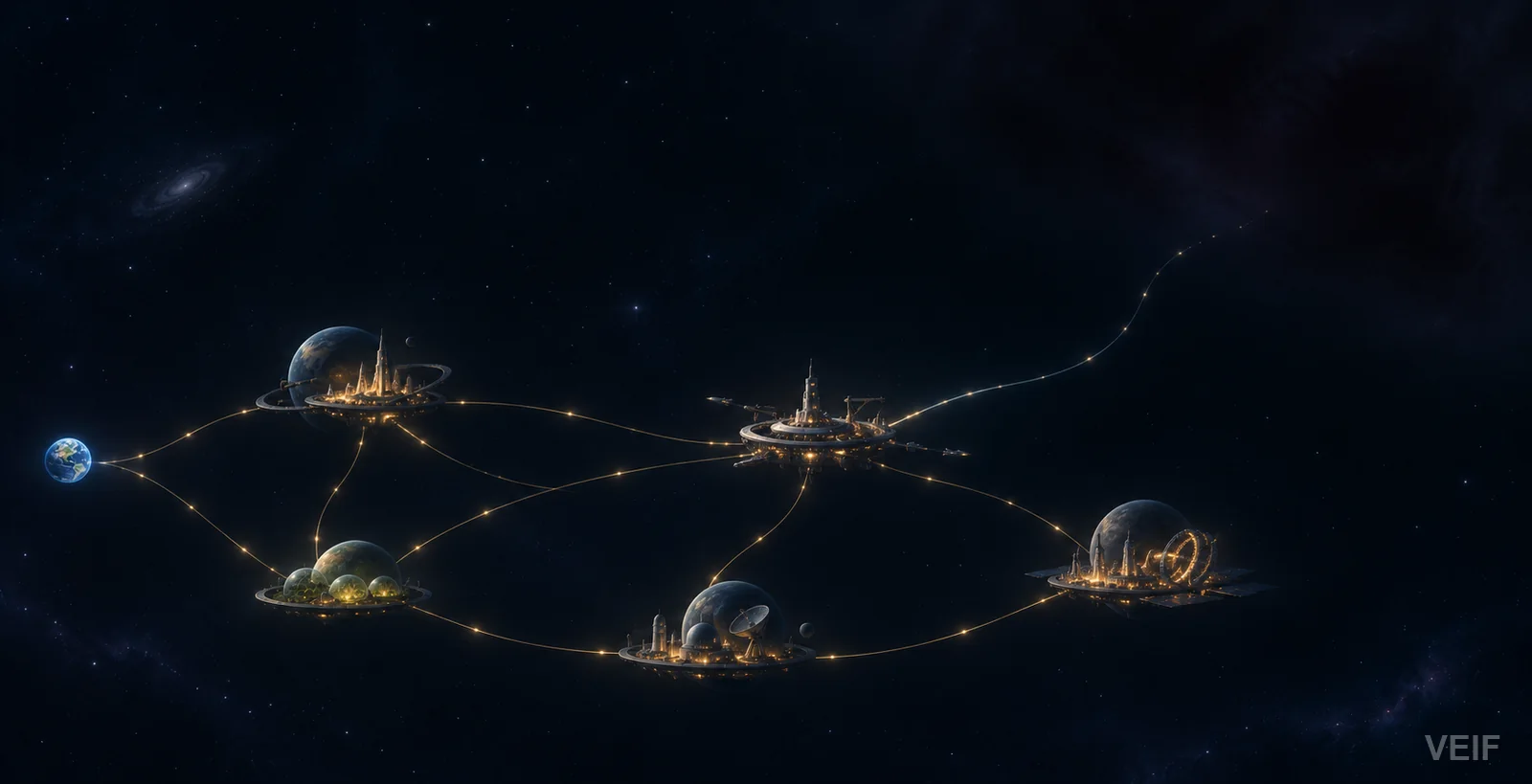
With support from its network, a mature frontier becomes a place for the next departure. Artistic concept, not to scale.
Research Scope and Further Development
This essay is the second supporting argument of The Great Space Age: Humanity's Second Expansion into Space. Focusing on sustainable expansion, it proposes principles for judging civilizational frontiers, the home planet's capacity to bear costs, expansion windows, capability continuity, and rooted expansion. “Civilizational frontier,” “interstellar expansion trap,” “expansion window,” and “Rooted Expansion Principle” are analytical concepts, not established laws of natural science. The phrase “interstellar civilization” is used broadly here to describe the long-term prospect of expansion into the universe; the present discussion primarily concerns the initial conditions for expansion within the Solar System.
The forthcoming Planners of Interstellar Civilization series will examine how expansion proposals can be tested, designed, and revised through focused studies of the home planet's lifelines and compensation, the evolution of civilizational exploration, resource and time windows, civilization's roots and autonomous growth beyond Earth, frontier planning, and governance and responsibility across generations. This essay sets out evaluative questions and general principles. The focused studies will develop models, evidence, and applied judgments; their conclusions are not presumed here.
References
The following provide relevant background. They do not constitute direct proof of this essay's analytical concepts.
- NASA, Moon ABCs Fact Sheet, basic Earth and Moon data: https://science.nasa.gov/wp-content/uploads/2024/01/exploring-the-moon-teachers-guide.pdf
- NASA, Overview: In-Situ Resource Utilization, using resources at the destination: https://www.nasa.gov/overview-in-situ-resource-utilization/
- NASA, Architecture: Moon to Mars, developing long-term space capabilities: https://www.nasa.gov/architecture/
- United Nations, Outer Space Treaty (1967), basic principles for activities in outer space: https://www.un.org/en/global-issues/outer-space
Read this series · The Great Space Age
- The Great Space Age: Humanity’s Second Great Expansion
- The Great Space Age: On the Expansion of Civilizational Frontiers
- The Great Space Age: Interplanetary Technology Diffusion