Space Carriage Drivers 2: Rethinking the Paradigm of Mobility
From a revolution in speed to a revolution in space: our gaze reaches deep into the universe, while our footsteps remain in the age of the carriage
Space Carriage Drivers series · Part 2 | Technology, Evolution and Civilization | November 16, 2026
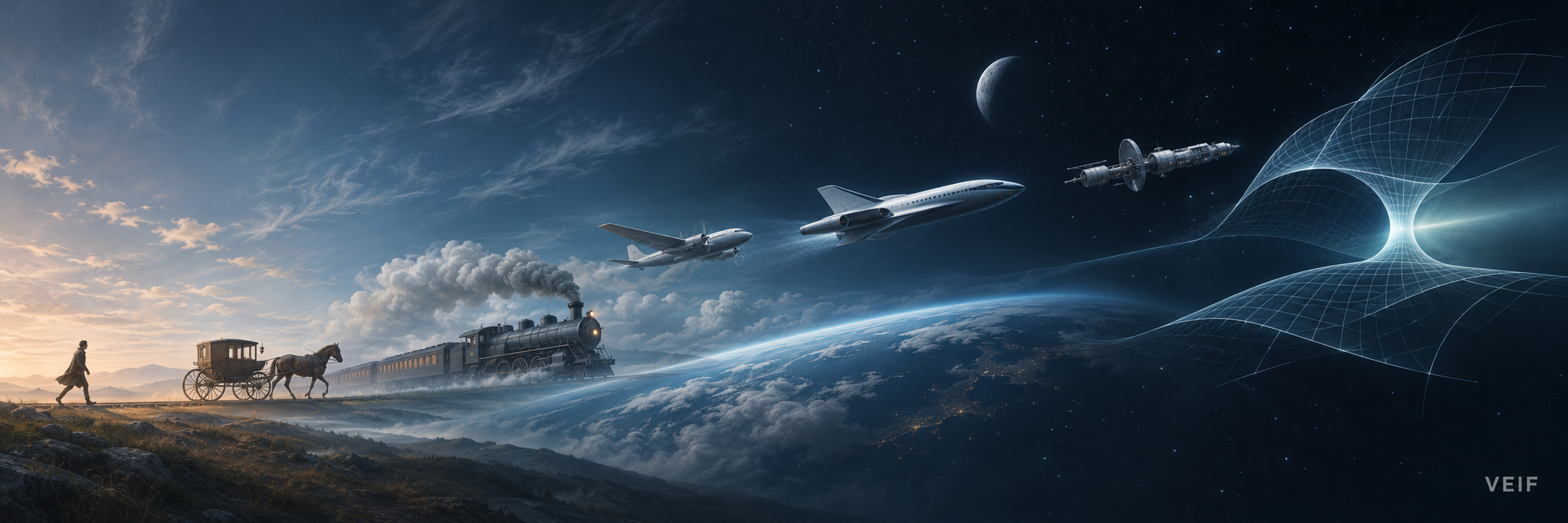
From walking and carriages to modern aircraft, humanity keeps extending its mobility. The spacetime jump at the right is a theoretical imagining, not an established transport technology.
I. We Are Still Driving Space Carriages
The history of human transport is often told as a succession of breakthroughs in speed.
From walking, carriages and sailing ships to steam locomotives, cars, aircraft and rockets escaping Earth's gravity, humanity has acquired more power, greater speed and a wider sphere of activity.
Yet if we set aside the appearance, power sources and control systems of our vehicles and return to the physical nature of movement, we may reach an uncomfortable conclusion:
From carriages to rockets, we have mainly improved propulsion and transport systems to overcome distance within a given spacetime geometry. We are becoming better at changing the motion of objects, but have yet to master the use of spacetime geometry itself as transport infrastructure.
Horses pull carriages; steam drives locomotive pistons; aircraft engines produce thrust; rockets generate reaction forces by expelling propellant at high speed. Even more advanced ion engines, nuclear thermal propulsion and proposed fusion spacecraft still obey fundamental physical laws, including conservation of momentum.
Of course, these technologies are not identical. Aircraft are constrained by aerodynamics, spacecraft by orbital mechanics, and light sails obtain momentum from photons. Modern spacecraft navigation must also account for relativistic effects.
But at the level discussed here, they share a premise: within a given spacetime geometry, an object reaches its destination through the arrangement of trajectories, the exchange of momentum and the expenditure of energy.
Here, the “old paradigm” means a technological approach that overcomes distance primarily by changing the motion of objects. It does not suggest that carriages and rockets lack fundamental differences in engineering capability.
Power technologies advance and motion control improves, but we cannot yet construct spacetime geometries connecting distant places to meet our transport needs.
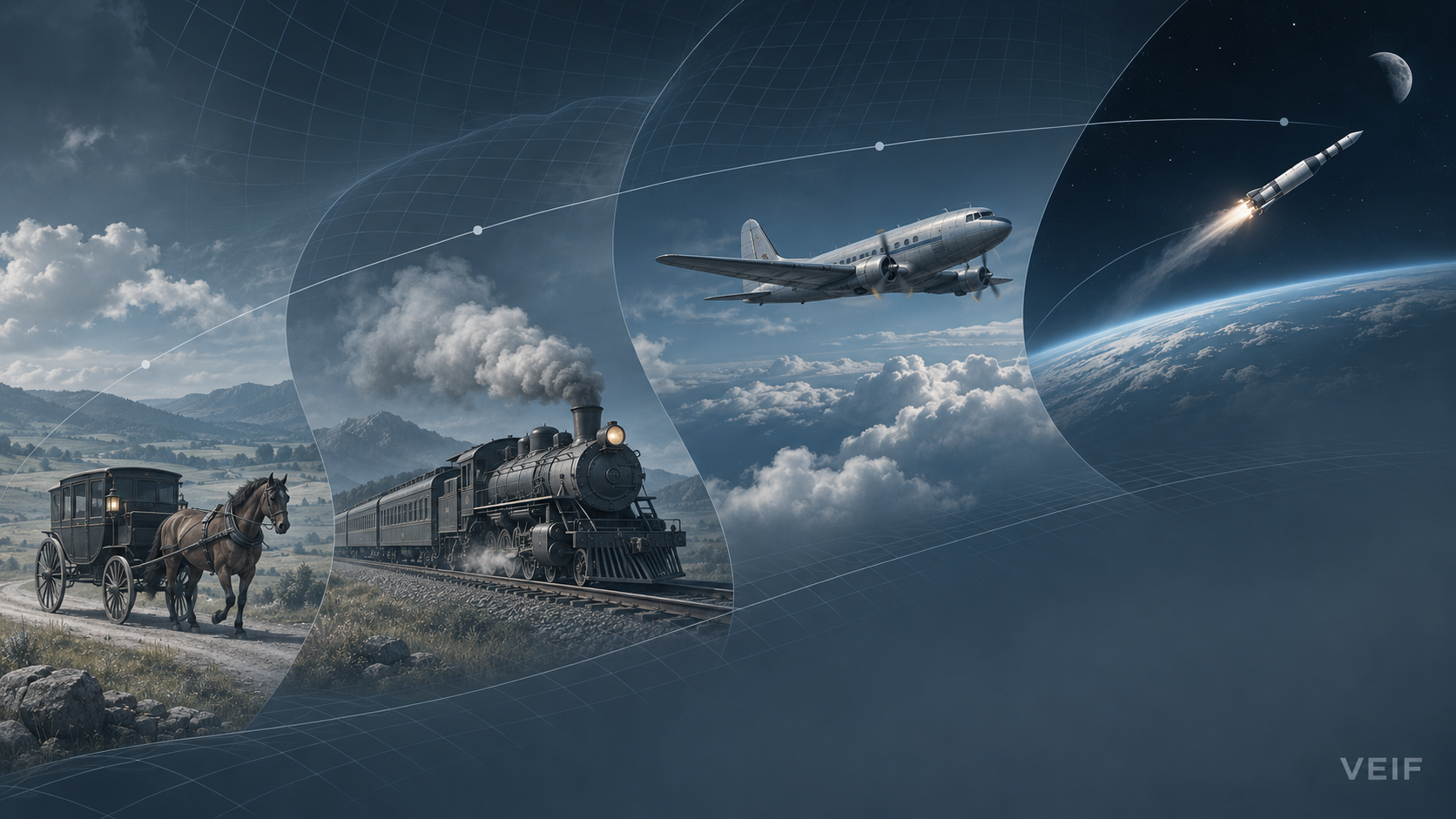
Engineering capabilities have changed enormously, but overcoming distance still depends mainly on changing motion and transport systems.
This paradigm has been spectacularly successful on Earth. It has reduced ocean crossings from months to little more than ten hours, enabled the worldwide circulation of goods, and allowed humanity to leave its home planet for the first time.
On cosmic scales, however, this once extraordinarily successful technological system begins to reveal limitations that are difficult to overcome.
Our rockets may be highly advanced. Yet viewed through the paradigm of mobility, they remain carriages fitted with modern engines.
II. A Universe We Can See, and Destinations We Cannot Reach
Modern astronomy has extended human vision to almost unimaginable scales.
We observe distant galaxies through telescopes, study objects formed in the early universe, and use spectroscopy to infer the atmospheric composition of distant worlds. The observable universe is estimated to be about 92 billion light-years across.
But when we actually contemplate traveling to these places, a striking asymmetry emerges:
The gap between our ability to understand the universe and our ability to reach it has become almost absurd.
Launched in 1977, Voyager 1 is the most distant spacecraft humanity has ever sent out.
By November 18, 2026, it is expected to be about one light-day from Earth, a distance corresponding to approximately 24 hours of one-way light travel time.
Voyager 1 has taken 49 years to make that journey.
This probe, an embodiment of human scientific ingenuity, has needed almost half a century to cover the distance light travels in a single day.
More sobering still, Proxima Centauri, the nearest star to the Sun, lies 4.24 light-years away. A simple estimate using Voyager 1's current speed of roughly 17 kilometers per second puts the journey at tens of thousands of years.
That does not include slowing down, entering an orbit within the target star system, or eventually returning to Earth.
We can observe galaxies billions of light-years away, yet with existing spacecraft we cannot complete a round-trip investigation of even the nearest star within a human lifetime.
In the reach of its understanding and the reach of its actions, human civilization faces two almost incommensurable universes.
This is more than a shortage of speed.
Special relativity tells us that an object with mass cannot reach or exceed the speed of light in vacuum through continued acceleration. Even if future energy systems support near-light-speed travel, interstellar distances measured in light-years will remain formidable constraints on transport and communication.
Moreover, because of cosmic expansion, some distant regions we can observe today may not be reachable by signals or spacecraft sent from Earth in the future.
Being observable does not mean being reachable. Being reachable does not mean supporting economically meaningful round trips.
This is a reality the Great Space Age must confront from the outset.
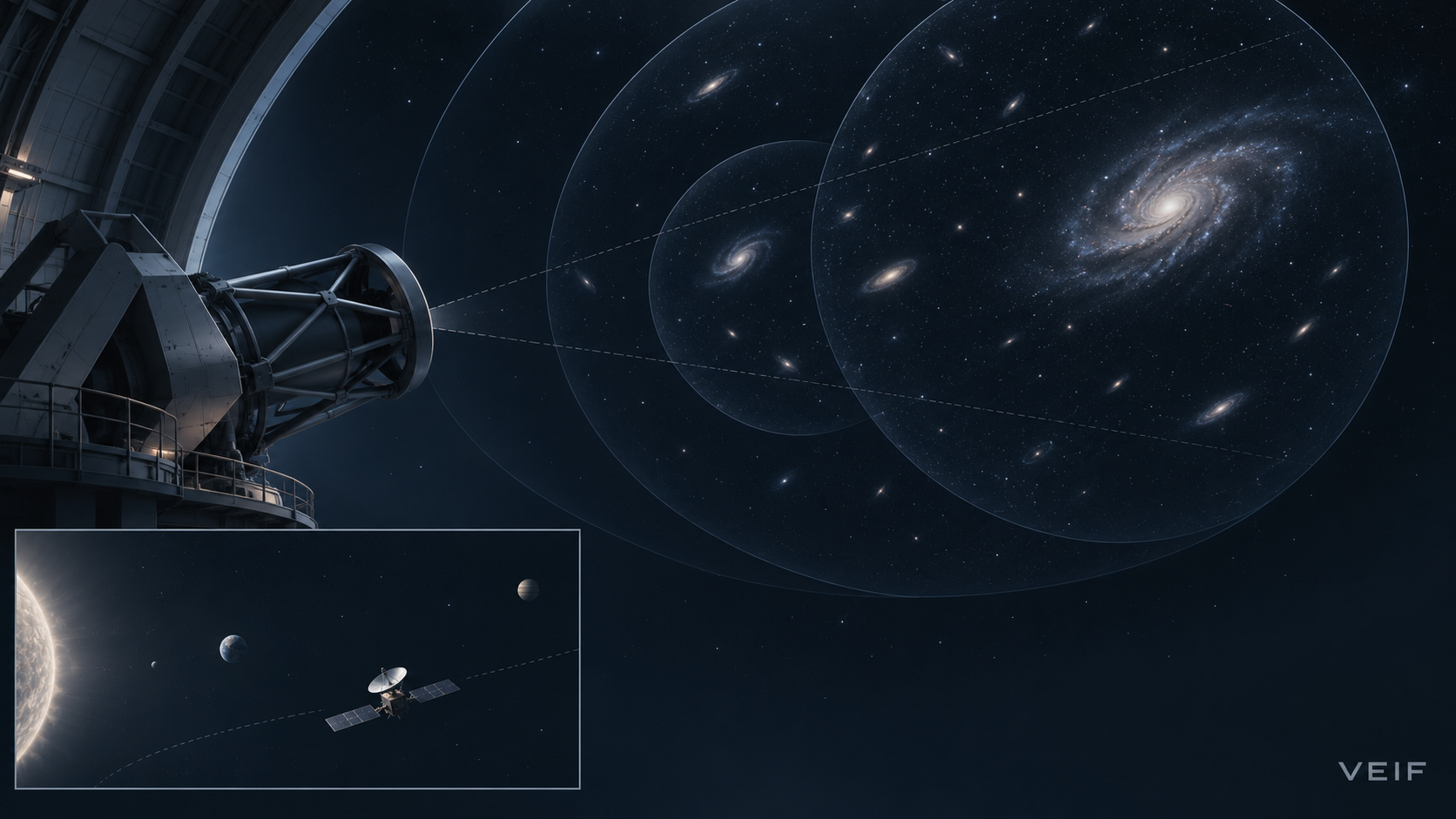
The reach of observation contrasts sharply with the reach of action. Conceptual illustration; not to scale.
III. Space Is Becoming a New Factor of Production
In the past, space was primarily the setting for human life and production.
Land, minerals, energy and labor supplied the basic conditions for production. Transport moved resources, goods and people between production sites.
The rise of space activities will gradually change this relationship.
Space is no longer merely where production takes place. Its physical conditions may themselves become usable factors of production.
Microgravity, high vacuum, distinctive thermal environments, solar radiation, orbital position and observing conditions far from Earth may all become important resources for particular industrial and scientific activities.
For example, the space environment can provide conditions difficult to reproduce fully on Earth for some materials-science experiments, crystal growth and astronomical observations. Orbital solar-power facilities, lunar resource utilization and asteroid mining could further extend the boundaries of economic activity in space.
Not every space environment is superior to Earth's. Radiation, heat rejection, maintenance, launch costs and long-term reliability may still offset some environmental advantages.
But if space transport costs continue to fall, while robotics, autonomous manufacturing, energy technologies and remote-control systems mature, the economic structure of space activities could change.
Celestial bodies, orbits and particular physical environments would then become components of production, rather than solely objects of scientific study.
This raises a new question:
When space beyond Earth starts creating economic value, will the transport capacity connecting these factors of production be sufficient to support a complete economic system?
On Earth, railways, ports and aviation networks have redefined the economic value of resources.
A remote mine's value depends not only on the size of its deposits but also on the combined costs of extraction, transport and sales. A naturally favorable harbor may become a major economic hub because of its transport connections.
The same logic will reappear in space.
An asteroid rich in minerals may remain economically unusable for a long time if transport costs far exceed the proceeds from its resources.
An orbital factory capable of specialized manufacturing may lose that advantage if its products take decades to reach customers.
The boundaries of the future space economy will depend not only on what we discover, but also on what we can deliver, where, at what cost and within what time.
Space mobility could therefore become infrastructure for the entire space economy, rather than simply one branch of the aerospace industry.
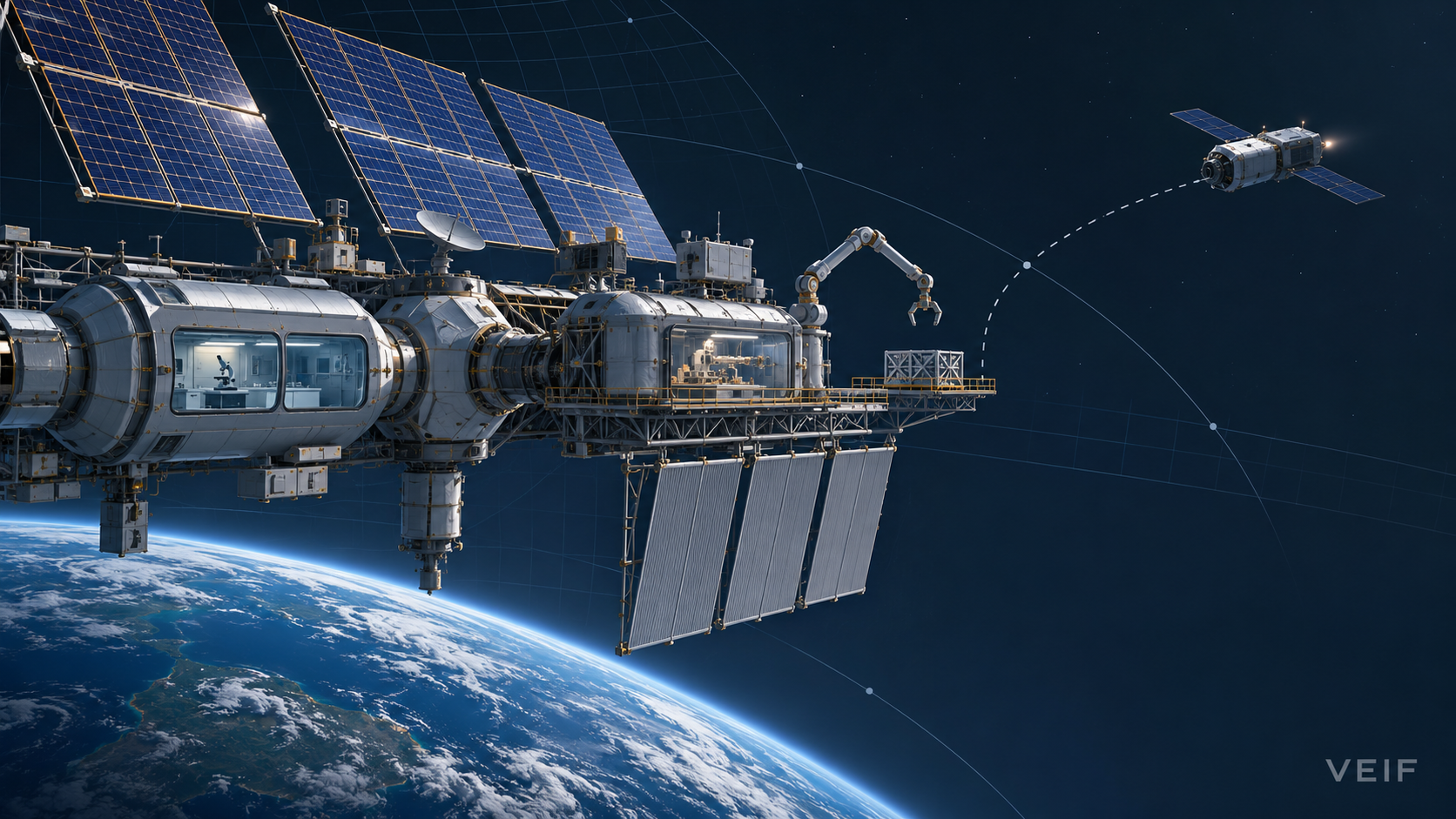
When the space environment becomes a condition of production, transport capacity becomes one constraint on using it. Concept for a future facility.
IV. Within the Solar System: Conventional Propulsion Still Has Room to Work, but the Frontier Exposes Its Constraints
Conventional space propulsion is far from the end of its engineering potential.
In Earth orbit, cislunar space and the vicinity of Mars, chemical rockets, electric propulsion, gravity assists and potentially mature future nuclear propulsion could still support useful transport systems.
The Moon is about 380,000 kilometers from Earth. The Apollo crewed missions demonstrated that humans could reach it and return within days.
The distance between Earth and Mars changes with their relative positions, and conventional missions typically take months to arrive. That is not ideal for frequent human travel, but it remains practical for robotic exploration, deploying automated equipment and some nonurgent cargo.
By improving vehicles, building orbital infrastructure, supplying propellant and automating missions, we could gradually establish substantial logistics networks within the solar system.
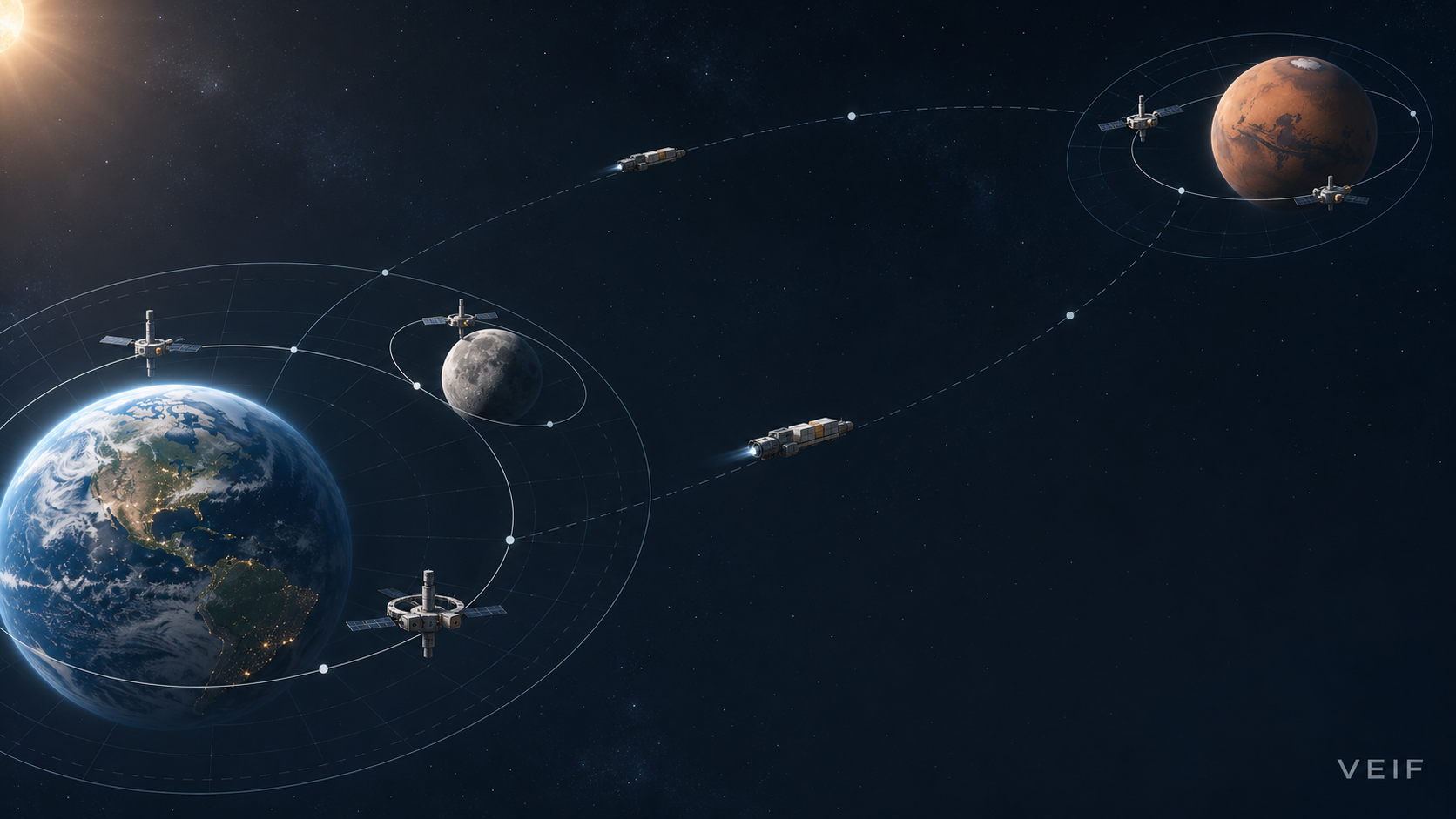
Conventional propulsion can still extend activity within the inner solar system, subject to orbital, launch-window, payload and supply constraints. Network concept; not to scale.
The difficulty is that, as our activities extend toward the solar system's frontier, the same transport model begins to look cumbersome.
Launched in 2006, New Horizons used a Jupiter gravity assist and reached Pluto's vicinity in 2015, completing a flyby journey of about 9.5 years.
As a scientific exploration mission, it was an enormous success.
But if a scientific station near Pluto required ongoing maintenance, or commercially valuable resource facilities appeared in the Kuiper Belt, such transport cycles would become a major constraint on sustained activity.
New Horizons' journey is not a lower bound on future transport times to the outer solar system. Faster transport remains open to exploration, but it must also answer: how much energy is needed, how much useful payload can be carried, and how will the vehicle slow down at its destination?
Another distinction is easily overlooked: flying past a target, entering orbit, delivering a payload and making a round trip are tasks of different levels of difficulty.
A fast flyby reduces the need for braking. A real logistics system must account for payload, capture at the destination, return journeys, refueling and maintenance.
Conventional propulsion may thus support initial exploration and some production within the solar system, without necessarily supporting frequent economic coordination throughout it.
From cislunar space to Mars, then Jupiter, Saturn, Neptune and the Kuiper Belt, the tension between transport time and spatial distance will become increasingly pronounced.
The real challenge is not simply sending spacecraft farther. It is making distant places accessible repeatedly and usable on a sustained basis.
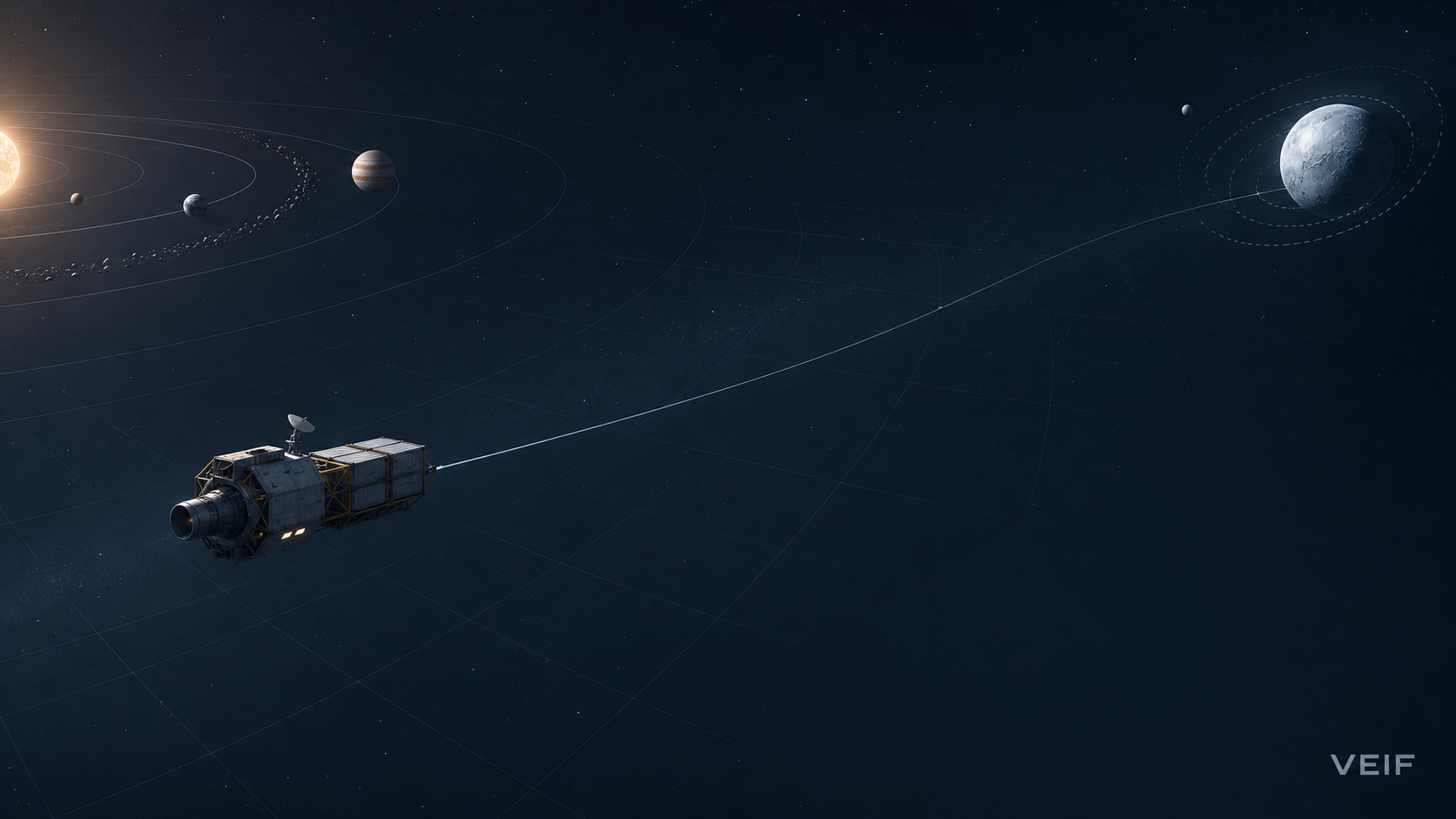
As distances grow, the challenge includes arrival, braking and sustained delivery. Existing exploration journeys do not establish a lower bound on future transport times. Conceptual illustration.
V. From Increasing Speed to Rethinking Mobility
As the scale of activity expands, humanity can respond to distance along three routes.
The first is to increase transport capability: improve propulsion, energy, braking and supply systems so objects can cross space more efficiently.
The second is to reduce transport demand: use local resources, autonomous manufacturing and distributed production to reduce the materials and people that must travel long distances.
The third is to investigate whether the constraint of distance itself can change: could we use spacetime geometry to establish connections different from conventional routes?
The first two routes can advance within known physics. The third concerns fundamental physics. The pressure imposed by distance motivates exploration, but does not prove that nature provides such a passage.
We will first consider extensions of transport capability and the different possibilities suggested by spacetime geometry. Reducing transport demand will be discussed later.
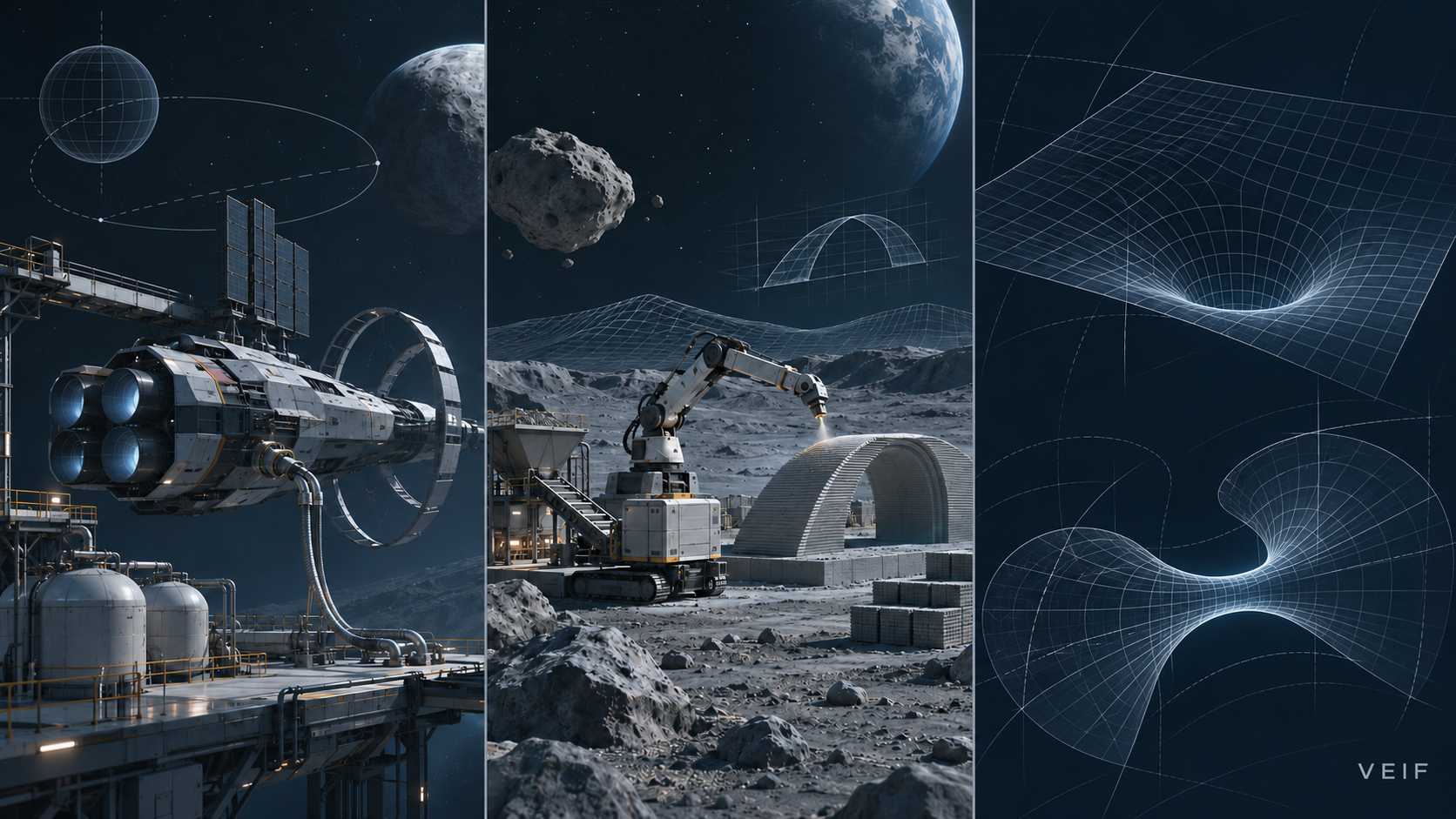
Improving transport, reducing transport demand and exploring spacetime geometry are different responses to distance. The first two can advance within known physics, although the engineering shown remains conceptual. The third does not represent an existing, feasible spacetime transport technology.
1. Approaching Light Speed: Taking the Conventional Paradigm to Its Limit
Laser-driven light sails are a research direction worth watching.
Breakthrough Starshot proposes using powerful directed light beams to accelerate extremely lightweight probes to about 20% of light speed, enabling a flyby of the Alpha Centauri system after a journey of a little over 20 years.
Compared with conventional chemical rockets, that would be a remarkable increase in speed.
It would still follow the basic logic of momentum transfer and continuous motion through space. The laser replaces conventional propellant as the source of momentum; the spacecraft must still travel along a path.
Such proposals also primarily concern extremely lightweight probes. Accelerating, braking, powering and protecting massive spacecraft from interstellar dust remain enormous technical challenges.
Light sails might open an era of genuine interstellar exploration without directly opening an era of routine transport between stars.
2. Warp Spacetime: Moving an Object, or Changing Space?
In 1994, physicist Miguel Alcubierre proposed a particular spacetime geometry within general relativity.
In this model, a so-called warp region forms near a spacecraft. Space contracts in front and expands behind, producing an effective faster-than-light displacement relative to distant observers.
This suggests an approach very different from conventional propulsion:
If an object cannot exceed light speed through local motion, could changing spacetime geometry allow a distant destination to approach more quickly in an effective sense?
This proposal does not mean a faster-than-light engine has been discovered.
The original Alcubierre model requires very unusual energy distributions, including negative energy in the usual sense. There are currently no engineering solutions for producing and controlling the necessary spacetime structure, ensuring stability or addressing possible causality problems.
In 2024, researchers proposed a mathematical solution for constant-velocity, subluminal warp spacetime satisfying classical energy conditions.
Its significance lies in exploring whether spacetime models can avoid certain exotic-matter requirements. Such mathematical solutions do not yet provide engineering methods for creating, accelerating or controlling the required structures, much less demonstrate feasible faster-than-light travel.
They nevertheless raise a question worth following over the long term: does spacetime geometry contain usable degrees of freedom beyond conventional propulsion mechanisms?
3. Wormholes: Redefining the Distance Between Two Points
Wormholes offer another, more radical theoretical route.
Some mathematical solutions of general relativity allow spacetime to have complex global connections. A theoretical wormhole might connect two regions far apart in ordinary space.
If stable, traversable wormholes existed, spacecraft might reach distant places by a shorter spacetime path.
The spacecraft would not be exceeding light speed locally. The geometry of the path itself would be different.
The problem is that wormholes have not been confirmed by direct observation. Classical models of traversable wormholes generally face difficulties involving unusual energy conditions, stability and causal consistency.
In 2022, researchers used a quantum processor to study a simplified quantum model with a correspondence to wormhole dynamics. They did not create a real-universe wormhole through which spacecraft could pass. Later research also questioned whether the experimental model adequately exhibited gravitational features.
Wormholes therefore remain a subject of theoretical physics and quantum-gravity research.
Several fundamental scientific breakthroughs that have not yet occurred may still separate them from practical space transport.
VI. Communication Delay: Another Boundary of Mobility
Delivering matter is not the only constraint facing the space economy.
On large spatial scales, the transfer of information is also constrained by light speed.
Radio signals between Earth and Mars typically take several minutes to more than twenty minutes each way. For preplanned robotic exploration, automation can accommodate this delay.
But for robots requiring real-time operation, complex production systems and emergency responses, it becomes impossible to ignore.
Farther toward the solar system's frontier, communication delays increase from minutes to hours and eventually days.
According to NASA's published estimate, when Voyager 1 reaches the one-light-day milestone from Earth on November 18, 2026, a command and an immediate reply will take approximately two days to make the round trip.
At interstellar distances, delays are measured in years.
Suppose humanity established an outpost near Proxima Centauri. Even with perfectly reliable communications, sending an instruction from Earth and receiving a reply would take at least about 8.5 years.
Real-time remote control in the conventional sense is therefore impossible on interstellar scales.
Artificial intelligence and embodied intelligence may initially solve part of this problem. Distant machines could pursue long-term objectives autonomously, rather than wait for Earth to issue each instruction.
Autonomy can reduce dependence on real-time communication, but cannot eliminate propagation delay.
This first raises a question of coordination: how do humans organize activities across vast distances when distant systems cannot respond in real time?
It also extends the question of mobility to information: must the propagation of both matter and information accept distance constraints within a given spacetime?
1. Quantum Entanglement: Inviting Imagination—and Misunderstanding
Quantum entanglement exhibits correlations that differ from classical local intuition.
The measurement outcomes of two entangled quantum systems can show particular statistical correlations even when they are far apart.
It is natural to wonder whether we could establish entanglement between Earth and a distant interstellar probe, then measure one end to send an immediate instruction to the other.
Unfortunately, within currently well-validated quantum theory, the answer is no.
Quantum entanglement cannot be used directly for controllable faster-than-light information transmission.
Quantum teleportation can transfer quantum states, but it requires a classical communication channel, which remains subject to the light-speed limit.
Progress in quantum communication therefore cannot be read directly as a breakthrough in propagation speed.
2. Communication Through Spacetime Shortcuts: A Theoretical Possibility Alongside Spatial Jumps
If future physics could demonstrate and realize a traversable spacetime shortcut, information might also travel through it.
This route differs from communication based on quantum entanglement.
It does not require signals to move faster than light locally. Instead, it imagines information arriving by a shorter effective path.
In theory, wormholes or certain spacetime structures permitting matter or light to pass could serve as infrastructure for both transport and communication.
But the same difficulties remain: we have not discovered usable real wormholes, do not know how to build or maintain such passages, and cannot establish that they would permit unconventional communication consistent with causality.
For now, this is a direction for exploration, not a technology with demonstrated engineering feasibility.
3. Improving Communication Within Known Physics
Remaining below light speed still leaves substantial room for progress in communication technology.
NASA's Deep Space Optical Communications project, DSOC, has demonstrated that laser communication can support relatively high data-transmission capability across deep-space distances.
Such technologies can increase bandwidth and transmission efficiency to support future exploration and space industry.
They cannot make a signal propagate faster than light.
Higher bandwidth, reliability and network coverage can improve distant coordination; more autonomous distant systems can reduce how often they must wait for instructions. None of these changes requires breaking the light-speed limit.
Whether spacetime structures can shorten information paths faces the same fundamental physical difficulties as the transport shortcuts in the previous section. Urgent communication needs cannot substitute for proof of feasibility.
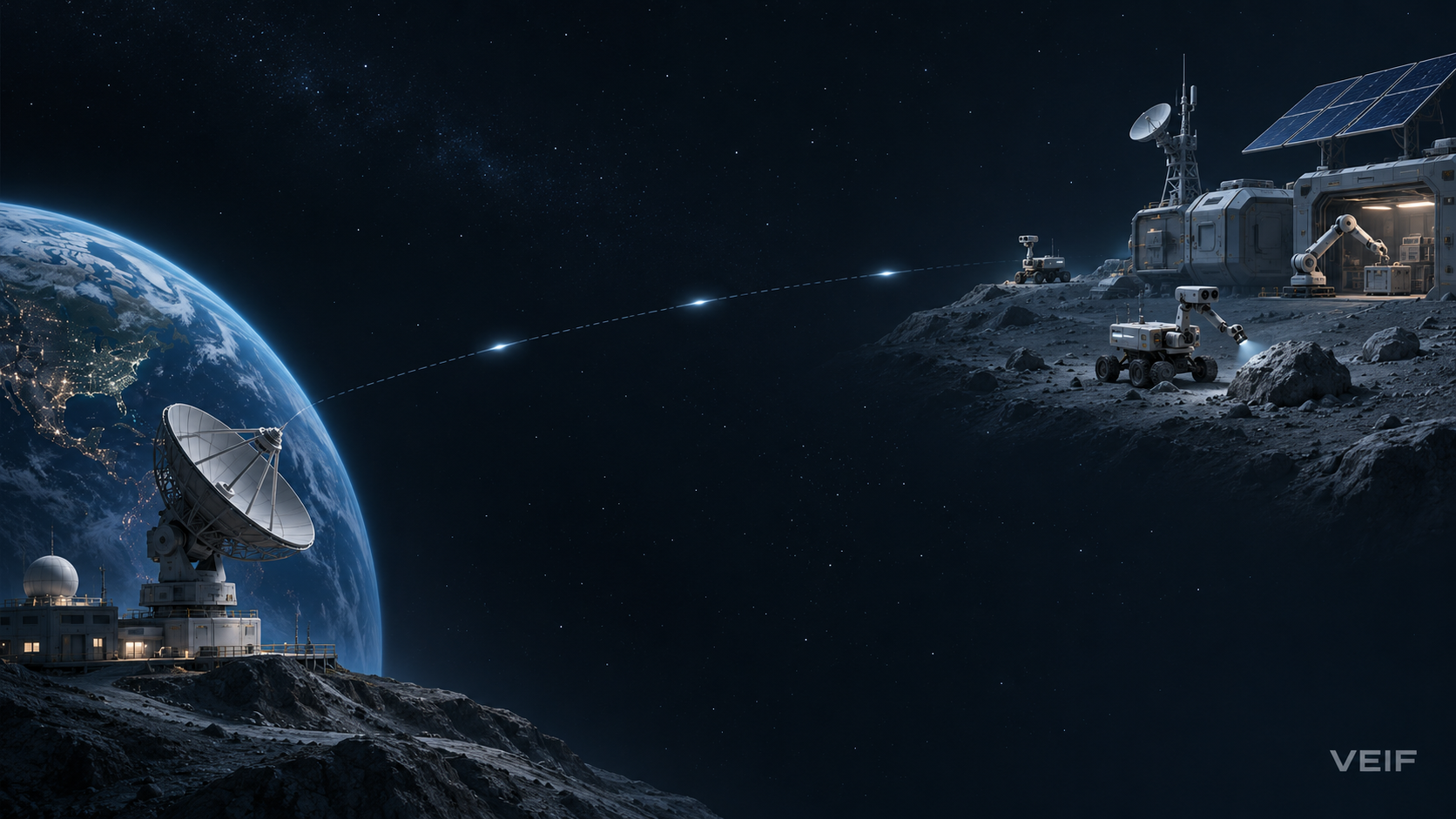
Greater bandwidth increases the volume of data transmitted; autonomous systems reduce how often they wait for instructions. Neither eliminates light travel time. Future coordination concept; not to scale.
VII. A New Mobility Paradigm May Not Begin with a New Spacecraft
We tend to understand a transport revolution as the birth of a new vehicle.
But a mobility revolution in the Great Space Age may not entirely follow that historical pattern.
Even if spacetime shortcuts never become possible, humanity can still pursue the second route outlined earlier: reorganizing production to partly work around long-distance transport difficulties.
Examples include automated mining and processing near asteroids, materials manufacturing in orbit, robots using local resources to maintain and replicate themselves, and distributed intelligent systems allowing production in different regions to operate independently.
What must cross vast distances might then be a small quantity of critical equipment, design information, research findings and high-value products, rather than large amounts of raw material and people.
In a sense, civilization can expand its sphere of activity by reducing its transport requirements.
This resembles local manufacturing, supply-chain localization and digital production in Earth's industrial history, taken to a more extreme form on cosmic scales.
Distributed production cannot, however, fully replace long-distance movement.
If planets or star systems are to engage in large-scale trade, scientific cooperation, human travel and economic integration, transport time will still determine how far those activities can develop.
Two forms of spatial expansion may therefore emerge.
One is a distributed civilization built around high autonomy, with relatively independent production nodes.
The other relies on revolutionary transport and communication infrastructure, allowing distant regions to form more tightly connected economic networks.
The former has a clearer technological continuity within known physical laws. The latter may require physics we have not yet mastered.
VIII. From Space Transport Operators to Builders of Spatial Infrastructure
The evolution of mobility paradigms also has important economic implications for future space industries.
During the age of ocean exploration, shipbuilders, port operators and shipping companies connected the world.
In the aviation age, aircraft manufacturers, airlines and airport networks became part of the global economy's infrastructure.
At the beginning of the Great Space Age, that role will most likely still fall to rocket manufacturers, orbital transport operators, spacecraft-propulsion suppliers and space-energy companies.
They are the carriage drivers of a new era.
As production extends from Earth orbit to the Moon, Mars and the outer solar system, incremental improvements in transport and communication could directly alter the economic feasibility of resources and industrial projects in space.
Evaluating future space companies therefore requires looking beyond rocket thrust, launch counts and launch costs.
We also need to ask:
- Can they reduce the actual delivery cost per unit of useful payload, rather than only launch costs?
- Can they shorten long-distance transport and return cycles?
- Can they establish orbital refueling, deep-space energy and autonomous navigation systems?
- Can they use robotics and local manufacturing to reduce the need for physical transport?
- Can they progressively turn research in advanced propulsion and deep-space communication into verifiable delivery capabilities?
Research into gravitation and spacetime geometry belongs to a longer scientific horizon and cannot be evaluated on the same footing as measurable transport capabilities. Theoretical validity, engineering realization, manageable costs and commercial success are separate hurdles.
Nevertheless, a long-term industrial judgment is possible:
Progress in spatial connectivity will change the development thresholds and activity ranges of many space resources.
If engineerable spacetime shortcuts ever emerge, they may change not just the spacecraft market but our whole understanding of spatial infrastructure, transport nodes and economic geography.
Regions previously lacking value because of distance might enter the sphere of economic activity.
Just as railways changed the value of inland land and aviation reshaped the geography of global industry, changes in mobility paradigms could redraw the universe's economic map.
There is currently insufficient scientific evidence, however, to establish that such a transformation will happen.
IX. The Next Space Carriage Drivers May No Longer Drive Carriages
Technological history reveals a curious pattern: within an existing paradigm, we often achieve astonishing optimization, yet those improvements alone rarely let us derive the precise form of the next paradigm.
Carriages can become lighter, wheels more durable and roads smoother, but these improvements do not themselves directly produce an aviation system.
This historical analogy concerns structural changes in transport systems. Aviation still belongs to the conventional mobility paradigm discussed here. It is not evidence that humanity will necessarily learn to manipulate spacetime.
Likewise, chemical rockets can become reusable, nuclear propulsion may improve performance, and light sails may accelerate tiny probes to remarkable speeds.
These advances are immensely important and may continue to dominate space industries for a long time.
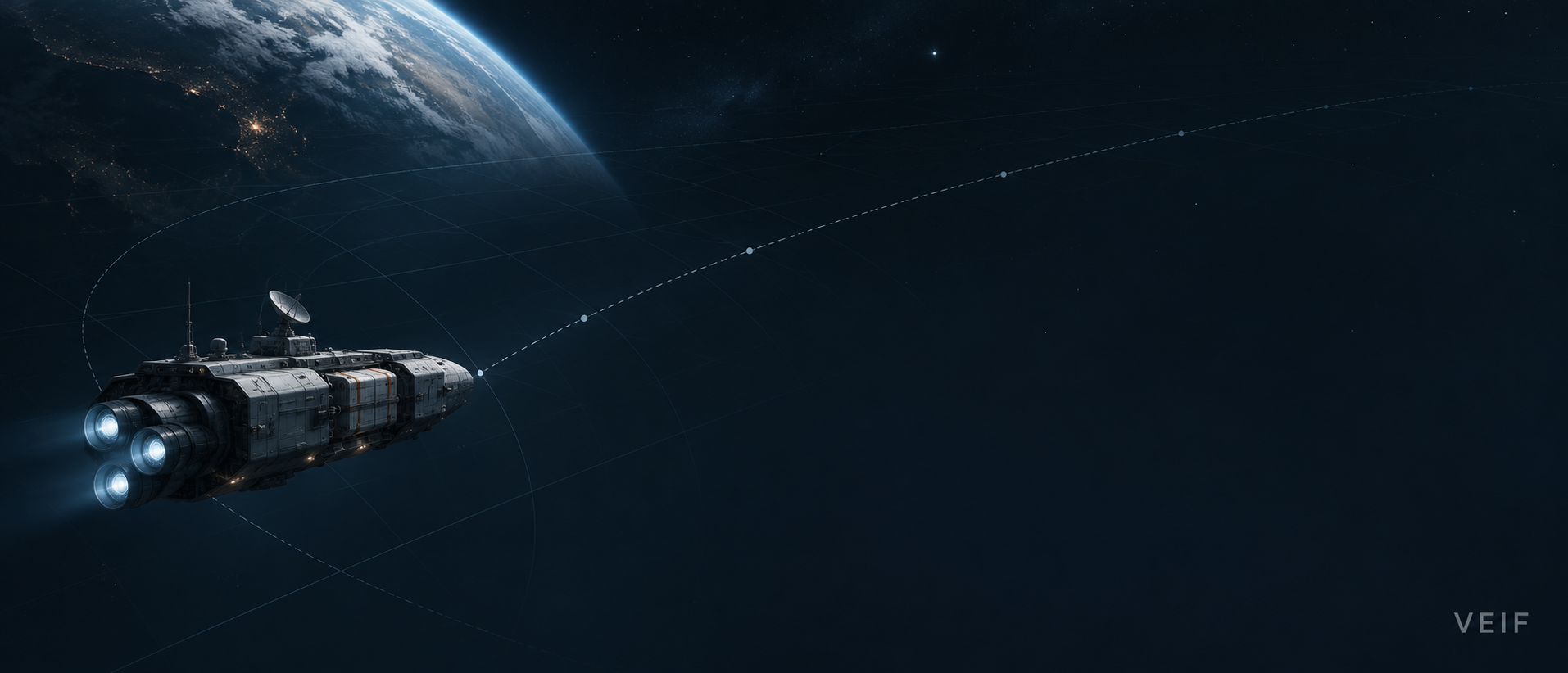
Spacecraft can grow ever more advanced, while the distances separating us from faraway places continue to challenge our understanding of movement. Deep-space transport concept.
But when humanity truly makes the solar system and more distant stellar space its arena of activity, increasing thrust and speed cannot remain the only answer to every mobility problem.
We must investigate two different questions in parallel.
One is how to move objects through space more efficiently.
The other is whether space itself has properties not yet discovered, understood or used that could change our understanding of movement.
Existing physics does not guarantee an ideal answer to the second question. The light-speed limit may indeed be an unavoidable boundary of nature.
Even so, advances in propulsion, autonomous manufacturing, distributed production and intelligent systems can still reorganize civilization's presence in the universe.
What deserves attention may therefore be more than when a particular faster-than-light spacecraft will appear. It is whether humanity begins to recognize that:
When civilization's sphere of activity expands by orders of magnitude, simply continuing an existing transport paradigm may be insufficient to support new forms of production.
From Earth to the Moon, from Mars to the solar system's frontier, and onward to distant stars, the barrier of distance grows at each step.
Space is gradually becoming a potential factor of production as well as an object of scientific exploration.
The corresponding mobility technologies will face increasingly strong demands for change. Demand can drive exploration, but cannot determine its answers in advance.
Whether humanity can alter spacetime structures remains unknown.
One thing, however, is already clear:
We have acquired eyes that can look deep into the universe, but not yet the footsteps to match them.
The next great breakthrough of the Great Space Age may not be a faster space carriage.
It may be a new understanding of routes, distance and movement itself.
Data sources
- NASA, How Big is Space? We Asked a NASA Expert (2025). https://www.nasa.gov/science-research/astrophysics/how-big-is-space-we-asked-a-nasa-expert-episode-61/
- NASA, Voyager 1: What Is a Light-Day (2026). https://science.nasa.gov/mission/voyager/voyager-1/voyager-1-what-is-a-light-day/
- NASA, New Horizons Mission. https://science.nasa.gov/mission/new-horizons/
- Breakthrough Initiatives, Breakthrough Starshot. https://breakthroughinitiatives.org/initiative/3
- Alcubierre, M. (1994), The Warp Drive: Hyper-fast Travel Within General Relativity, Classical and Quantum Gravity. https://doi.org/10.1088/0264-9381/11/5/001
- Fuchs, J. et al. (2024), Constant Velocity Physical Warp Drive Solution. https://arxiv.org/abs/2405.02709
- Jafferis, D. et al. (2022), Traversable Wormhole Dynamics on a Quantum Processor, Nature. https://www.nature.com/articles/s41586-022-05424-3
- Kobrin, B., Schuster, T. & Yao, N. (2025), Experiments Implementing Small Commuting Models Lack Gravitational Features, Nature. https://www.nature.com/articles/s41586-025-08939-7
- IBM Quantum Learning, Quantum Teleportation. https://quantum.cloud.ibm.com/learning/en/courses/basics-of-quantum-information/entanglement-in-action/quantum-teleportation
- NASA/JPL, Deep Space Optical Communications. https://www.jpl.nasa.gov/missions/deep-space-optical-communications-dsoc/
Disclaimer
This is a research essay on technological evolution and the development of civilization. Its discussion of future space economies and mobility paradigms presents the author's views and forward-looking reasoning. Warp travel, traversable wormholes and faster-than-light communication have not demonstrated engineering feasibility and should not be confused with validated spaceflight and communication technologies.
Read this series · Expansion into Space · Space Carriage Drivers
- Space Carriage Drivers 1: Ferrymen of the Great Space Age
- Space Carriage Drivers 2: Rethinking the Paradigm of Mobility