Space Carriage Drivers 1: Ferrymen of the Great Space Age
From Transport Services to Industrial Infrastructure: Paving the Way for the Space Economy
VEIF · Insights | Observations on Industrial Evolution | October 2026

Figure 01 | From sea routes to space routes: the sailing-ship helmsman on the left and the space transport operator on the right represent the “carriage drivers” who open new paths for industry in different eras. AI-generated concept illustration, not a photograph of an actual mission.
Introduction: Why the Carriage Drivers Matter
History's pathfinders are not always those who ultimately earn the greatest profits in the worlds they open. Without them, however, many businesses that follow would never have been possible.
During the Age of Exploration, shipowners and navigators carried merchants, goods, and capital to distant shores. The builders of railways and roads connected previously fragmented markets. They did more than transport existing demand: they created a new economic geography.
The space age is approaching a similar turning point. Commercial space companies such as SpaceX and Rocket Lab are commonly seen as rocket manufacturers or launch providers. Yet judging them solely by payload capacity, launch frequency, and the price of a single launch risks understating their potential historical role.
The carriage drivers of the space age do more than deliver cargo to orbit. They must also give industries that have never considered entering space a route that is accessible, affordable, and usable time and again.
Only at the end of that road might a true space economy emerge.
1. The First Generation: Nations Open the Gateway
The first generation of space pioneers was driven primarily by sovereign states. The breakthroughs of the mid-twentieth century arose from scientific exploration but were also deeply embedded in national security, strategic competition, and the development of national capabilities.
The first artificial satellite entered orbit in 1957; the first human reached space in 1961; and humans first landed on the Moon in 1969. These milestones proved that humanity could leave Earth. They did not prove that ordinary businesses could afford the economic cost of reaching space.
Under this first-generation model, governments could coordinate resources across industries for important missions, accepting long development cycles, expensive specialized equipment, and investments whose value could not be measured by near-term revenue. Engineering success was itself a major objective.
This produced extraordinary technological progress. It also gave space activity a distinctive character that endured for decades: prestigious, mysterious, and expensive, with participation largely confined to government agencies, major contractors, and a small number of research organizations.
The first generation answered the question: Can humanity reach space?
The second must answer a different one: How can space become an economic domain that more and more businesses both want to enter and can afford to enter?
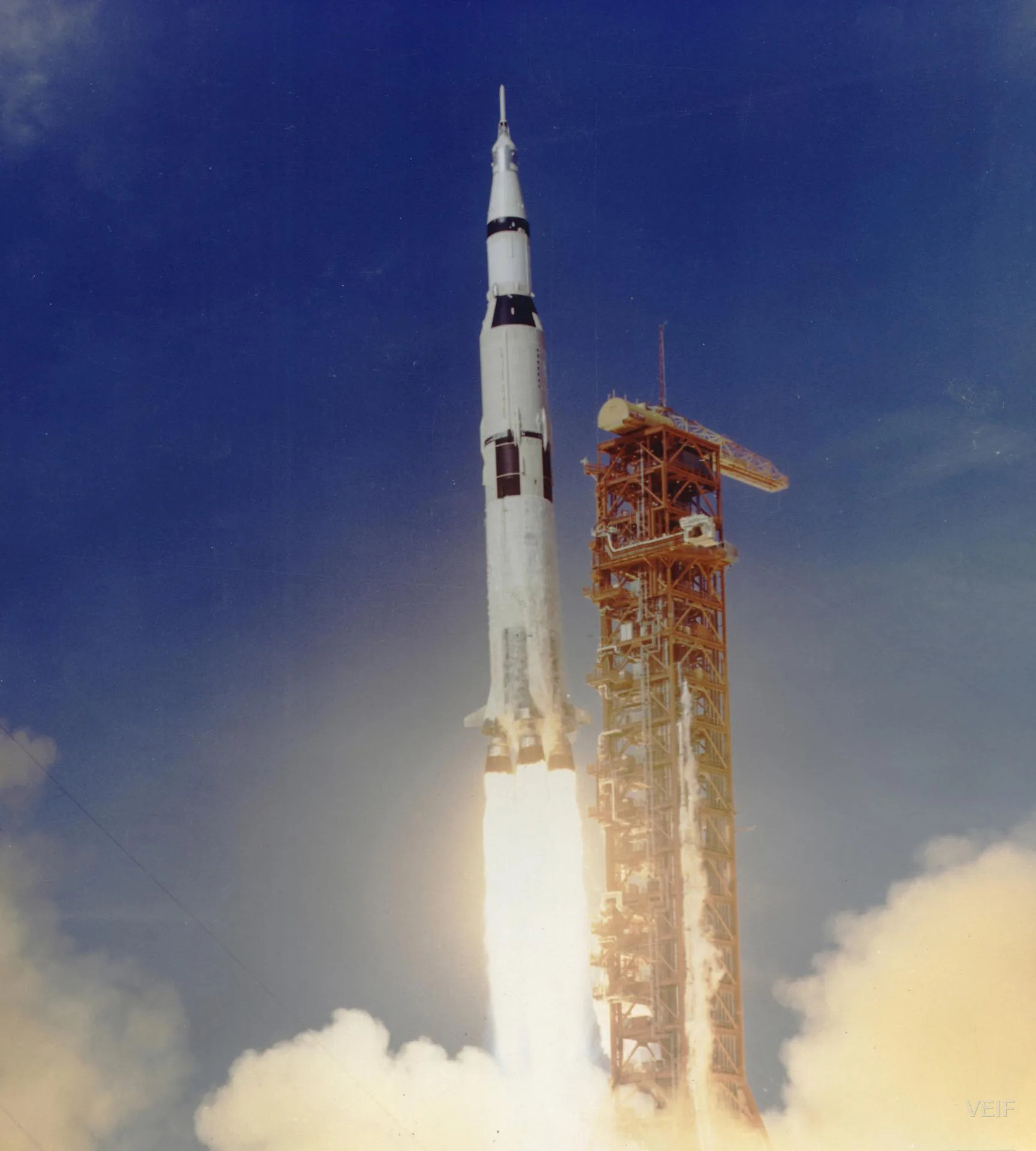
Figure 02 | Apollo 11 lifts off aboard a Saturn V on July 16, 1969. The first generation of pioneers established that humanity could reach the destination. Credit: NASA/Marshall Space Flight Center; source.
2. The Second Generation: Lower Transport Costs Bring the Drivers onto the Scene
A transport revolution first changes the economic meaning of distance.
A sea route, a railway, or a road does more than move existing goods faster and more cheaply. It changes which resources are worth developing, which goods can be traded, and which industries can achieve scale.
For space, launch cost and availability have long been fundamental constraints. High transport prices, infrequent departures, and highly customized missions mean that only a limited set of applications can bear the cost of moving from the ground to orbit.
The second generation of commercial space pioneers is beginning to change these constraints. Reusable rockets, scaled manufacturing, improved launch operations, and standardized services are reshaping the cost structure, launch frequency, and availability of some missions. Actual costs across launch systems must still be compared by mission, orbit, payload mass, and service conditions; no single number captures them all.
SpaceX and Rocket Lab are therefore more than rocket companies. They are also the “carriage drivers” of the space age.
There is, however, a major difference between space carriage drivers and traditional ones: drivers on Earth can wait for passengers; early space drivers must help cultivate them.
When most prospective customers do not yet know how to enter space, or why they should, a cheaper launch quotation alone will not create a vast new market.
3. Shedding the Scholar's Robe: Bringing Space Down from Its Pedestal
The space industry needs to shed the “scholar's robe” that symbolizes technical authority and barriers to participation.
This does not diminish the first generation of explorers or deny the complexity and risks of spaceflight. Precisely because orbital mechanics, radiation, thermal control, communications, reliability, and regulation remain demanding, specialist platforms must absorb that complexity rather than require every new customer to learn the entire discipline of space engineering from scratch.
A materials company may want to study crystal growth in microgravity without maintaining a satellite design team. A biopharmaceutical company may want to conduct space experiments without expertise in payload integration or orbital operations. A resources company may need lunar remote-sensing and exploration data without intending to build a launch vehicle.
For these businesses, the appropriate commercial starting point should be a clear statement of requirements, rather than a lengthy plan to develop their own space capabilities.
They need to answer practical questions: What physical environment does the experiment require? For how long? How much power, communication, and data are needed? Must samples return to Earth? What is the final deliverable?
Mission design, hardware adaptation, launch scheduling, tracking and control, operations, and risk management should, wherever possible, be integrated by the service platform.
Just as using cloud services does not require a company to build power plants, data centers, and global networks, buying space capabilities should not automatically mean becoming a fully fledged space company.
Commercial maturity in space means more than selling cheaper rockets. It means making access to space simple enough to use.
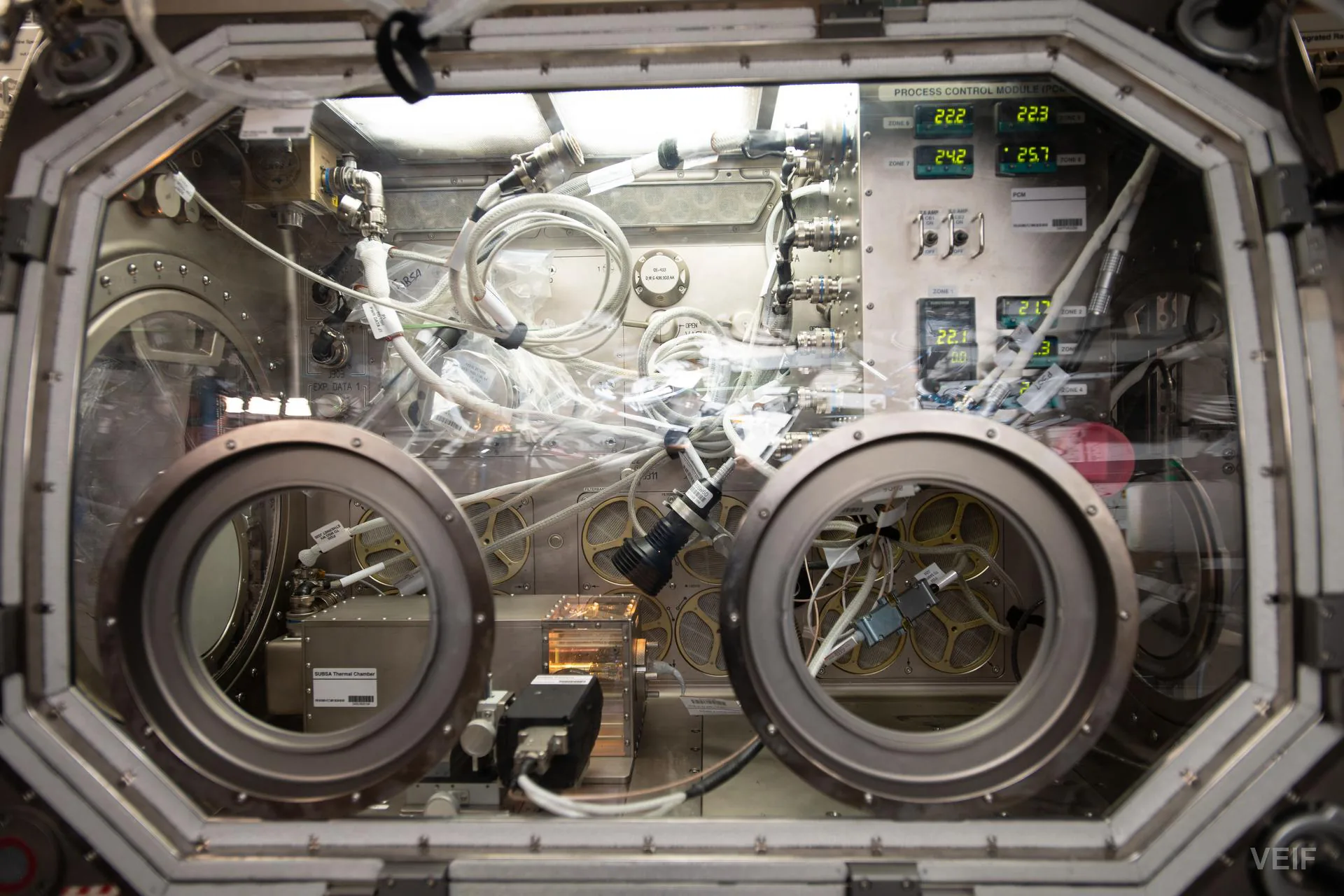
Figure 03 | The Microgravity Science Glovebox in the International Space Station's Destiny laboratory, during configuration of SUBSA crystal-research equipment on March 7, 2019. Shared experimental facilities give researchers access to the space environment. Credit: NASA/Anne McClain; source.
4. From Driver to Platform: Decoupling the Value Chain
Lowering barriers means reorganizing the division of labor across the space industry, rather than merely extending one company's product catalog.
An ideal industry structure can be divided into at least three connected but increasingly decoupled layers:
Transport and space infrastructure: rockets, launch sites, orbital transport, basic space facilities, ground stations, and related services.
Payload and mission services: spacecraft platforms, mission design, payload integration, power and thermal control, tracking and communications, orbital management, and data delivery.
Space applications: communications, remote sensing, scientific experiments, advanced materials, biopharmaceuticals, space manufacturing, resource exploration, and uses that have yet to emerge.
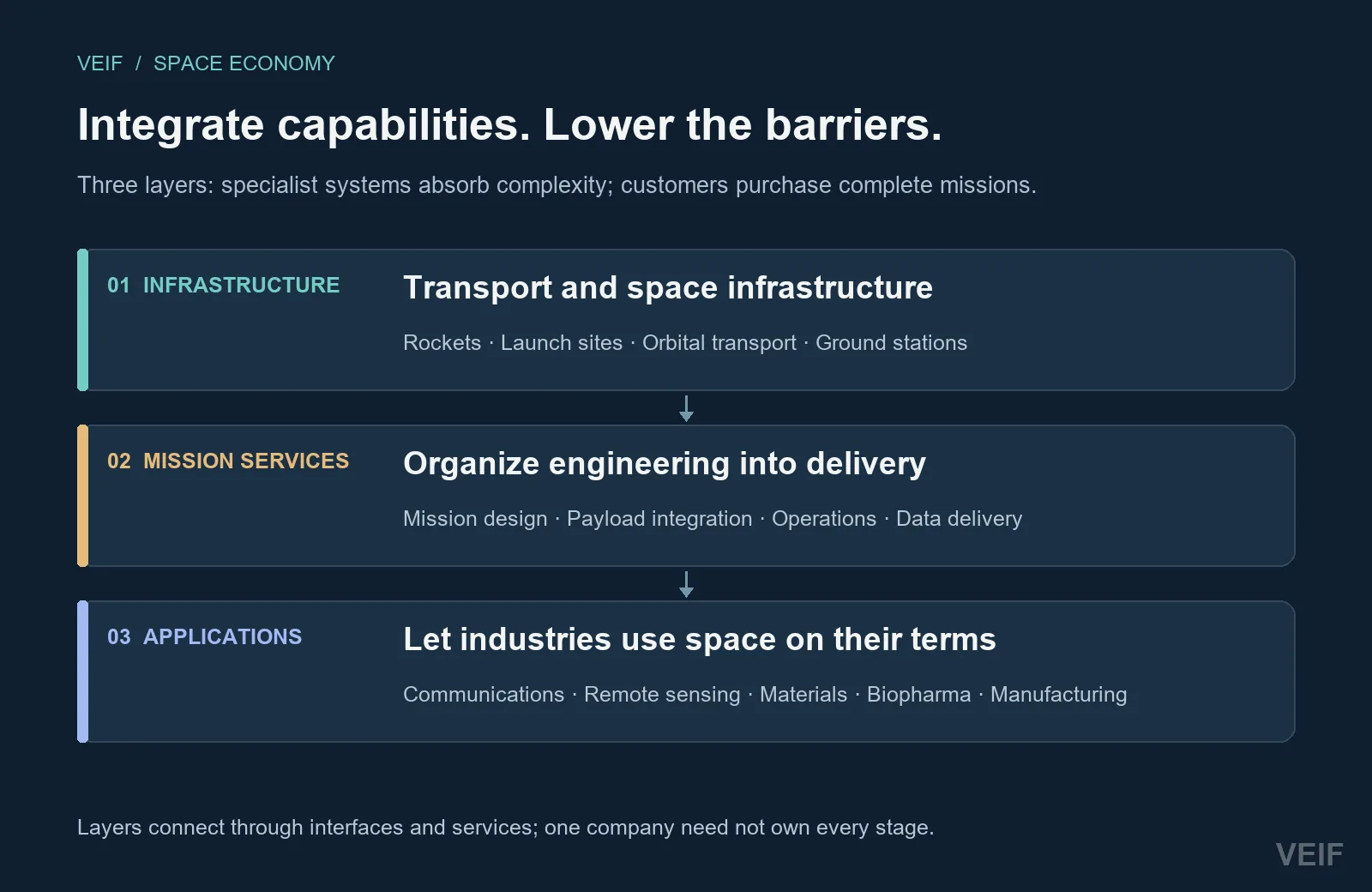
Figure 04 | Three layers of industrial activity: specialist systems absorb the complexity, while customers buy complete missions. Original VEIF diagram.
There is an apparent contradiction here: service providers need to integrate capabilities across the value chain, while customers need to be decoupled from its intricate details.
That contradiction explains the value of a platform. It integrates specialist capabilities internally and presents standardized interfaces externally, gradually turning work that once required a dedicated project into services that can be quoted, purchased, delivered, and repeated.
A platform does not have to own every stage. Interfaces, standards, accountability, and delivery capabilities matter most. Some platforms may be highly vertically integrated; others may coordinate capabilities from multiple suppliers.
From an industry perspective, the decisive sign is not how many subsidiaries a provider owns. It is whether new space-application businesses can operate without mastering the underlying space engineering themselves.
5. Rocket Lab: From Vertical Integration toward Space Applications
Rocket Lab offers a useful example of the second generation of carriage drivers.
It built its market reputation through Electron launches, then expanded into spacecraft components, satellite platforms, mission integration, and space systems services, while pursuing greater launch capability through the Neutron program.
There are practical reasons for this path. Compared with SpaceX, Rocket Lab differs in the capital it can deploy, its existing launch capacity, and its accumulated systems expertise. With limited resources, first developing mutually supporting businesses and building a vertical service capability from launch through satellite systems is a coherent choice.
However, vertical integration describes its current stage of development. It should not be interpreted as proof that the company could never become a major space-application operator.
The Iridium transaction that Rocket Lab is pursuing offers a way to observe its strategic intent. Whether or not the transaction ultimately closes, seeking to enter an established satellite communications business through acquisition signals an ambition to move beyond “helping customers reach space” toward “operating applications and customer relationships supported by space infrastructure.” Actual completion, the results of business integration, and financing pressures must still be distinguished from strategic intent.
In this sense, Rocket Lab's potential evolution extends beyond:
Launch services → spacecraft and mission services → a one-stop platform for space access.
It could continue toward:
A one-stop platform for space access → proprietary space applications and operations → a broader ecosystem of external applications.
This is the deeper meaning of being “both the driver and a passenger.” A company's own space businesses may provide a stable source of demand for its transport and space systems capabilities, while standardized services for external customers expand the overall market.
The two directions must nevertheless be tested separately. Internal demand can help establish scale; a genuine external ecosystem requires customers with independent economic value who continue to pay.
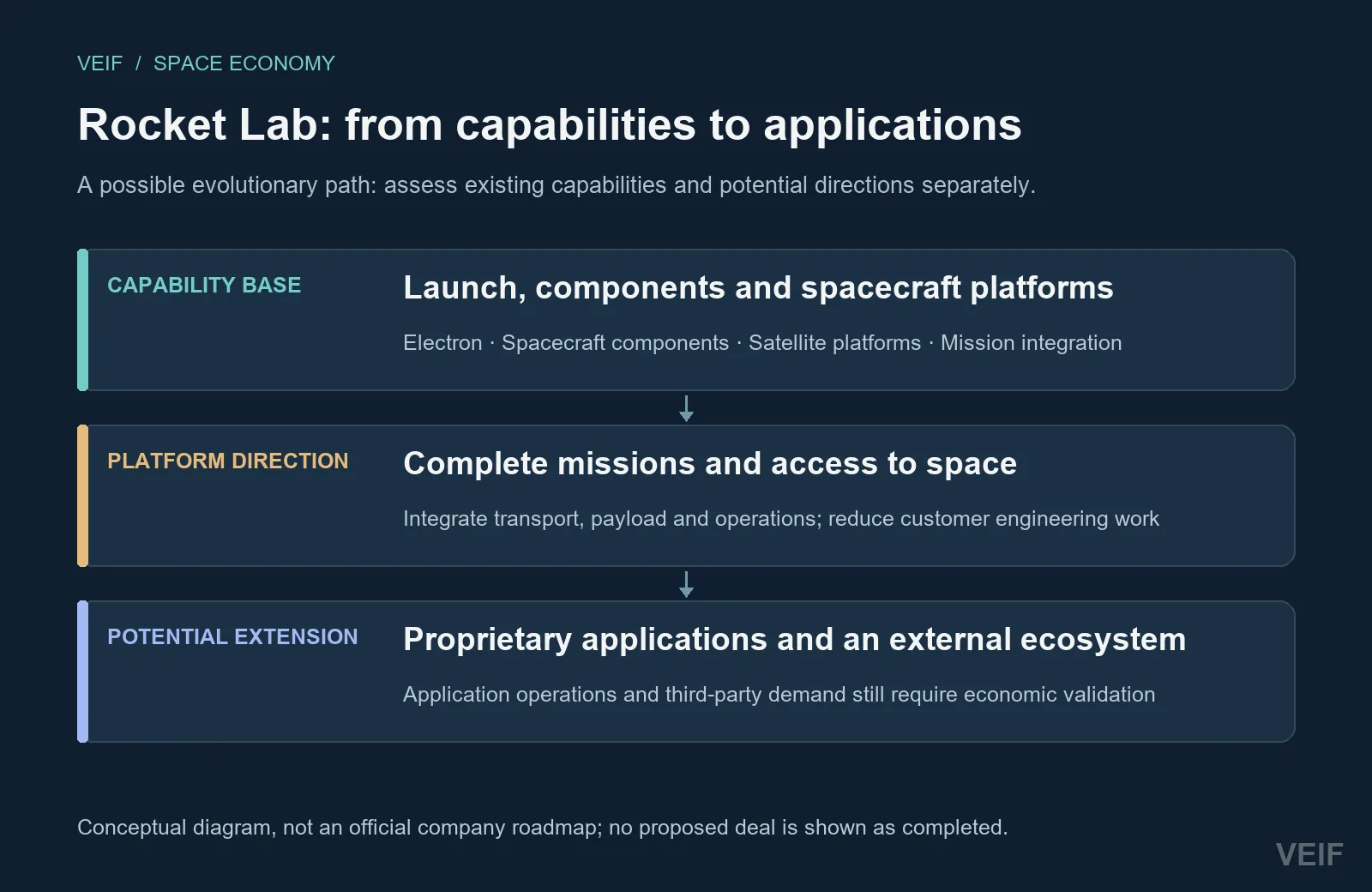
Figure 05 | A possible evolutionary path: existing capabilities and potential directions must be assessed separately. Original VEIF diagram.
6. SpaceX: Wider Roads and More Destinations
SpaceX illustrates a different path at the current stage.
Falcon 9's reuse and frequent launches have changed the supply conditions for some orbital transport missions. Starlink has taken SpaceX from transport provider to operator of a large-scale space communications service: the company supplies launch capacity while its own satellite network continually generates launch demand.
SpaceX has therefore long been more than a driver “carrying cargo for others.”
It builds the road, transports the cargo, and operates some of the businesses at the destination.
The larger transport capacity represented by Starship could change the economics of heavier payloads, space facilities, and future lunar activities if it eventually meets commercial requirements for reliability, reuse frequency, and full lifecycle cost.
That possibility must not be confused with economic results already achieved. Greater capacity does not automatically make every space project profitable. Energy, orbital maintenance, operations, insurance, cargo return, and end-market demand may still become bottlenecks.
For now, the more useful observation is that SpaceX tends to make large-scale transport capabilities and its own space applications reinforce one another, bringing more previously unaffordable industrial ideas back into consideration.
By comparison, Rocket Lab's end-to-end service model is more pronounced, while SpaceX's record in transport scale and proprietary applications stands out. These differences reflect a comparison at the current stage, rather than fixed destinations for either company. Rocket Lab may continue toward operating space applications; SpaceX may further expand integrated services for external customers.
Their long-term paths could converge: combining transport, platforms, and selected applications while opening access to space for more third parties.
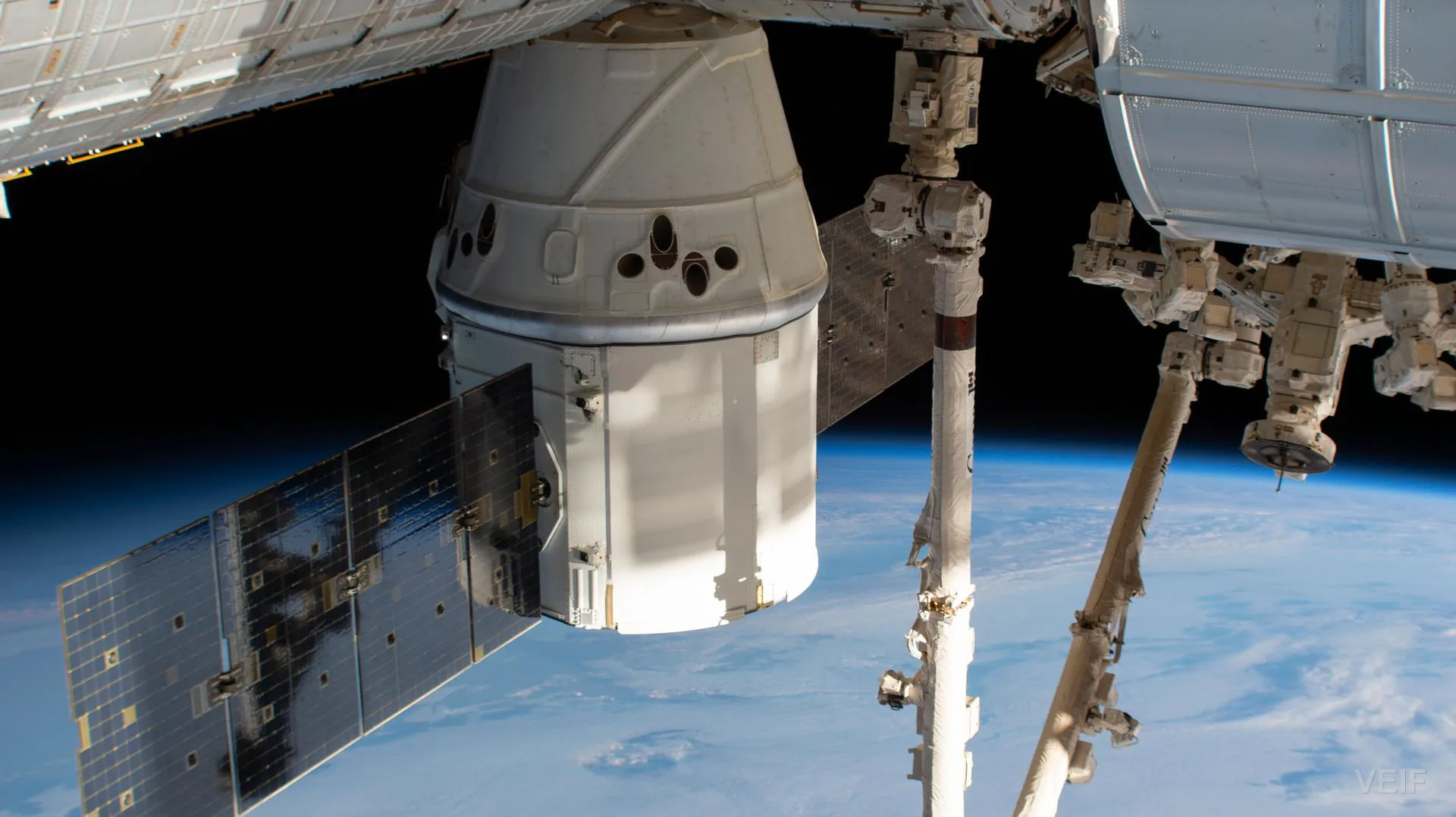
Figure 06 | A SpaceX Dragon cargo spacecraft attached to the International Space Station on January 7, 2019, with the Indian Ocean in the background. The photograph shows the connection between space transport and orbital facilities; it does not depict Starlink or Starship. Credit: NASA; source.
7. The Driver's Paradox: The More Accessible Transport Becomes, the Less Transport Alone May Suffice
Transport history repeatedly shows that breakthrough technologies can open markets. As those technologies spread, capacity expands, and services become standardized, however, transport itself may face intense price competition.
This creates a paradox for the early carriage drivers of the space age.
They work to lower costs and expand supply so that the space economy can flourish. If they succeed, the ability to carry payloads alone may cease to be the scarcest resource.
Companies therefore need to look beyond the return on a single launch to the value of a customer's entire mission: mission design, payload supply, reliable delivery, operating networks, data interfaces, and continuing services.
This could increase customer lifetime value while bringing into the market industries that previously could not bear the complexity of space activity.
More vertical integration is not always better. Excessive capital commitments, loss of managerial control across domains, competition with ecosystem partners, and dependence on internal orders can weaken a platform's openness. A successful platform must demonstrate that the efficiencies of integration exceed its costs.
The carriage driver's most important asset may ultimately be more than the carriage: it may be the entire transport system on which customers can rely.
8. The Third Generation: Tomorrow's Space Prospectors
If transport costs gradually decline and space services become more standardized, the space economy may welcome more genuine “passengers.”
These passengers may come from materials science, biopharmaceuticals, energy, manufacturing, communications, artificial intelligence, and resource development, rather than traditional space companies.
They will enter space not to prove that they, too, can build rockets, but to use microgravity, vacuum, extreme temperature differences, distinctive observation positions, or extraterrestrial resources to pursue technical approaches that are difficult to achieve on Earth, or in some cases more costly there.
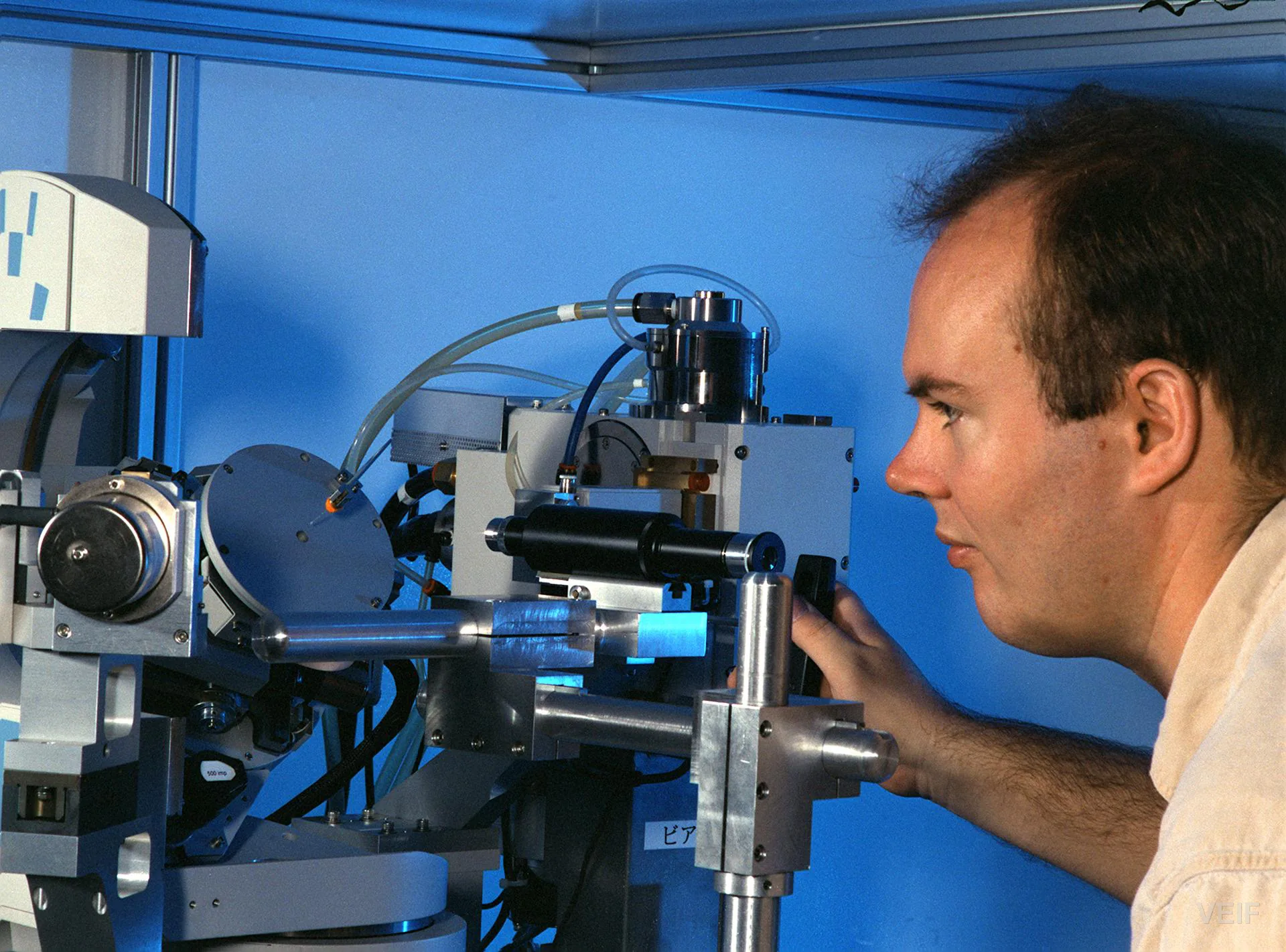
Figure 07 | A researcher uses a diffractometer to analyze macromolecular crystal quality on June 16, 1998. Such tools support research into protein crystals grown in experiments on Earth and in space. This is a terrestrial laboratory, not evidence that commercial applications have already matured. Credit: NASA/Marshall Space Flight Center; source.
Technical potential in these fields is not the same as commercial viability. The space environment may remove some terrestrial constraints while adding new ones involving radiation, transport, thermal control, maintenance, and recovery. The full economics must ultimately be compared.
Some future large-scale space activities may also require substantial capital, complex collaboration across industries, and sustained investment. The real space prospectors may be large companies, industrial groups, and long-term capital providers with deep financial and technical resources, rather than necessarily today's best-known rocket startups.
The term “third generation” here describes roles, rather than simply the order in which organizations were founded:
The first generation proves that humanity can reach the destination.
The second generation works to make it accessible to different industries.
The third generation asks what value can be created after arrival.
These roles can overlap within a single company. SpaceX's Starlink shows that a second-generation carriage driver can also be an early participant in space applications. Rocket Lab's strategic interest in Iridium suggests a similar evolutionary intent.
9. The Real Turning Point: When Customers No Longer Need to Understand Rockets
Whether the space economy has entered a new phase cannot be judged solely by launch counts, rocket size, or the valuations of rocket companies.
The more revealing question is whether the structure of demand is changing.
If incremental demand still comes mainly from government space missions, defense, and traditional satellite operators, transport capacity may grow without a meaningful expansion in the industry's boundaries.
If, however, more companies from outside the space industry repeatedly purchase space experimentation, manufacturing, observation, and operational services and earn economic returns from them, a more fundamental change is underway.
Five questions can help track this process:
Customer mix: Is the number of commercial customers from nontraditional space industries continuing to grow?
Barriers to access: Can businesses without space engineering teams purchase complete missions?
Standardized delivery: Can services be delivered repeatedly, rather than customized from scratch each time?
Unit economics: Can the value created in space cover the costs of the entire chain?
Platform openness: Can customers choose among transport, payload, and application suppliers without being locked into a single system?
The true turning point arrives when the immense technical complexity of space activity still exists, but customers no longer have to bear all of it themselves.
Just as cloud computing does not require every business to build its own data center, mature space services should not require every business to become a space expert.
10. Conclusion: What Passengers Will the Carriage Drivers Welcome?
The first generation of pioneers opened humanity's gateway to space.
The second is trying to turn that gateway into a road: reducing transport costs, establishing service standards, integrating complex engineering, and enabling more industries to enter space.
Whether that road leads to prosperity ultimately depends on whether real economic activity develops at its destination.
Rocket Lab and SpaceX are more than companies that sell rockets. Nor should they be permanently classified as a “vertically integrated service provider” and a “horizontal application operator.” At different scales, with different resources and at different speeds, they are trying to use transport capabilities as a starting point to help shape the commercial structure of the entire space industry.
The second generation's most enduring achievement may be remembered not as the number of rockets it built, but as the number of terrestrial industries it enabled to reach space for the first time.
The true space prospectors have yet to arrive in full force. They may emerge from materials laboratories, pharmaceutical companies, mining groups, robotics manufacturers, or industries that do not yet exist.
They will not go to space merely for the sake of reaching it. They will go to bring human production, research, and commerce into a new physical environment.
Great carriage drivers ultimately create more than a flourishing transport business. They help create a new world worth traveling to.
Image Sources
This article uses four NASA documentary photographs, one AI-generated concept cover illustration, and two original VEIF diagrams. The photographs are unaltered. The diagrams do not depict completed transactions, actual asset ownership, or official company roadmaps.
| Figure | Subject | Credit and source |
|---|---|---|
| FIG-01 | Carriage drivers at sea and in space | OpenAI ImageGen · AI-generated concept illustration |
| FIG-02 | Nations open the gateway | NASA/Marshall Space Flight Center |
| FIG-03 | Leaving complexity with the platform | NASA/Anne McClain |
| FIG-04 | Integrating capabilities and lowering barriers | Original VEIF diagram, English edition |
| FIG-05 | Rocket Lab: from capabilities to applications | Original VEIF diagram, English edition |
| FIG-06 | Delivery at the end of the road | NASA |
| FIG-07 | Future passengers come from terrestrial industries | NASA/Marshall Space Flight Center |
The photographs are used for informational purposes under NASA's media usage guidelines, with attribution retained and without implying endorsement by the agency or the people pictured. Accessed October 18, 2026.
Factual Boundaries and Research Notes
This is an opinion essay on industrial evolution, not a factual guarantee concerning acquisition completion, future launch costs, or investment returns. The Rocket Lab–Iridium transaction is discussed solely as an example of strategic intent and a potential evolutionary direction; a proposed transaction is not treated as a completed acquisition. Costs, reliability, and application economics across space activities require validation using mission-specific data. The discussion of future space manufacturing, resource development, and the division of industrial labor consists of scenario analysis.
Further Reading
Read this series · Expansion into Space · Space Carriage Drivers
- Space Carriage Drivers 1: Ferrymen of the Great Space Age
- Space Carriage Drivers 2: Rethinking the Paradigm of Mobility