The Space Gold Rush 2: The Real Wealth of the Great Space Age
Discovering value in materials, space, location, environments, and physical conditions
VEIF Insights | Theme: Space Economy and Industry Evolution | November 2026
The central proposition: A resource is not a price tag inherent in a material. It is a relationship between natural endowments and humanity's ability to use them. Discovering resources in the space age means more than finding extraterrestrial deposits: it also means identifying physical conditions that Earth cannot readily provide at low cost, but that future industries may be able to use.
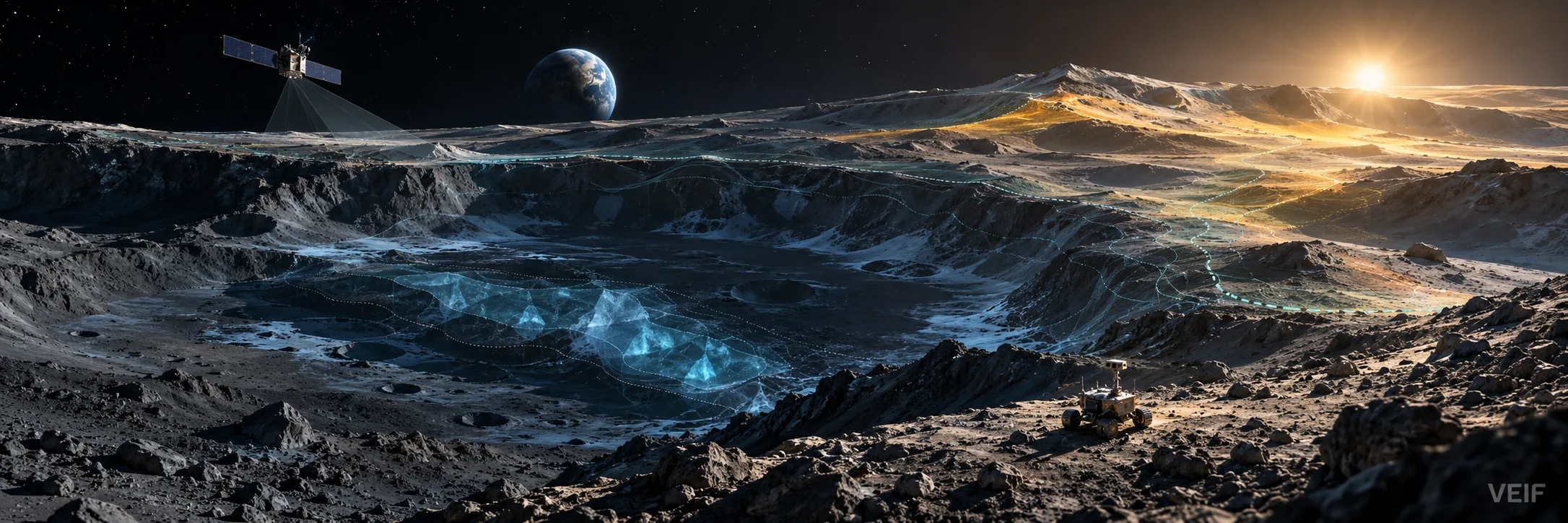
Natural conditions may derive value from combinations of energy, environment, and location as well as materials. The blue and gold overlays are artistic representations of potential uses, not measured distributions or confirmed resources.
Introduction: Wealth Does Not Always Glitter
On Earth, the word resource readily brings to mind gold, iron ore, oil, and natural gas. When discussing space, the imagination often extends naturally to precious metals in asteroids, water ice on the Moon, or a rare element.
These resources matter, but they may not encompass the future space economy. Consider two lunar regions. One contains a metal but is remote, difficult to reach, and extremely expensive to extract and process. The other has no precious metals worth mining, yet offers terrain suitable for long-running equipment, distinctive illumination, and nearby conditions that support scientific and engineering activities. For a particular developer, the second location may be more valuable.
An industrial process may also require low gravity, high vacuum, very low temperatures, or little radio interference. Engineers on Earth must devote energy and equipment to creating such conditions, while some locations in space naturally possess some of these characteristics. What is worth discovering may therefore be an environment that must be visited to be used, rather than a piece of ore that can be carried away.
The question changes: What counts as a resource in space?
If extractable material remains the sole criterion, we may overlook resource types that could attract some of the earliest demand and hold considerable strategic significance in the future space economy.
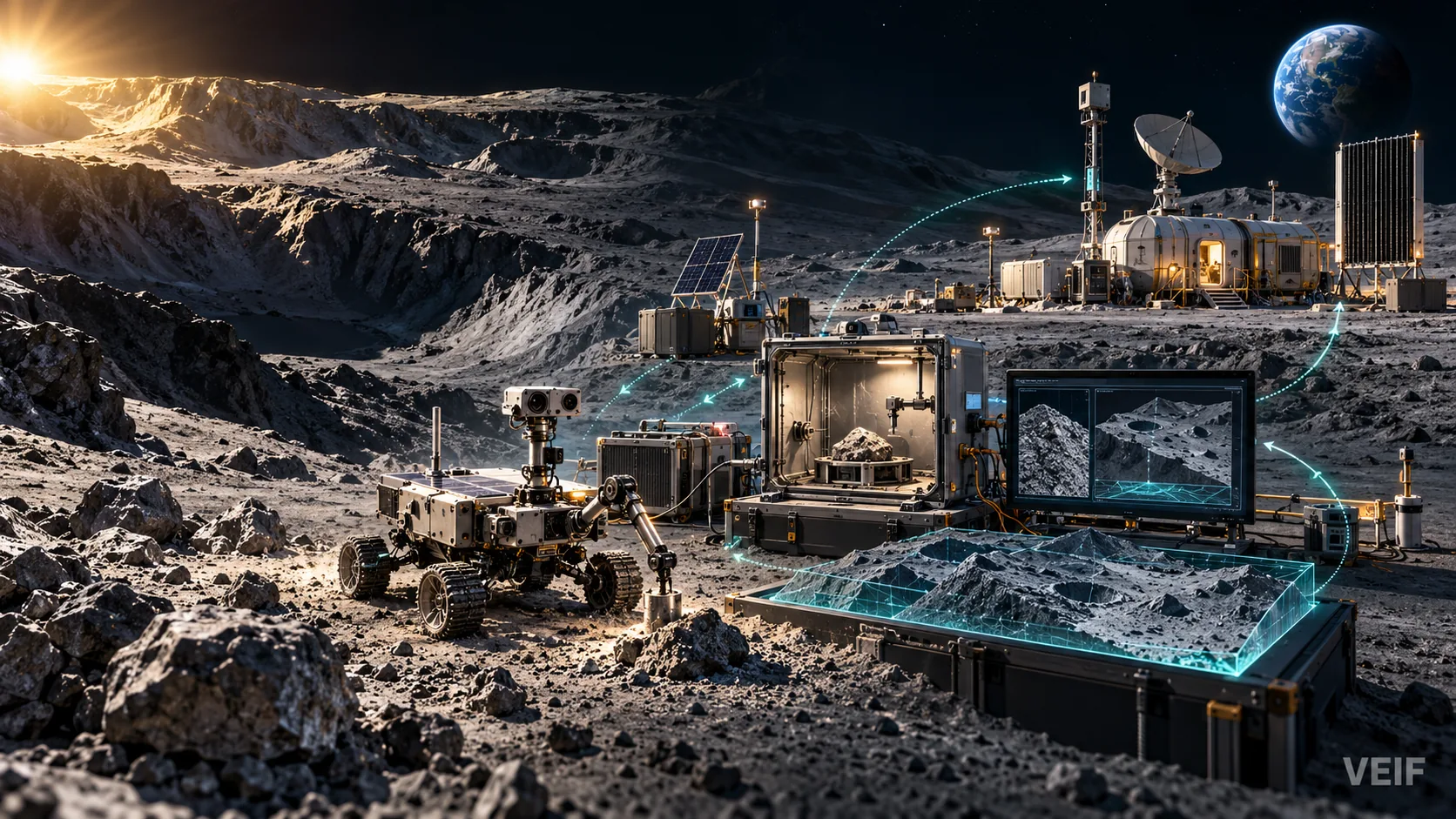
Turning natural conditions into a specific use requires exploration, verification, energy, construction, operations, and maintenance. Technical usability does not establish economic viability. Artist's concept.
1. Rethinking Resources: From What Exists to What It Enables
1.1 Natural Endowments Do Not Automatically Become Economic Resources
A material or environment may have existed for billions of years without commercial significance when the necessary technology, demand, or access was absent. Humanity's use of oil, uranium, rare earths, and the electromagnetic spectrum depends on particular knowledge and industrial systems. The analogy does not imply identical legal characteristics. It illustrates how the ability to use natural conditions changes their value.
Three levels can therefore be distinguished:
Natural endowments: Materials, terrain, orbits, or physical conditions that objectively exist.
Potential resources: Endowments known or reasonably expected to assist a scientific, engineering, or social activity.
Usable resources: Endowments that can actually be used within technical, economic, legal, and environmental constraints.
Having value and making money remain different propositions. Scientific research can give a location substantial public value without an identifiable paying market. A company's discovery of an industrially useful environment likewise does not establish tradable property rights over it.
1.2 Extending the Definition from Materials to Conditions
This article adopts a broad analytical concept of cosmic resources: natural materials, space, and physical conditions on extraterrestrial bodies, their surfaces and subsurfaces, in orbits, and at other locations beyond Earth that can provide utility for science, production, transportation, habitation, or infrastructure.
This is a definition for industry research, not a uniform legal category under existing international space law.
Here, a resource is first an endowment that provides utility, rather than necessarily a commodity already available for sale. Further distinctions are needed: Does it improve a particular mission? Can it be used at an acceptable cost? Can anyone lawfully provide a related service and earn revenue? Public scientific value, mission engineering value, and business revenue are not interchangeable.
Three overlapping forms of use can be identified:
Extraction: Obtaining water ice, gases, minerals, or other materials for local use or transportation.
Use in place: Using surface space, natural temperatures, vacuum, gravity, or electromagnetic conditions, with most of the value remaining at the location.
Network location: Using orbital geometry, communications sightlines, transfer windows, and connections between nodes to assist multiple missions.
Resources thus become more than a material inventory. They form a map of opportunities shaped by matter, environment, and location. This does not assign a commercial price to every natural condition. An advantage becomes testable only when its use and comparison are specified.
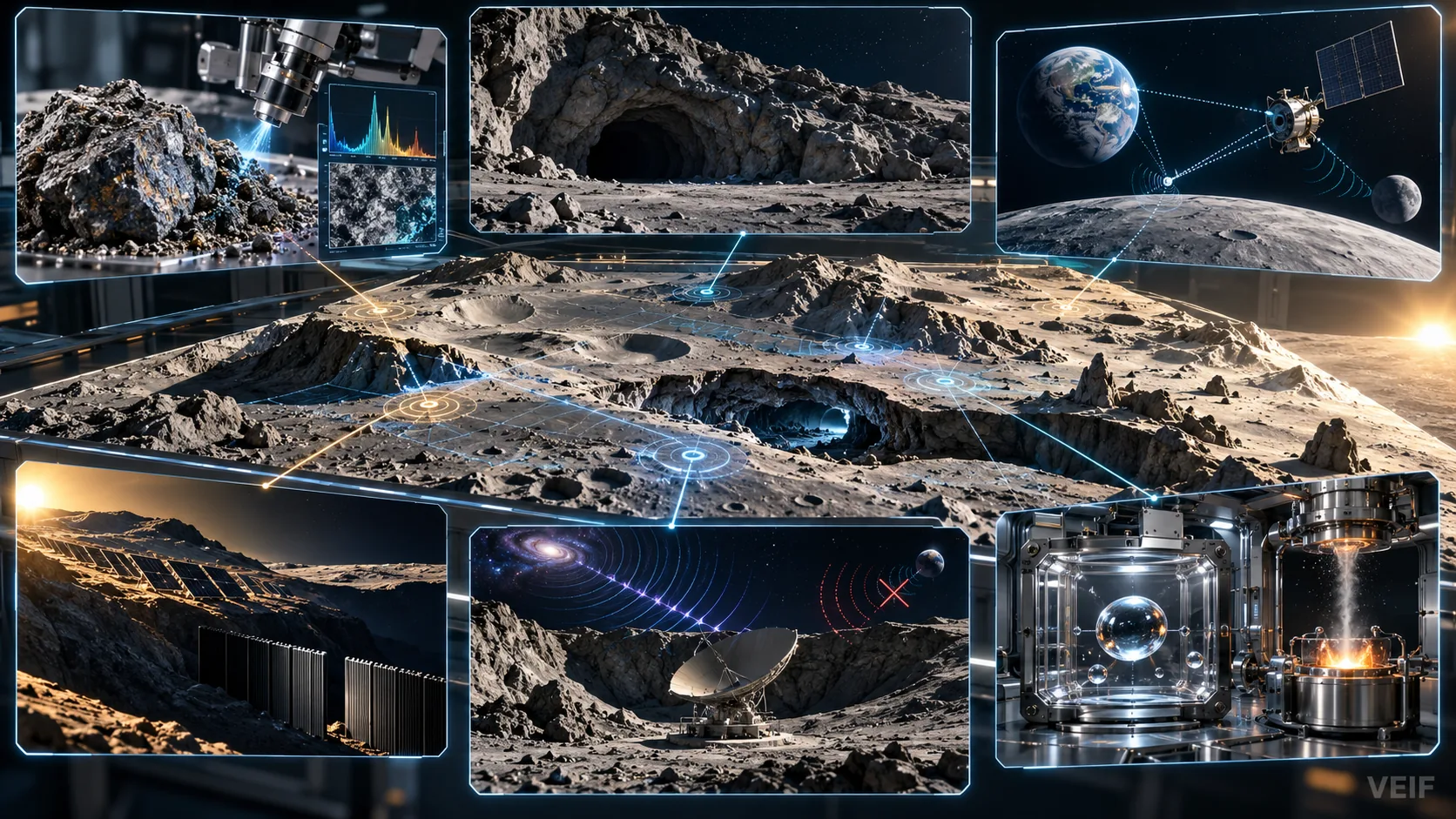
Six foundational endowments combine within a shared mission: materials, usable space, location, energy and thermal conditions, radiation and electromagnetic environments, and gravity and vacuum. The central model represents combinations, not a seventh independent mineral resource. Artist's concept.
2. Seven Faces of Cosmic Resources
The following categories identify sources of value rather than mutually exclusive scientific classes. The first six describe foundational endowments; the seventh examines combinations and should not be added to them when estimating market size. A location can have spatial, locational, energy, and environmental attributes simultaneously. Analysis should explain how each attribute changes mission performance.
| Type | Typical examples | Potential source of value | Main constraints |
|---|---|---|---|
| Material resources | Water ice, oxygen, volatiles, metals, silicates | Life support, propellant, construction materials, feedstocks | Grade, scale, extraction, processing, transportation |
| Spatial resources | Flat surfaces, underground caves, deployment areas | Construction, storage, equipment placement, long-term operations | Geological stability, accessibility, construction costs |
| Locational resources | Particular orbits, transfer nodes, communications and observation positions | Transport, replenishment, communications, observation, network connections | Stationkeeping, windows, congestion, rules |
| Energy and thermal endowments | Usable sunlight, permanently shadowed cold traps, relatively stable underground temperatures | Solar power, specific cooling and preservation uses, thermal management | Illumination continuity, conversion and storage, heat flows, operational risks |
| Radiation and electromagnetic environments | Naturally shielded areas, regions with low radio interference, particular particle environments | Precision observation, testing, shielding needs | Environmental variability, shielding performance, measurement standards |
| Gravity and vacuum conditions | Microgravity from orbital free fall, lunar low gravity, natural high vacuum | Materials and fluid experiments, specialized manufacturing | Disturbances, contamination, energy use, orbital maintenance |
| Combined conditions: a systems perspective | Regions where water ice, energy, transport, communications, and construction conditions fit together | Complementary endowments improving mission performance | Conflicting conditions, coordination costs, double counting |
Some bodies may matter because of their overall composition or gravity. Other resources may exist only at the bottom of a deep crater, on one side of a ridge, or near a particular orbit. Two conclusions follow: resources have both types and scales, and both spatial distributions and temporal characteristics.
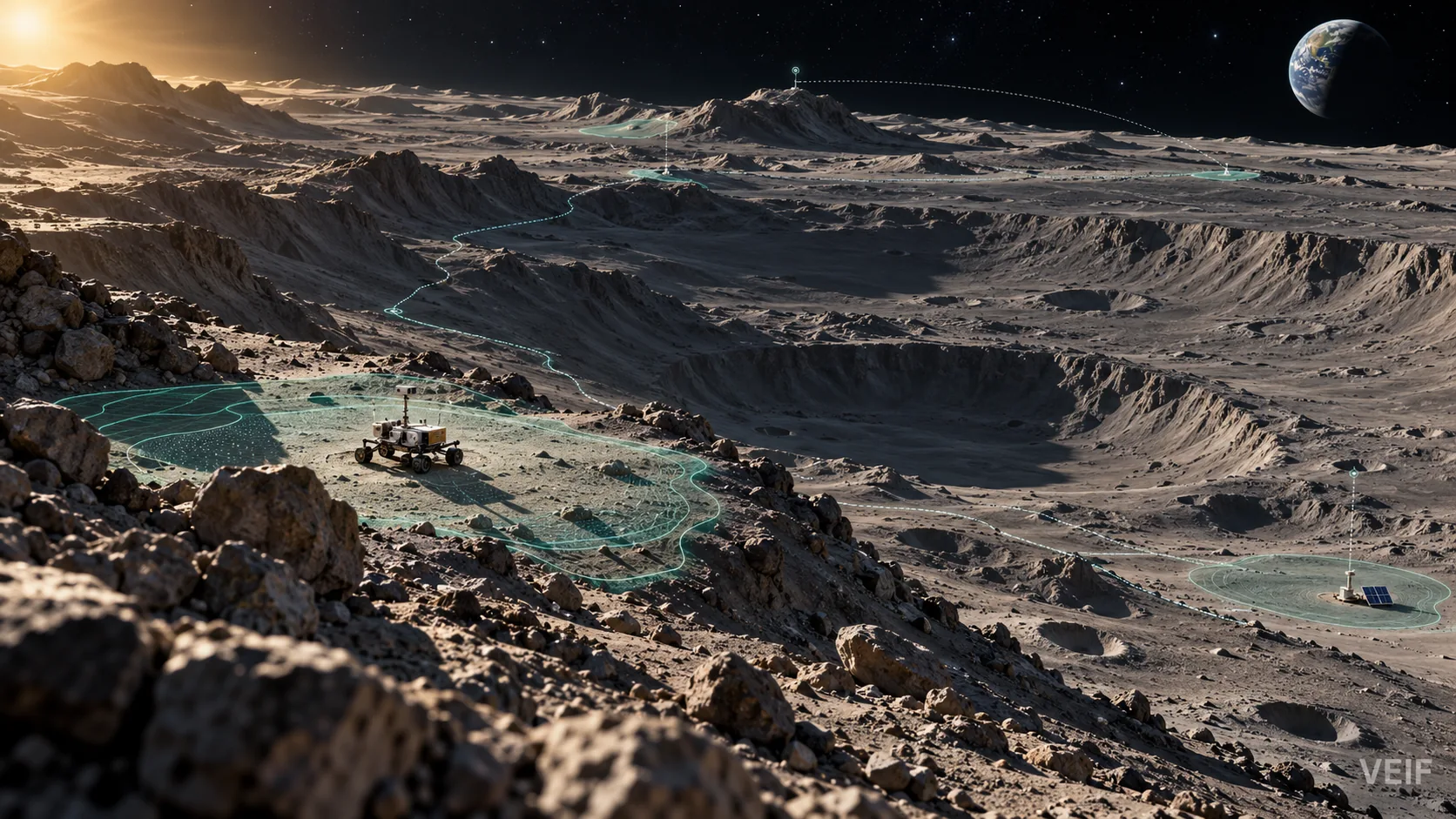
Vastness does not make every location suitable. Candidate deployment sites must satisfy terrain, access, power, and communications requirements together. The suitability overlays are not actual site-selection findings. Artist's concept.
3. Space Itself as a Resource: From Area to Usability
Land value is familiar on Earth, yet extraterrestrial spatial resources are easily misunderstood as a matter of having more area. The vastness of space does not remove scarcity from usable space.
On an unfamiliar body, suitable terrain, lower construction risks, good communications, available energy, and proximity to mission targets may give a few areas a distinct advantage. A flat landing site in the right place may be worth more than a large but inaccessible wilderness.
Below the surface, cavities and naturally sheltered terrain may also offer value. Whether a cave is stable, accessible, sealable, or suitable for long-term facilities nevertheless requires field investigation. A natural void should not be presumed habitable merely because it exists.
Spatial resources also include some aspects of orbital capacity and operating environments. An orbit, however, is not a parcel of land that can simply be enclosed. Its use involves dynamics, collision risk, spectrum, and international rules, and must be distinguished from surface development.
In the space age, a good location may first mean a place that reduces the total engineering effort required for an activity, rather than one with the greatest area.
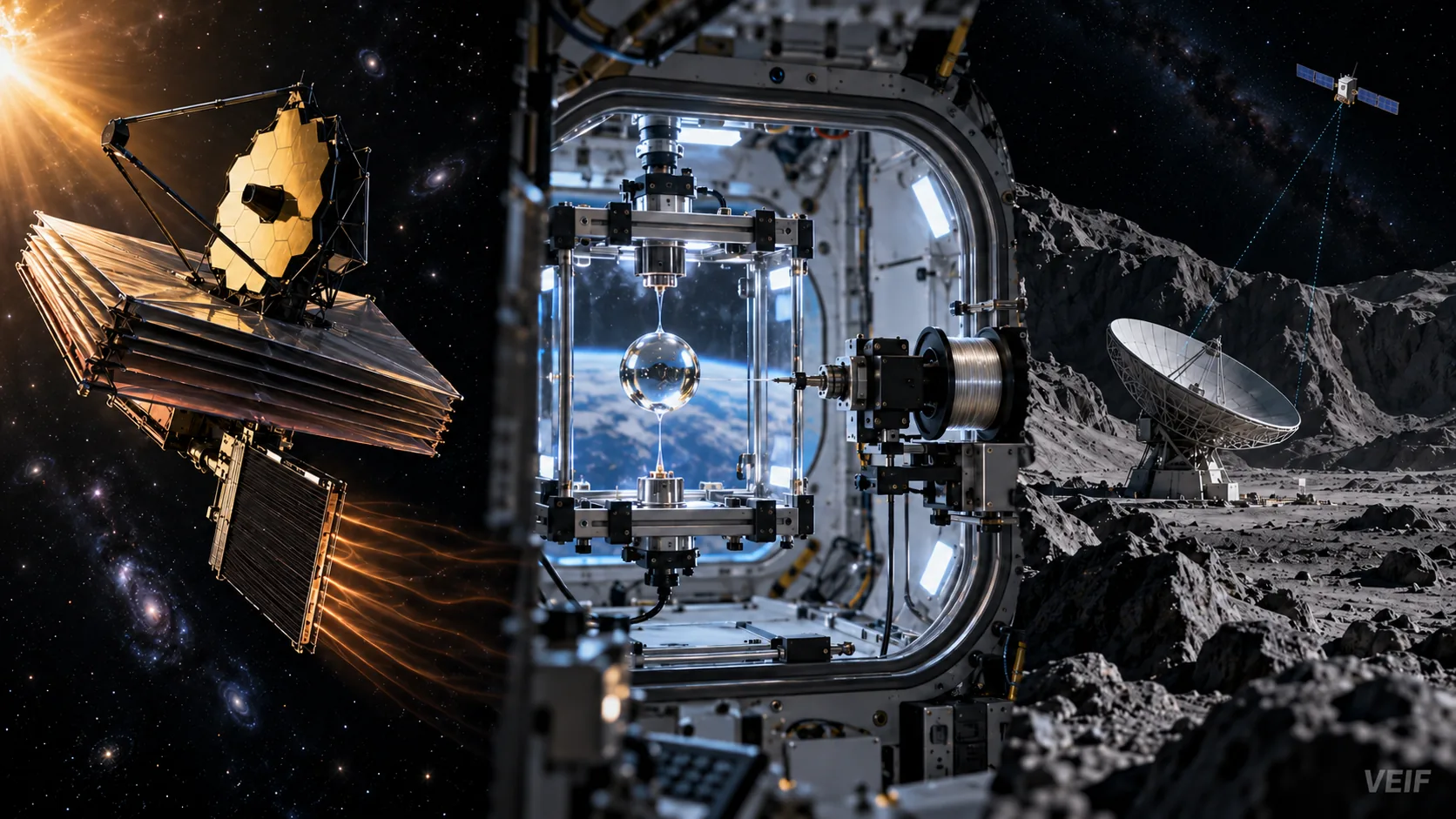
Deep-space thermal control, orbital materials experiments, and lunar radio astronomy use different conditions while depending on dedicated engineering and environmental protection. This is a conceptual composite. Heat-flow lines are visual explanations, not visible exhaust or a photograph of a specific mission.
4. Extreme Environments: From Survival Barriers to Industrial Conditions
4.1 From Suitability for People to Suitability for Missions
Environmental evaluation on Earth has long centered on human life: breathable air, comfortable temperatures, safe radiation, and gravity suitable for bodily activity. These criteria are essential to crewed habitation, but they are not sufficient as the sole standard for every industrial activity in space.
Industrial equipment, automated laboratories, and uncrewed exploration systems do not need to reproduce all aspects of Earth's living environment. Some conditions hostile to people may help particular processes reduce supporting equipment or provide experimental conditions that are difficult to maintain on Earth.
Orbital microgravity, for example, is the operating condition in which a spacecraft and its payload are in shared free fall. It does not mean gravity is absent in orbit, and it is not equivalent to low gravity on the lunar surface. It changes buoyancy-driven convection and sedimentation. Natural vacuum may reduce the need to maintain low pressures for some processes, but usability still depends on contamination, outgassing, and equipment sealing.
Cold does not mean easy heat rejection, and vacuum is not a free refrigerator. Vacuum lacks convective heat transfer through surrounding gas. Equipment must move heat internally through conduction or other paths to radiating surfaces, which exchange heat with the external environment. Sunlight, thermal radiation from surrounding terrain, orientation, and the equipment's own heat generation all affect temperature. NASA's thermal-control guidance distinguishes these mechanisms.[4] Natural low temperatures therefore do not provide unlimited cooling, nor replace contamination control, active refrigeration, or a complete heat-rejection system.
4.2 Is Predictability More Important Than Comfort?
Environmental predictability deserves particular attention.
For some highly automated equipment, extreme but predictable boundary conditions may be easier to incorporate into engineering than milder average conditions that change frequently. Stability must specify the variable, timescale, and spatial extent.
Temperature may be stable while radiation is not. A low radiation background may still be disturbed by solar activity. Illumination, surface temperature, and terrain shadows can vary substantially on the same body. Ideas of constant temperature or constant radiation should therefore become measurable ranges of variability, rather than broad claims of absolute constancy.
There is also a counterintuitive trade-off: very cold conditions may help some preservation tasks while making robots, electronics, lubricants, and power systems harder to maintain. Environmental benefits must be evaluated after accounting for the additional costs of adapting to that environment.
4.3 Three Cases: What Level of Evidence Does Each Provide?
Specific missions are needed to test concepts. The following cases support different judgments about environmental use, process experiments, and environmental protection. They cannot all be described as established business models.
| Case | How natural conditions contribute | What existing evidence supports | What cannot yet be inferred |
|---|---|---|---|
| James Webb Space Telescope | Sunshielding, observing location, and deep-space radiative conditions work with engineered systems | Near-infrared instruments can operate using passive cooling; MIRI still needs additional active refrigeration[5][6] | Natural cold requires no engineering, or an independent cooling market already exists |
| ZBLAN optical-fiber experiments on the International Space Station | Microgravity changes convection, sedimentation, and crystallization affecting fiber drawing | NASA's 2024 report documents long-fiber production and repeated orbital draws[7] | All quality requirements, lifecycle cost advantages, and sustained commercial profits have been demonstrated |
| Radio observation conditions on the lunar far side | The Moon blocks some radio emissions originating from Earth and near-Earth space | ITU describes scientific uses of the lunar shielded zone and interference-protection arrangements[8] | The far side has no interference, or one operator owns the environment |
Webb demonstrates a scientific mission using particular conditions, rather than an effect created by nature alone. The fiber case demonstrates process research: commercial lengths must not be mistaken for commercial profitability. Radio observation shows that some value requires constraints on other activities. These distinctions explain more than the general claim that unusual environments are valuable.
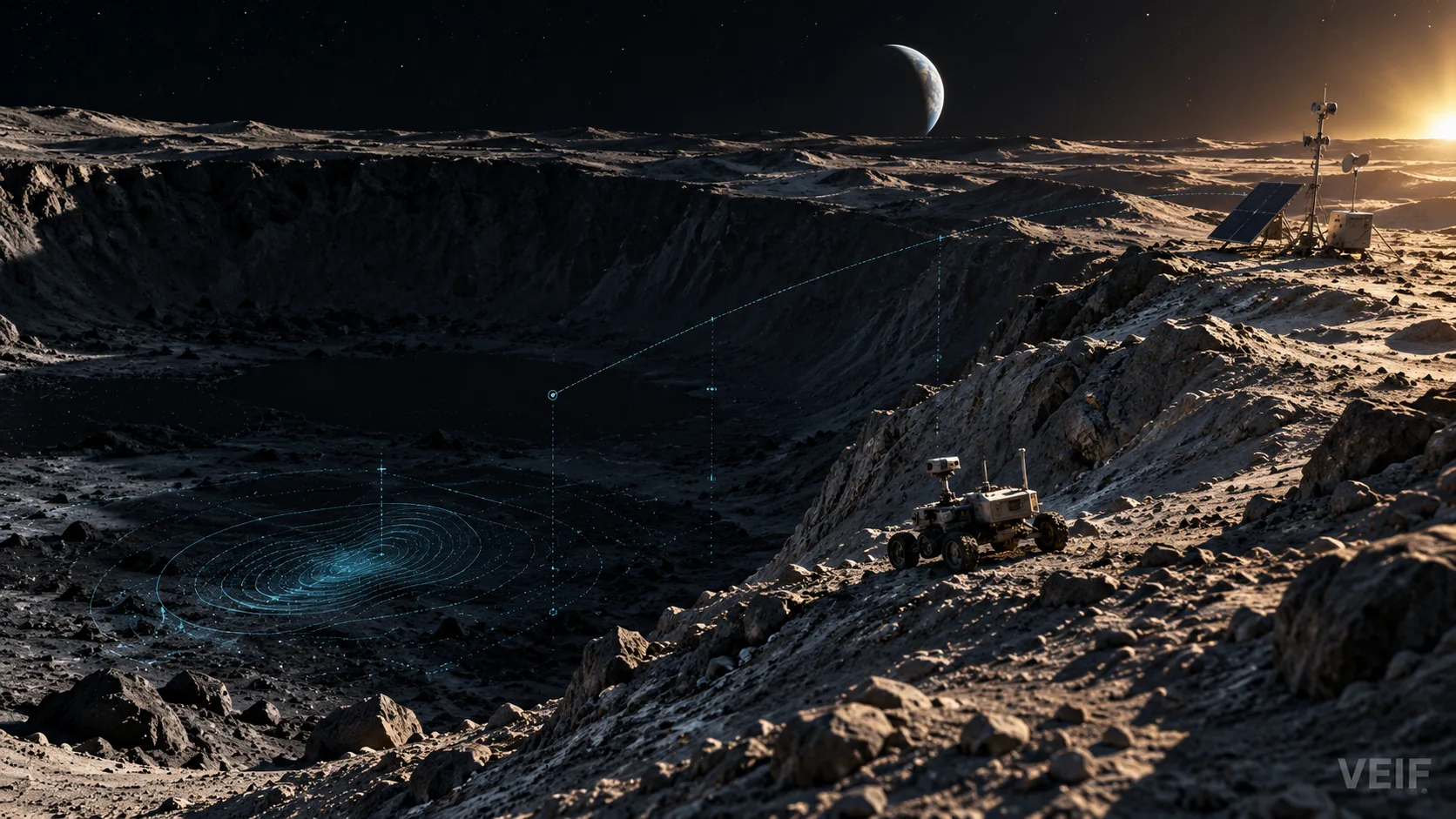
Shadowed areas and sunlit high ground may provide different, complementary conditions. Contours in shadow indicate targets awaiting verification, not widespread recoverable ice. High ground does not imply uninterrupted year-round sunlight. Artist's concept.
5. The Lunar South Pole: Different Wealth in Adjacent Terrain
The lunar South Pole is a useful example of cosmic resources in the broader sense.
NASA explains that some southern polar terrain receives prolonged sunlight, while permanently shadowed areas can remain without direct sunlight. Some permanently shadowed regions can reach approximately −203°C. Exploration has found evidence of water ice and other volatiles in some shadowed areas, but distributions are complex. Recoverable resources cannot be assumed in every cold trap.[1]
Adjacent areas may therefore offer very different resource combinations:
High ground with prolonged illumination: Potentially useful for solar power, communications, or equipment deployment, subject to terrain obstruction, illumination schedules, and construction costs.
Permanently shadowed regions: Potential water ice and natural cold, accompanied by extremely low temperatures and difficulties with lighting, power, access, and exit.
Connecting terrain: Potentially greater combined engineering value where access between these environments is practical.
A region's value is therefore not determined by mineral content alone. Ice concentration, safe access, infrastructure needed to transmit energy from sunlit areas, and transportation and operating costs can all change the ranking.
On the same Moon, slopes, crater floors, and ridges can have different resource identities.
Future planetary cartographers should therefore identify not only resource locations, but also the relationships that allow them to function as a system.
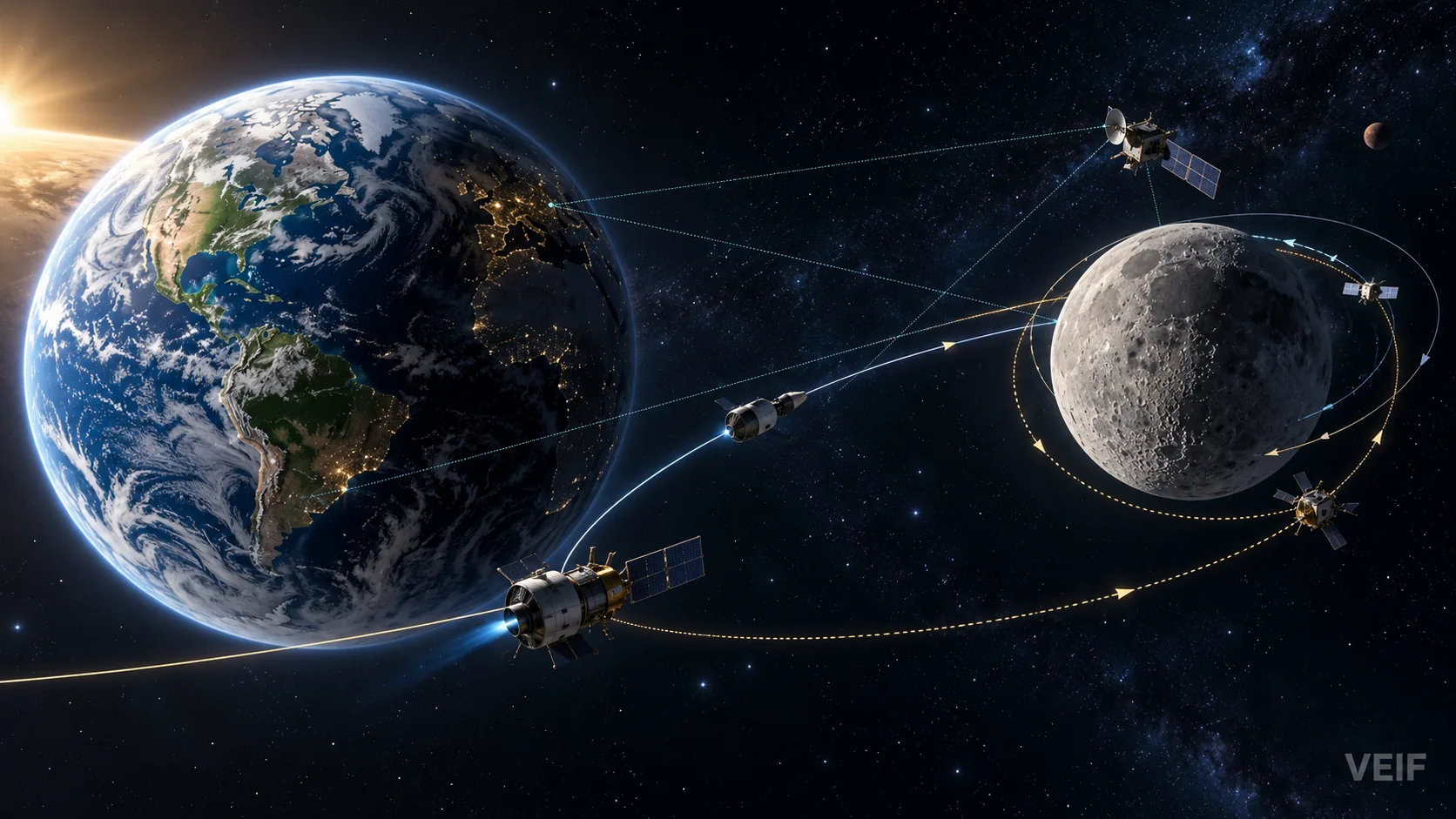
Location value depends on mission accessibility, timing, communications geometry, and service demand. Routes, nodes, and body sizes are conceptual and not to scale. They are not actual trajectory designs or statements of propellant requirements.
6. Location as Wealth: Ports, Straits, and Hubs in Space
Ports, straits, and trade routes created significant locational value during the Age of Exploration. Economic geography persists in space, but coastlines and sea lanes give way to orbital dynamics, energy budgets, communications geometry, and mission networks.
A useful transfer location need not be geometrically closest to two destinations. Orbital transfers and rendezvous depend on launch windows, required changes in velocity, propulsion, travel time, and mission risk.
Lagrange points illustrate distinctive locations. NASA describes L1, L2, and L3 as dynamically unstable, requiring stationkeeping for relevant missions. L4 and L5 have stability subject to conditions including the mass ratio. Orbits near certain Lagrange points suit particular observations, but that does not mean every spacecraft saves money by visiting them.[2]
Future nodes might support observation, communications relay, replenishment, manufacturing services, or transfers. Whether a location becomes a port depends on enough missions passing through, stopping, or needing services, rather than orbital properties alone.
The price of a location in space may ultimately reflect its effect on the costs of the wider mission network.
7. Rarer Does Not Always Mean More Valuable: Fit and Combinations
Resource narratives often equate scarcity with value. Yet an endowment may be extremely rare without supporting a commercial market if nobody needs it or its use is prohibitively expensive.
Conversely, ordinary water, oxygen, construction materials, or a stable operating space could become important early resources if local use substitutes for expensive supplies from Earth.
A conceptual assessment framework can express this:
Relative value advantage ≈ incremental mission benefits over the full lifecycle compared with the best feasible alternative − incremental lifecycle costs.
This is a research checklist, not a general financial valuation formula. Comparisons should hold mission outputs, delivery location, timing, quality, and reliability requirements constant, then account for differences in transportation, verification, construction, operation, maintenance, failure handling, and compliance. If avoided Earth-supply costs have been counted as a benefit, the same expense must not also be deducted elsewhere. Economic assessment of costs and benefits occurring at different times must also address tied-up capital and uncertainty.
The alternative cannot always be defined as recreating the conditions on Earth. Water for lunar use should be compared with other water-supply options at the same point of use. Orbital products for Earth markets should be compared, after delivery to Earth, with terrestrial products of equivalent specification. Scientific observations may require comparison with other mission designs that achieve the same objective, rather than assigning an artificial market price to scientific findings.
Combinations are more important still. One region may have potential ice but lack energy and transport. Another may have less ice yet sit near reliable power, communications, and construction areas. The latter could be more attractive to a particular mission.
Conditions can also conflict. Permanent shadow helps some cold-environment uses but obstructs direct solar generation. A complete mission-system model is needed to establish whether the conditions complement or offset one another.
The relevant unit of assessment may therefore become a combination of resources that jointly supports an industrial activity, rather than an isolated deposit. Combined benefits must be calculated at the mission-system level: power, cooling, location, and construction advantages at the same site cannot each be valued independently and simply added together.
8. Resource Scale and Time: From an Entire Body to a Single Shadow
Cosmic resources exist at at least four spatial scales:
Celestial-system scale: Gravitational configurations, orbital networks, transfer pathways, and regional transport structures.
Whole-body scale: Overall gravity, vacuum conditions, composition, day-night cycles, and seasonal characteristics.
Regional scale: Polar regions, basins, ridges, subsurface formations, and energy and communications conditions.
Site scale: A landing site, cold trap, deposit, cave, or specific equipment deployment area.
Different scales call for different observation and verification methods. Orbital remote sensing can identify candidate areas, while critical conclusions about resource grade, geological conditions, or engineering feasibility often require finer measurement or in-situ verification.
Resources also have a temporal dimension. A location useful for uncrewed exploration today might support manufacturing after transport infrastructure improves. A material of little value without local demand might become an important feedstock once a long-term lunar base exists.
Technology can also make some locations less scarce. Better storage, communications, and thermal systems could reduce dependence on particular illumination or temperature conditions.
Resource value evolves with technology, demand, and industrial networks. Discovery does not make it permanent.
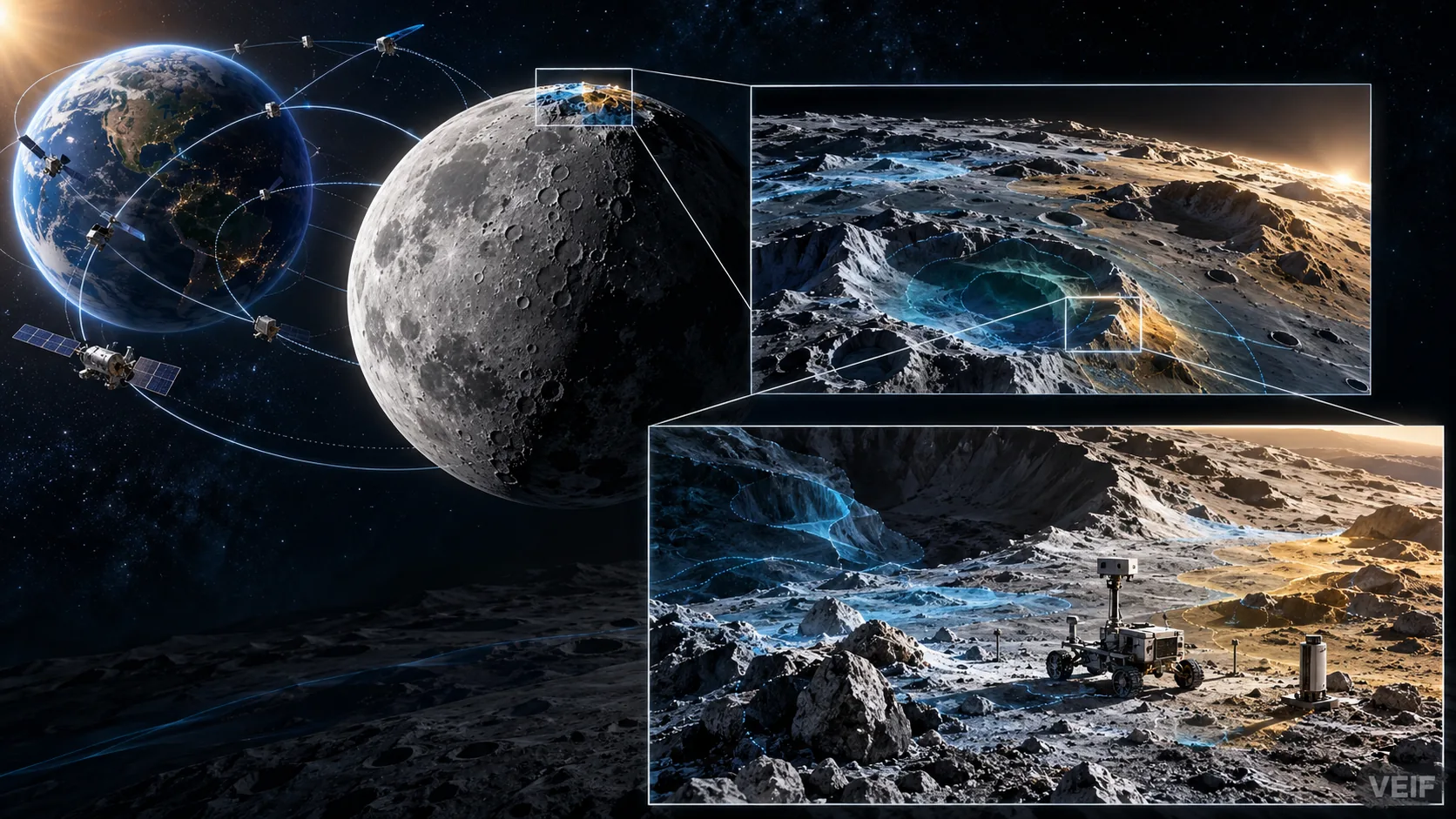
Different scales require different evidence. Mission networks, body-wide characteristics, regional environments, and local terrain jointly shape use. The windows do not share a common scale, and the overlays are not survey results for actual sites. Artist's concept.
9. From Resource Maps to Maps of Physical-Condition Value
If this definition is useful, future planetary mapping will extend beyond mineral spectra and topography.
A cosmic resource map supporting development decisions might combine these information layers:
Materials: composition, abundance, distribution, and verification confidence.
Terrain: slopes, bearing capacity, and construction feasibility.
Environment: temperature ranges, thermal cycling, radiation, and electromagnetic background.
Energy: continuity of sunlight, obstructions, and energy transmission conditions.
Location: orbital accessibility, communications windows, transport, and replenishment costs.
Systems: complementarities with other resources and infrastructure.
Rights and constraints: applicable rules, data rights, interference with activities, and environmental protection requirements.
This connects with the Planetary Cartographers series. Cartographers identify more than underground deposits: they assess which activities suit different locations, and how reliable those judgments are. The trilogy discusses how the industry might emerge, how information acquires value, and how participants organize. This article adds an upstream question: which natural conditions merit mapping and evaluation? It extends the theme without becoming a fourth installment of the trilogy.
The next questions on the path from discovery to exchange concern who produces the information, how it is verified, who pays, and whether it can be lawfully licensed. The earlier discussion of information-platform business models is not repeated here.
10. Resources Are Not Property Rights: Institutional Boundaries in the Space Age
If an orbit, ridge, or cold trap has great economic value, can its discoverer declare ownership? Economics alone cannot provide the answer.
The 1967 Outer Space Treaty establishes that outer space, including the Moon and other celestial bodies, is not subject to national appropriation through sovereignty claims, use, occupation, or other means. The United Nations' overview also emphasizes freedom of exploration and use and state responsibility for space activities.[3]
Countries have different arrangements for the use of extracted space resources, authorization of commercial activities, and safety coordination. Resource use and the boundaries of related rights remain subjects of international discussion. Terms such as spatial resources and locational resources in this article should not be understood as automatically creating private property rights over land, orbits, or celestial bodies.
Locations of substantial scientific value may also be unsuitable for commercial development. Contamination, irreversible damage, interference between missions, and effects on future research opportunities can impose important constraints.
An internal tension arises: development itself may alter the valuable conditions. Communications equipment can increase radio interference; equipment heat and dust can affect observations or local environments; intensive activity can increase congestion and coordination costs. The lunar shielded-zone discussion shows that environmental value must be collectively maintained as well as discovered.[8] Reducing one company's mission cost does not necessarily raise net benefits across the network. Effects on other users and scientific activities may need to be included.
Resource assessment should ask not only whether a condition can be used, but how, by whom, and under which rules.
11. The VEIF Perspective: What Should the Next Generation of Value Discovery Seek?
For the value evolution investing framework, the key shift is from asking which deposit someone holds to asking which natural conditions can support sustained industrial use.
Not every unusual environment creates an investment opportunity. The intersection of natural conditions, technical maturity, and customer demand deserves attention. Another question follows: even if a mission benefits, who can earn revenue through which contract?
A developer may reduce supply spending through local water, while a mapping provider earns only exploration and data-service revenue. A scientific institution may benefit from a quiet observing environment, while commercial revenue goes to instrument, deployment, or maintenance suppliers. The utility of natural endowments, total project benefits, and supplier profits are different quantities.
Five questions can guide continuing research into a cosmic-resource concept:
Reality: Has the material, location, or environment been established through repeatable scientific measurement?
Fit: Which specific mission need does it address, beyond a general vision of the future?
Accessibility: Is there a feasible route for transportation, construction, energy supply, and maintenance?
Economics: Does the advantage over terrestrial production, Earth supply, or other off-world locations cover the additional costs?
Value capture and sustainability: Who pays whom, and for which delivery? Are there long-term needs, enforceable data or service agreements, and acceptable legal and environmental arrangements?
Research leads can be placed in three states: scientifically confirmed natural conditions, engineering uses already demonstrated or still awaiting verification, and services with evidence of payment. Each case should identify its evidence date, mission, and measurement boundaries. One state cannot substitute for the others. Payment evidence should also distinguish research procurement, technology-demonstration funding, one-off contracts, and repeat purchases.
Under this framework, relevant companies may include mapping, in-situ exploration, robotic construction, thermal management, orbital manufacturing, communications, and transport infrastructure providers, rather than miners alone. Determining which companies can turn endowments into sustainable revenue requires separate company research, not a direct inference from a conceptual essay.
Conclusion: Space Wealth Begins in Conditions We Have Yet to Understand
Gold has value without the universe having attached a price tag to it. Water ice matters for reasons beyond being a material. Value emerges when demand, technology, and usable conditions meet.
On Earth, changing transport routes can turn barren land into an urban hub. New technology can make a previously unused mineral a critical material. Similar value evolution may unfold in space on a wider and less familiar scale.
A shadow too cold for people to remain in may offer preservation or scientific value. An orbit with no solid ground may become an important observation or service node. A body lacking conventional precious metals may attract interest because of its overall physical environment.
Yet unusual does not mean scarce, scarce does not mean usable, and usable does not mean profitable. The challenge is finding resources that can pass through all these thresholds.
Future space prospectors may not be looking for gold. They may be seeking places where natural cosmic conditions can be turned into productive capabilities for civilization.
The new wealth of space may lie in locations and environments that seem empty today but could support industries tomorrow.
Data sources
Verification date: November 1, 2026. These sources support environmental facts, engineering cases, and institutional context respectively. Taken together, they do not establish that any particular business model has succeeded.
[1] NASA, The Lunar South Pole Region
[2] NASA Science, What are Lagrange Points?
[3] United Nations, Outer Space
[4] NASA, Small Spacecraft Technology State of the Art: Thermal Control
[5] NASA Science, Webb’s Sunshield
[7] NASA, Optical Fiber Production (2024-03-25)
[8] ITU, Safeguarding radio astronomy on the Moon (2022-05-25)
Further reading: NASA Science, Shadows near the Moon’s South Pole
Disclaimer
This is forward-looking industry research for VEIF Insights, using an expanded analytical definition of cosmic resources. It combines scientific facts supported by public sources with hypotheses about future industrial value. Commercial scenarios do not establish technical maturity, an existing market, or settled rights. This article is not investment advice. References support environmental conditions at the lunar South Pole, orbital dynamics, thermal management, process experiments, and the institutional background of space activities. Revenue allocation, organizational choices, and industry evolution are the author's analysis. Historical experiments illustrate the evidence at their respective dates; they are not presented as the latest commercial status as of the verification date.
Read this series · Expansion into Space · The Space Gold Rush
- The Space Gold Rush 1: Who Will Build and Control the Next Industrial Frontier?
- The Space Gold Rush 2: The Real Wealth of the Great Space Age