Planetary Cartographers 3: Treasure Maps
When Exploration of Unknown Worlds Produces Knowledge Assets That Can Be Priced
VEIF Insights · Planetary Cartographers Series, Part Three | November 2026
Theme: Space Economy and Industry Evolution
Series navigation: Part One · Industry Origins · Part Two · Participants and Competition · Part Three · Commercial Value (this article)

Introduction: Before the Gold Appears, the Map Already Has Value
During the Age of Exploration, wealth did not accrue only to those who reached distant shores themselves. Some built ships, some sailed, some drew charts, and others supplied capital. Still others used knowledge of routes, ports, and resources to reshape their commercial judgments before their competitors. A map was not gold, but it could change the cost and probability of finding it.
Space development may reproduce this division of labor without reproducing its institutional or economic outcomes. Launch and transportation address how to arrive; planetary cartographers address where further exploration is worthwhile; resource developers must still determine whether materials can be obtained and used at an acceptable cost. These questions are connected, but the gaps between them cannot be skipped.
The first essay, Planetary Cartographers 1: Mapmakers of the Space Gold Rush, examined how commercial spaceflight, robotic exploration, and technological accumulation could give rise to specialized planetary mapping. This essay shifts from the formation of capabilities to the circulation of value: if an independent team holds more precise and credible resource information than is available to the market, can it earn revenue from that discovery without operating a mine or building a base?
This is more than a question of selling maps. It concerns information, rights, verification, capital, and the organization of markets.
The central hypothesis is conditional: if demand for off-world development emerges, proprietary information can be lawfully controlled, and survey conclusions can be verified, planetary cartographers may evolve from commissioned surveyors into independent discoverers. Their outputs may develop from individual data licenses into information assets around which bidding and trading can be organized. This is a possible evolutionary path under particular conditions, not an established industry reality.
1. Discovering Value: Economic Activity Before Resource Development
1.1 The Unknown Is Not Necessarily Valueless; Its Value Has Yet to Be Demonstrated
The Moon, Mars, and asteroids have different geological, environmental, and orbital conditions. Yet the presence of a material and the presence of a resource worth developing are different propositions. Economic significance also depends on concentration, spatial distribution, extraction difficulty, equipment reliability, energy supply, transportation, the target market, and legal constraints.
Water ice at the lunar poles offers an illustrative example. NASA's scientific objectives for VIPER include characterizing the distribution and physical state of polar water and other volatiles, and providing data for evaluating in-situ resource utilization. Related USGS research combines terrain, temperature, permanently shadowed regions, ice stability, and other inputs into a resource-prospectivity model. Moving from evidence of water to targets that can inform mission deployment requires continuing verification and modeling; a single remote-sensing discovery is not enough.[1][2]
The planetary cartographer's task is therefore to reduce uncertainty, rather than merely identify anomalies:
- Identify leads: detect unusual spectral, terrain, thermal, or other signals that may indicate resources.
- Cross-validate: combine orbital observations, historical data, and different sensors to reduce the risk of misinterpretation.
- Verify in situ: where feasible, use rovers, drilling, or measuring instruments to establish local conditions.
- Interpret development potential: incorporate illumination, slope, communications, energy, transportation, and engineering constraints.
- Update continuously: revise interpretations and confidence levels as new evidence appears.
Through this process, information develops from general knowledge into evidence that may influence investment and mission design.
1.2 Planetary Cartographers First Sell a Reduction in Uncertainty
Suppose two areas are both thought to contain useful materials, but one has been surveyed in greater detail, with original observations, error ranges, and reproducible analytical methods. A developer might prioritize that area because less remains unknown, even if it does not contain more resources.
This is the economic value of information: it can help avoid unnecessary missions, adjust landing and sampling locations, reduce poor site choices, or rule out an attractive but ultimately unviable project before further commitments are made.
A map showing that a location is not worth developing may be more valuable than a treasure map that exaggerates its potential. Part of a planetary cartographer's credibility comes from the ability to deliver disappointing conclusions.
1.3 Economic Value Does Not Automatically Become Revenue for the Discoverer
Information that could save a developer a billion dollars in potential losses does not entitle its producer to charge a billion-dollar fee. Pricing also depends on exclusivity, the number of buyers, alternative data, contractual rights, useful life, and bargaining power.
Three levels must be distinguished:
- Social value: the total benefits a discovery brings to science, industry, and public decision-making.
- Customer value: the expected benefit a particular developer obtains by making better decisions with the information.
- Capturable revenue: the amount the discoverer can charge under actual contracts and market conditions.
The commercial challenge is to turn part of the second level into the third, lawfully and on a continuing basis.

2. From Maps to Treasure Maps: Different Business Models for Discoverers
2.1 Commissioned Surveying: Selling Mission Execution Capabilities
The most straightforward business is to accept commissions from governments, research institutions, or commercial customers for remote-sensing analysis, operation of survey payloads, site mapping, or environmental assessments. Revenue comes from contracts, with relatively clear requirements and delivery boundaries.
This model can support technical accumulation and early cash flow. However, companies generally deliver results under contractual terms and may not hold the right to resell core data. Making a remarkable discovery on commission does not necessarily give the surveyor an additional share of the economic returns from subsequent development.
2.2 Continuing Data Services: Selling Knowledge That Can Be Updated
As observations become more frequent and missions more numerous, mapping outputs may develop from one-off project reports into continuously updated data products: high-resolution terrain basemaps, landing-hazard maps, communications and illumination data, regional change monitoring, and models of equipment operating environments.
Potential revenue sources include subscriptions, access licenses, updates, and advanced analysis for particular missions. Compared with individual contracts, data services emphasize long-term customer relationships and standardized delivery.
They also face competition from public data. When basic observations are freely available, companies must justify payment through higher resolution, faster updates, cross-validation, mission-specific services, or distinctive acquisition capabilities.
2.3 Independent Prospecting: From Executing Missions to Selecting Targets
A significant commercial transition occurs when a company stops waiting for customers to specify survey locations and instead chooses targets, organizes observations and verification, and bears the risk of finding nothing commercially valuable.
If a discovery can materially influence development decisions, the company may package its findings as a proprietary information product and license it to one or more potential customers.
Such a company manages a portfolio of discoveries: some projects fail, others yield only scientific value, and a few may earn substantial commercial returns when they meet a particular need. It therefore resembles a risk-bearing exploration business more than a conventional outsourcing provider.
Independent prospecting does not automatically confer ownership of land or deposits on a celestial body, or exclusive development rights. A company must first establish which enforceable rights it holds over original data, processed outputs, and contractual deliverables.
2.4 Joint Exploration: Sharing the Uncertainty of Discovery
Between a single customer's commission and a company's independent prospecting lies another possibility: joint exploration. Multiple parties can co-fund missions, share payloads, or coordinate execution to spread survey costs and failure risks. They may bring different measurement requirements for the same region, then allocate original data, analytical outputs, priority access, and proceeds from external licensing under agreements made in advance.
Joint exploration is primarily a way to organize investment and risk, rather than another source of revenue. It can accommodate targeted assignments, continuing data services, and exploratory surveys within the same mission. Cooperation depends on compatible mission requirements and advance agreement on cost allocation, data delivery, confidentiality, disclosure obligations, and subsequent use of results.
For exploratory missions whose targets remain uncertain and whose observations may generate information with several uses, this essay treats joint exploration as a potentially more common organizational form. That judgment still requires practical validation: shared missions also increase coordination costs, while specialized payloads, timing requirements, or confidentiality needs may favor separate, targeted missions.

2.5 Four Revenue Paths That Can Coexist
| Path | What is sold | Commercial characteristics | Principal constraints |
|---|---|---|---|
| Mission contracts | Exploration and mapping services | Relatively clear deliverables | Revenue limited by mission volume and budgets |
| Data subscriptions | Maps, models, and continuing updates | Reuse and long-term relationships | Requires stable, recurring willingness to pay |
| Discovery licensing | Proprietary leads, verification reports, and access to original data | Potential discovery premium | High failure rates, rights, and confidentiality issues |
| Professional decision support | Integrated site selection and assessments of risk, engineering, and economic conditions | Closely connected to customer decisions | Liability boundaries and demanding reliability requirements |
These revenue paths need not replace one another in sequence, nor do they correspond one-to-one with mission structures. Single-customer commissions, independent prospecting, and multi-party joint exploration can each combine different revenue arrangements. Early organizations may use contract income to develop capabilities, joint investment to share exploration risks, and subsequent licensing to recover part of their investment. Any use of funds or results across projects must still comply with the relevant contracts.
3. Pricing Treasure Maps: From Private Licensing to Information Auctions
3.1 The Same Discovery Has Different Value for Different Buyers
A region that may contain usable water ice will have different value for a company planning a long-term lunar facility, one developing a propellant supply chain, and an institution conducting only short-duration scientific observations.
Information's economic value is determined by how much it can improve a particular buyer's decisions, rather than simply by adding up the costs of producing the map.
A conceptual expression can help explain a buyer's payment ceiling:
Expected decision value of information ≈ expected losses avoided and additional expected opportunity gains after obtaining the information − additional costs of acquiring and using it.
This is not a universal formula that can be applied directly to valuation. Actual assessments still require probabilities, mission costs, execution constraints, alternatives, risk preferences, and other parameters. Even highly valuable information may have very few buyers—perhaps only one.
3.2 One Survey May Serve Multiple Information Buyers
Space is immense, while each survey is limited by orbit, payload, energy, communications, and mission duration. It can cover only a bounded area, depth, and measurement range. Missions can define scientific and resource objectives in advance without knowing exactly what they will discover or which findings will matter most to which users. This uncertainty does not mean that every instrument can identify every resource: discoveries remain constrained by sensor capabilities, resolution, and verification conditions.
Survey outputs therefore need not correspond one-to-one with a single customer's requirements. The same observations may yield resource leads, terrain data, thermal records, and engineering-risk information. Their value may become clearer after the mission as different users develop their plans. Several users buying outputs for different purposes is a different transaction structure from several buyers bidding for the same right.
One path worth investigating is consequently for multiple parties to co-fund exploration, share payloads, or conduct joint missions, then allocate data and output rights under prior agreements. Participants may receive priority access to information that meets their own requirements, while other outputs eligible for external licensing are offered to suitable users. Joint exploration can coexist with targeted assignments: some payloads fulfill defined commissions while others conduct exploratory investigations.
When an output has several potential buyers, clear rights, and the possibility of controlled disclosure, competitive licensing may reveal its price more effectively than committing it to a single customer before the mission. Joint exploration does not automatically produce auctions, however. Funders may require internal sharing, priority use, or prohibit resale, while public funding may carry open-data obligations. If nonexclusive licenses can meet different users' needs, multi-customer licensing may not require bidding at all.
The resulting proposition is that, during an exploratory phase with uncertain targets and multiple uses for results, joint exploration followed by allocation of outputs and subsequent licensing may become an important organizational form. Information auctions are one possible price-discovery mechanism within that arrangement when the necessary conditions are met. Whether this model becomes more prevalent than single-customer targeted commissions must be tested against future missions and transactions.
3.3 Why Auctions Might Emerge
If several developers have competing needs for the same proprietary discovery, pricing solely on production cost may fail to reflect its differentiated value. The discoverer may organize bidding for information rights defined by contract, such as:
- A time-limited license for exclusive access to original data;
- Exclusive analytical-use rights for a particular purpose, area, or project;
- Nonexclusive data licenses for multiple buyers;
- Priority purchase rights or cooperation opportunities for subsequent verification missions;
- A contractual package combining data and professional interpretation services.
What is auctioned is access, licensing, and services—not lunar land or ownership of deposits whose rights have not been established. An exclusive data license does not mean that its holder can prevent others from lawfully surveying the same region themselves.
3.4 The Information Paradox: Buyers Need to See Its Value, but Disclosure Can Remove the Need to Buy
Information transactions contain an inherent tension: buyers need enough evidence to judge the price, but disclosing every detail in advance may eliminate the scarcity of what the discoverer is selling.
Potential responses involve graduated disclosure and credible verification, rather than a technological lock that solves everything:
- Public summary: disclose target type, regional scale, evidence level, acquisition date, and verification method while withholding critical coordinates or valuable parameters.
- Buyer qualification and confidentiality review: establish identity, intended use, and applicable disclosure restrictions.
- Independent review: have qualified third parties examine data authenticity, methods, and uncertainty without opening sensitive working material to every buyer.
- Controlled data room: provide limited access in an auditable environment.
- Bidding and contracting: define scope, duration, exclusivity, sublicensing, and resale restrictions.
- Delivery and subsequent verification: use data hashes, version records, escrow, or auditing mechanisms to reduce delivery disputes.
These mechanisms add transaction costs. They make economic sense only when information is sufficiently scarce and customers are willing to pay.
3.5 Auctions Are Neither the Only Mechanism nor Necessarily the Best
Where buyers are few, needs are specialized, and confidentiality matters, private negotiations, joint prospecting, milestone payments, or long-term licenses may be more appropriate than public bidding. Developers may also commission discoveries on an outright buyout basis.
Auctions are therefore one potential mechanism for planetary treasure-map markets, rather than a prerequisite for commercializing planetary cartography.

4. Information Trading Hubs: From Isolated Discoveries to Organized Markets
4.1 Why an Intermediary Layer Might Be Needed
If future activity involves many exploration teams, developers, and funders, they may struggle to assess data quality, find counterparties, or compare resource potential across regions. Repeating technical reviews and legal negotiations from scratch for every transaction would create substantial friction.
A specialized information infrastructure might then emerge. It would not necessarily launch probes itself; instead, it could provide discovery registration, evidence grading, trading rules, and data custody services.
This essay provisionally calls that model the Planetary Discovery Exchange (PDX). The term describes a research concept, rather than an existing institution or an established market.
4.2 The Core Problems a PDX Would Need to Address
| Functional layer | Main tasks | Misinterpretation to avoid |
|---|---|---|
| Discovery registration | Record survey dates, regional scale, provenance, and versions | Registration does not grant resource rights |
| Evidence grading | Distinguish anomalies, indirect inference, in-situ verification, and development-level assessments | A grade is not a guarantee of resource reserves |
| Data catalog | Provide searchable nonsensitive summaries and data standards | A public catalog does not make all content free or reliable |
| Independent verification | Review methods, cross-check findings, and explain quality and uncertainty | Verification does not guarantee commercial success |
| License transactions | Support quotations, bidding, contracts, and access controls | Selling data does not mean selling a mining area |
| Delivery and custody | Preserve evidence chains, versions, access records, and delivery receipts | Custody does not eliminate all copying or leakage risks |
| Subsequent updates | Flag new evidence, withdraw conclusions, and track report changes | Old conclusions cannot retain their original ratings indefinitely |
4.3 An Information Catalog Cannot Become an Exchange Overnight
The commercial development of this concept might involve four stages:
Stage One: Data catalog. Public-data indexes, professional report searches, and limited commercial-data listings, with an emphasis on discoverability and standardization.
Stage Two: Trusted brokerage. Independent verification, controlled access, contract templates, and introductions between buyers and sellers, potentially funded by service fees.
Stage Three: Organized bidding. Once recurring transactions, multiple buyers, and relatively standardized data rights exist, bidding and more transparent price formation could be attempted.
Stage Four: Industry information infrastructure. Given sufficient market scale, the platform might accumulate data-quality histories, transaction reputations, and knowledge graphs of discoveries across missions, supporting broader decision-making services.
This is not an established roadmap. Any stage could stall because customers are too few, data cannot be standardized, or rights remain unclear.
4.4 Network Effects and Countervailing Forces
More discoverers could attract buyers, while more buyers could attract discoverers: a potential two-sided network effect. Countervailing forces also exist. Major developers may secure the most valuable discoveries for long periods; large aerospace companies may retain data within closed ecosystems; and continuing public release of scientific data may constrain fees for ordinary material.
The real advantage may therefore lie in building genuine information relationships that are verifiable, updatable, and supported by customer demand, rather than having the largest number of listings.

5. Information Rights, Space Law, and the Boundaries of Public Science
5.1 Discovering Information Must Be Distinguished from Appropriating Celestial Resources
Article II of the 1967 Outer Space Treaty prohibits national appropriation of outer space, including the Moon and other celestial bodies, by claims of sovereignty, use, occupation, or other means. Article VI assigns States Parties international responsibility for nongovernmental space activities and requires authorization and continuing supervision.[3]
Section 10 of the Artemis Accords sets out principles for cooperation on space-resource extraction and utilization. It takes the position that extraction does not inherently constitute national appropriation, while relevant activities and contracts must remain consistent with the Outer Space Treaty. National laws and international practices still present questions requiring continuing coordination.[4]
Resource-information contracts should therefore carefully specify licenses or delivery of data, models, proprietary analysis, confidential information, and services, rather than implicitly representing already-acquired ownership of off-world land. Whether tradable proprietary rights exist must be assessed against data provenance, contractual terms, applicable law, and mission oversight.
5.2 Public Scientific Data Cannot Simply Be Repackaged as an Exclusive Discovery
Government-funded research and public scientific missions may carry open-data obligations. The Artemis Accords include scientific-data release principles and distinguish private-sector operations from missions conducted on behalf of signatories when discussing those commitments.[4]
If original observations are already public, a business cannot claim exclusive rights over the underlying natural facts merely by rearranging the data. It may hold rights in a lawfully created database structure, protected software, distinctive processing methods, additional verification outputs, or proprietary data within a contractual scope. Those rights must be specifically defined.
Public science and commercial discovery are likely to coexist for a long time. Public data lower entry barriers, while businesses can add value through distinctive measurements, timely updates, professional verification, and engineering decision support.
5.3 Practical Constraints on Transactions
Beyond space law, transactions may be affected by mission authorization, export controls, remote-sensing and technology-transfer rules, confidentiality obligations, intellectual property, data security, competition law, and cross-border contract enforcement. Applicable rules may differ considerably by country, mission, and data type.
Planetary cartographers must demonstrate not only what they have discovered, but also what they are entitled to deliver, to whom, and on what terms. This may become one of the foundational capabilities for commercializing information.
6. Economic Evolution: Where Value Might Accumulate
6.1 Three Possible Shifts in Value
As demand develops from occasional missions into continuing activity, profit and bargaining power may move among different functions:
- Mission capability: customers initially pay for reliable probes, communications, transportation, and execution.
- Proprietary knowledge: as multiple missions generate repeat observations, high-quality verification, maintained maps, and distinctive in-situ discoveries may become more differentiated.
- Transaction organization: with enough participants and information that can be licensed in standardized ways, discovery registration, reputation, matching, and trading rules may become services in their own right.
This does not imply that hardware must decline or platforms must prevail. Distinctive in-situ data may continue to depend on expensive, difficult-to-replicate hardware, while platforms may lack sufficient market scale to operate independently.
6.2 Buyers May Emerge Before Sellers
The earliest customers able to pay may be governments and commercial mission operators seeking scientific site selection, communications planning, landing-safety assessments, base-environment surveys, or resource-utilization trials, rather than mature off-world mining companies.
Early markets may therefore sell greater mission certainty before they sell mineral wealth. Discovery premiums and demand for exclusive licenses may strengthen only after development activity becomes more stable.
6.3 The Tension Between Exclusive Information and Industry-Wide Development
Exclusive data can protect incentives to invest in discovery, but may also impede knowledge accumulation and safety coordination for other missions. Full disclosure promotes scientific diffusion, yet may leave high-risk independent exploration without a commercial return.
Possible compromises include time-limited exclusive access, disclosure of some original information, minimum release requirements for safety-related information, research licenses, and gradual release of selected data after a reasonable return has been earned.
These arrangements go beyond legal drafting. They may influence whether a new industry can maintain a workable balance between innovation incentives and the public interest.
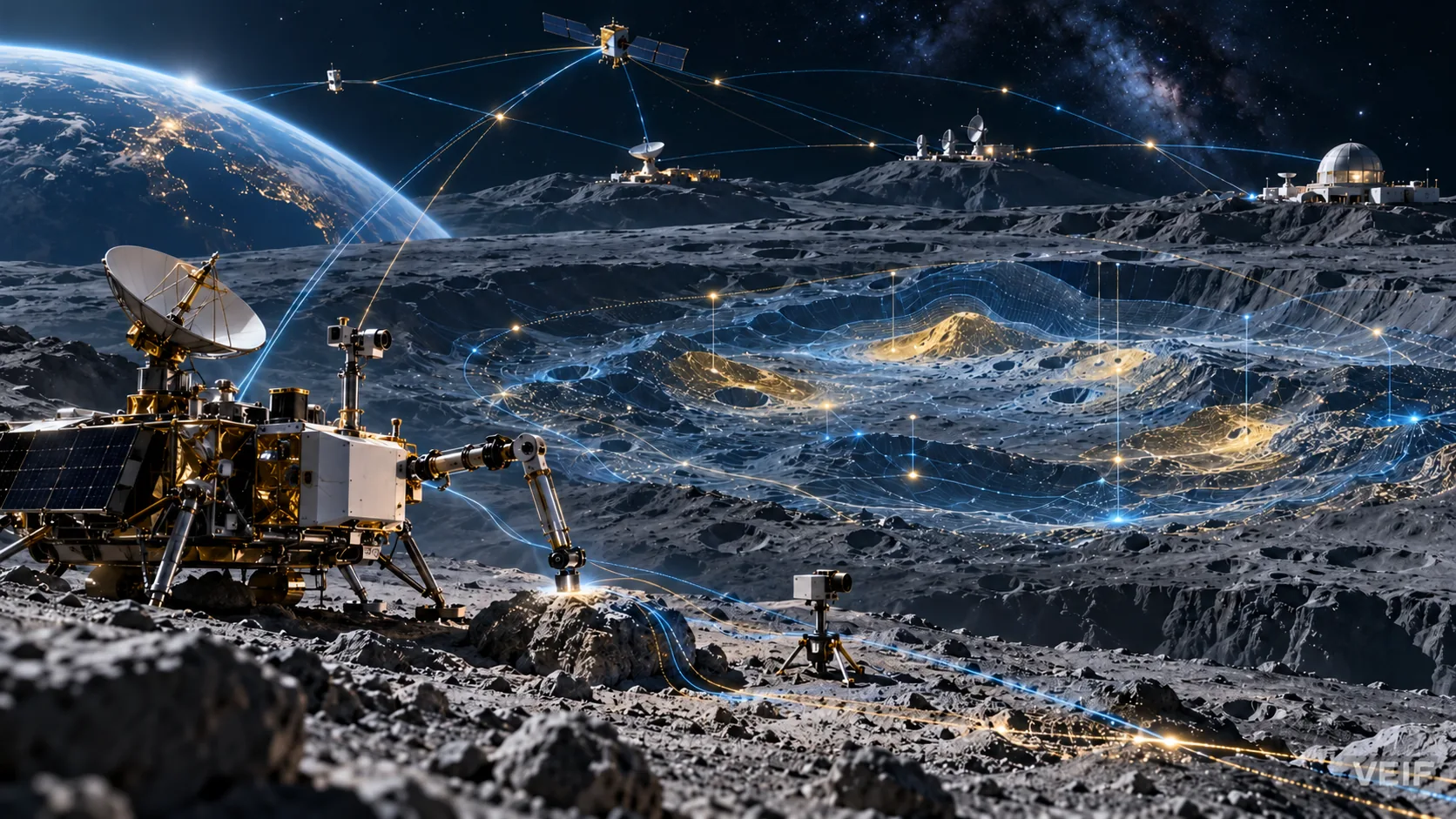
7. The VEIF Research Framework: Testing the Treasure-Map Economy
From the perspective of the Value Evolution Investing Framework (VEIF), the central research question goes beyond whether a future space gold rush will occur. It asks which observable developments would progressively support or undermine the hypothesis of an emerging planetary information economy.
7.1 A Technology Demonstration Is Not a Commercial Market
A successful landing can demonstrate mission capability. A resource anomaly can raise new scientific questions. A commercial license begins to demonstrate willingness to pay for particular information. These are three distinct forms of evidence.
7.2 Key Validation Signals
| Dimension | Early observable signals | Evidence that could undermine the hypothesis |
|---|---|---|
| Genuine demand | Customers pay for regional surveys, site selection, or resource assessments | Long-term dependence on subsidies and research budgets without repeat purchases |
| Data credibility | Multiple-source validation, in-situ checks, explicit errors, and evidence grades | Publicized discoveries repeatedly fail replication or are withdrawn |
| Repeatable revenue | Multiple customers, continuing subscriptions, and follow-on update contracts | Each engagement requires fresh financing for a new mission |
| Information rights | Clearly licensable data, contracts, and compliance pathways | Key data are restricted or fully public, leaving no differentiation |
| Transaction market | Independent buyers and sellers, repeated licensing, or bidding cases | Transactions remain inside closed groups, with no external market |
| Cost curve | Falling acquisition and verification costs per unit of useful data | Mission failures, communications, and transportation costs continue to consume the value created |
| Connection to development | Information changes actual mission sites and capital allocation | Many discoveries lack funded plans for subsequent use |
7.3 Long-Term Trends and Short-Term Investment Narratives
Even if planetary cartography becomes an established professional field, not every related company will earn excess returns. Markets may price in possibilities decades ahead while businesses remain without verifiable commercial orders for extended periods.
VEIF should therefore examine capabilities, demand, contracts, data rights, cash flow, and valuation separately, rather than infer exclusive resource-information potential simply from participation in a lunar project.
For participant origins, vertical integration, and the potential for specialist data providers or platforms, see Part Two.
8. This Market Is Not Yet Established: Necessary Conditions and Practical Boundaries
Turning planetary treasure maps into products requires improvement in at least five conditions:
- Demand: customers with actual budgets must be willing to keep paying for better prospecting and site-selection information.
- Verifiability: the evidence chain from remote-sensing anomalies to resource evaluation must support costly decisions.
- Affordable costs: survey and data-production costs must not persistently exceed reasonable charging capacity.
- Enforceable rights: data acquisition, confidentiality, licensing, transactions, and cross-border delivery need clear rules.
- Sufficient market openness: several relatively independent sellers and buyers must exist, rather than a wholly internalized single-project system.
If any condition remains absent for a prolonged period, activity may remain centered on government contracts and professional technical services, rather than developing into treasure-map auctions or information exchanges.
The most defensible expectation is therefore that the ability to understand, verify, license, and reuse survey outputs across organizations may gradually improve, rather than that off-world deposits are about to be listed for trading. This capability could itself become an important intermediary layer in the space economy.
Conclusion: Wealth Remains Unextracted, but Discoveries Begin to Circulate
Before people can develop an unfamiliar world, they must understand it. Investigation produces data, verification turns data into knowledge, and knowledge may acquire a price when it meets a specific need.
Planetary cartographers turn the first hurdle of future resource development into work that specialized organizations can undertake independently. Where that work produces proprietary, credible, and licensable information, maps may develop beyond public knowledge and mission deliverables into commercial assets.
Information auctions and professional trading hubs are possible organizational forms along this path, rather than its inevitable destination. Whether a market can form depends on whether discoveries change decisions, customers will pay, and society can establish trustworthy rules for information circulation.
Prospectors pursue wealth; planetary cartographers discover opportunities. When those opportunities can be verified and traded, treasure maps can acquire a market of their own.
Planetary Cartographers Trilogy · Reading Index
Industry formation → participants and competition → commercial value. Read the essays independently or in sequence.
- Part One | Planetary Cartographers 1: Mapmakers of the Space Gold Rush: Why the industry may emerge: accumulated technology, uncrewed exploration, and specialization.
- Part Two | Planetary Cartographers 2: Portraits of the Cartographers: Who may participate and compete: technical schools, company capabilities, cooperation, and integration.
- Part Three | Planetary Cartographers 3: Treasure Maps (this article): How value may be captured: joint exploration, information pricing, licensing, and trading.
References
- NASA Science, VIPER: Science and Exploration — https://science.nasa.gov/mission/viper/science-and-exploration/
- USGS, Prospectivity modeling of the NASA VIPER landing site at Mons Mouton near the Lunar South Pole (2025) — https://www.usgs.gov/publications/prospectivity-modeling-nasa-viper-landing-site-mons-mouton-near-lunar-south-pole
- United Nations Office for Outer Space Affairs, Treaty on Principles Governing the Activities of States in the Exploration and Use of Outer Space, including the Moon and Other Celestial Bodies — https://www.unoosa.org/pdf/gadocs/A_6392E.pdf
- The Artemis Accords, especially Sections 8 and 10 — https://www.nasa.gov/artemis-accords/ ; text and discussion: https://www.cambridge.org/core/journals/international-legal-materials/article/artemis-accords/5874DB518591888E52CF2B816E4593F0
Research Statement
This essay presents VEIF's forward-looking analysis of possible industry structures. Conceptual reasoning and existing facts are distinguished in the text. The Planetary Discovery Exchange (PDX) is a hypothetical business model proposed here; it is not represented as an existing organization or an established market. A resource discovery does not establish reserves, demonstrate economic recoverability, or confer rights to off-world resources. This research does not constitute investment, legal, or commercial decision-making advice.
Read this series · Civilizational Frontiers · Planetary Cartographers
- Planetary Cartographers 1: Mapmakers of the Space Gold Rush
- Planetary Cartographers 2: Portraits of the Cartographers
- Planetary Cartographers 3: Treasure Maps