Interstellar Firebringers 1: Odin’s Ravens
From Earthbound Drones to Autonomous Off-World Operations
Insights · The Great Space Age | Interstellar Firebringers · Part 1 This essay explores technological evolution and possible future industries. Demonstrated space engineering and prospective industrial arrangements have different evidential standing.
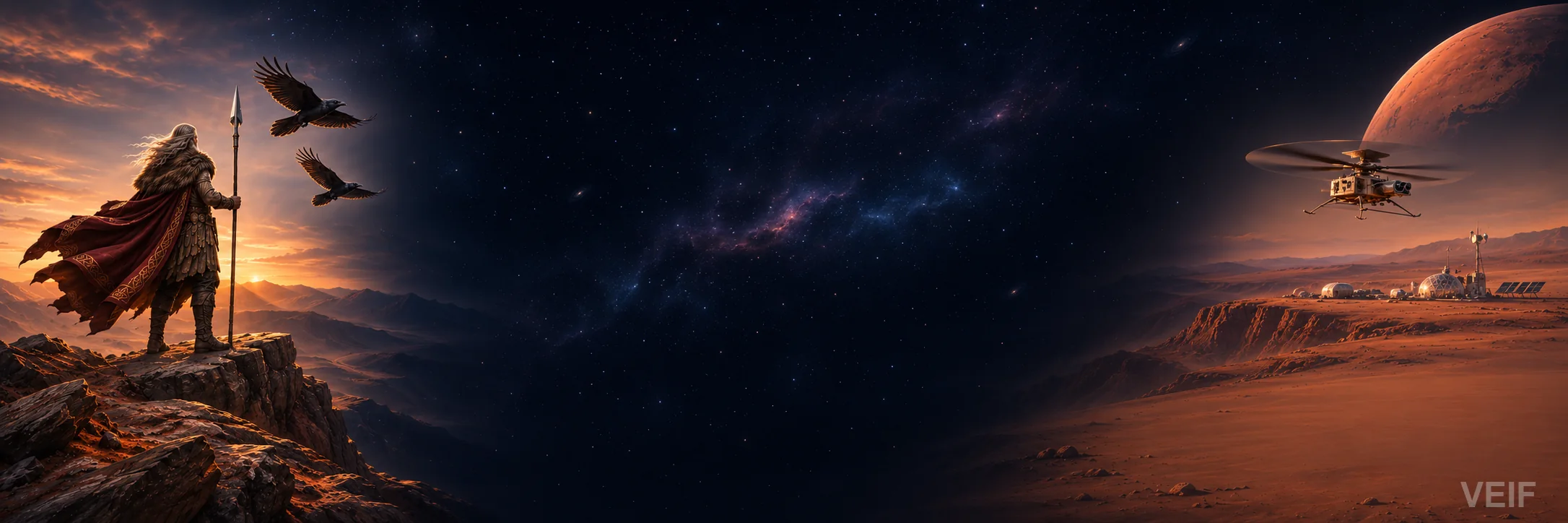
Figure 00 | Ravens Across the Divide. Deep space separates Odin’s ravens from off-world exploration, linking thought and technology across time and distance. Artistic concept.
Introduction: Let Thought and Memory Fly Toward the Stars
In Norse mythology, Odin’s two ravens are Huginn, commonly rendered as Thought, and Muninn, Memory. They fly across the world and return with what they have seen and heard. This essay uses those familiar interpretations to frame its technological discussion.[1]
The ancient image carries a modern question. When the human body cannot reach a distant place, can perception, thought and memory go ahead?
Uncrewed aircraft can now operate beyond their operators’ sight, using sensors and computing systems for increasingly complex tasks. Battlefield demands have accelerated some developments, while industry, surveying, agriculture and rescue have expanded their uses. Their significance may change again when we turn from Earth to the Moon, Mars and more distant bodies.
Machines crossing future canyons may search for geological structures, water ice, mineral deposits and building sites. They may return images, select routes, distribute tasks and gradually assemble knowledge of an unfamiliar world.
Odin’s ravens evoke two capabilities extending beyond Earth. Thought enables machines to act, and memory turns exploration into knowledge that civilization can accumulate.
1. We Need Not Reinvent the Wheel on Every Planet
Terrestrial transport passed through walking, animal power, wheeled vehicles, mechanized transport and aviation. That sequence arose under particular natural and social conditions. It need not prescribe every expansion of civilization.
When humans land on another body, they bring existing materials science, aerospace engineering, robotics, artificial intelligence, communications and energy technologies. Off-world exploration can therefore use flight before building extensive roads.
Ground explorers retain distinctive advantages in carrying instruments steadily, observing nearby surfaces, drilling, sampling and sustained operation. The question is whether mobility above the surface can enter the exploratory toolkit from the outset when terrain is difficult and targets dispersed.
Flight can cross obstacles and survey several areas rapidly on some worlds. Ground travel may remain more economical and reliable on others. Different worlds will develop different transport arrangements.
This exemplifies interplanetary technology diffusion. Capabilities and knowledge can spread without repeating the order in which technologies appeared on Earth.
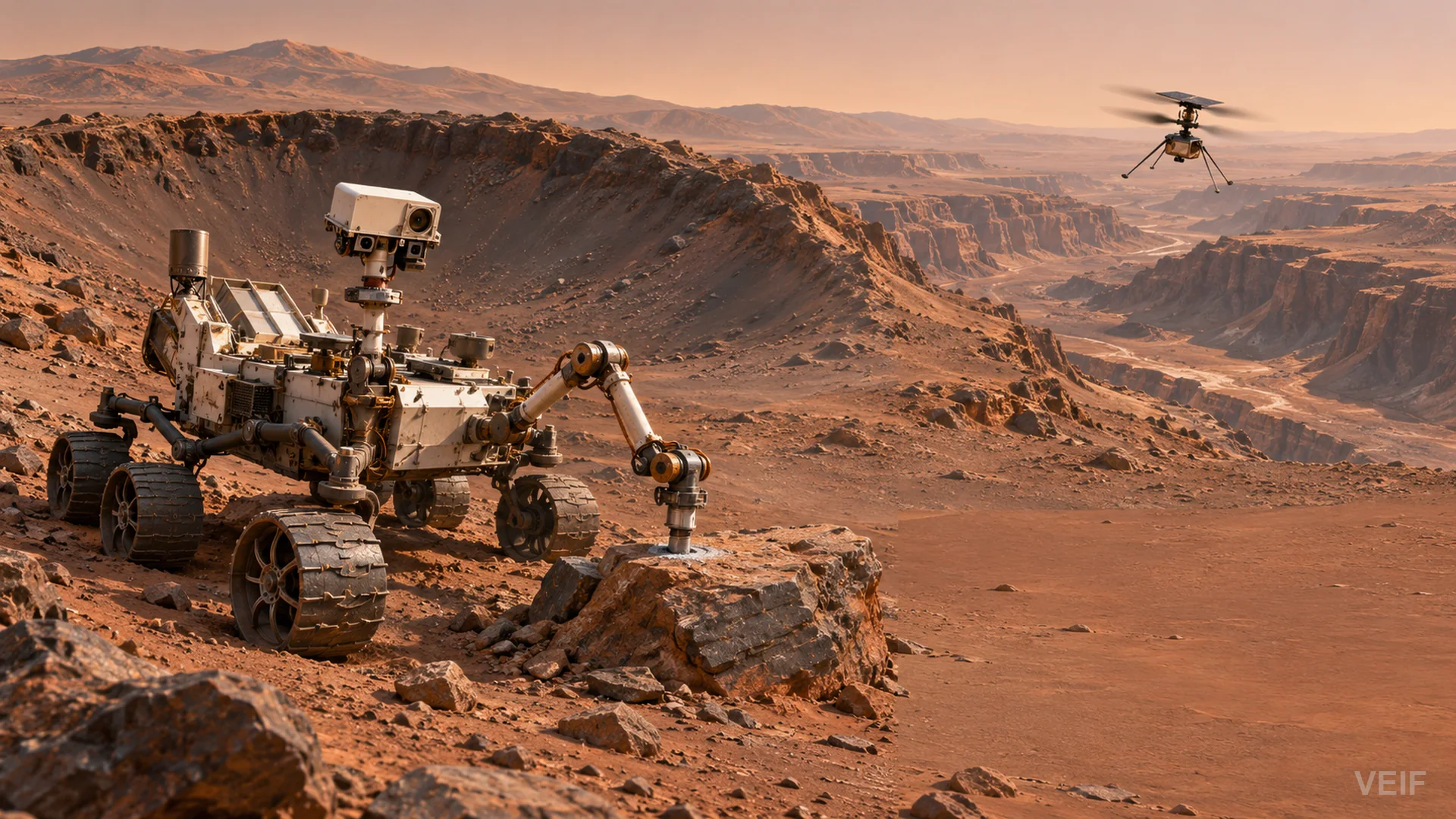
Figure 01 | Beyond the Wheel. Ground sampling and aerial scouting illustrate complementary mobility. Concept illustration.
2. Huginn: Aircraft Acquire “Thought”
Conventional aircraft chiefly answer how to get somewhere. Autonomous aerial agents must also address where to go, what to observe, how to avoid danger and what to do next.
These abilities combine perception, visual localization, path planning, control, scheduling and autonomous fault handling. Some judgments formerly requiring immediate remote intervention can be made locally. This is a functional description of machine capability.
Off-world exploration particularly needs local control. Communication with Mars has substantial one-way delays. An Earth-based operator cannot correct every movement as with a nearby model aircraft. Obstacle avoidance, attitude stability and emergency responses depend heavily on onboard systems.
Flight control, task selection and group scheduling require separate assessment. Ingenuity used onboard navigation and control to execute flights planned and commanded in advance by engineers.[2] Autonomous flight execution has been demonstrated. Deciding whether a geological target merits additional observations, or dynamically allocating surveys among several machines, requires further validation of scientific judgment, resource limits and fault handling.
Cooperating platforms raise further questions. Which surveys first, which checks a finding, which relays communications, and which returns for replenishment when energy runs low?
Huginn represents judgment in action. Exploration machines can gradually become intelligent tools that work independently within defined limits.
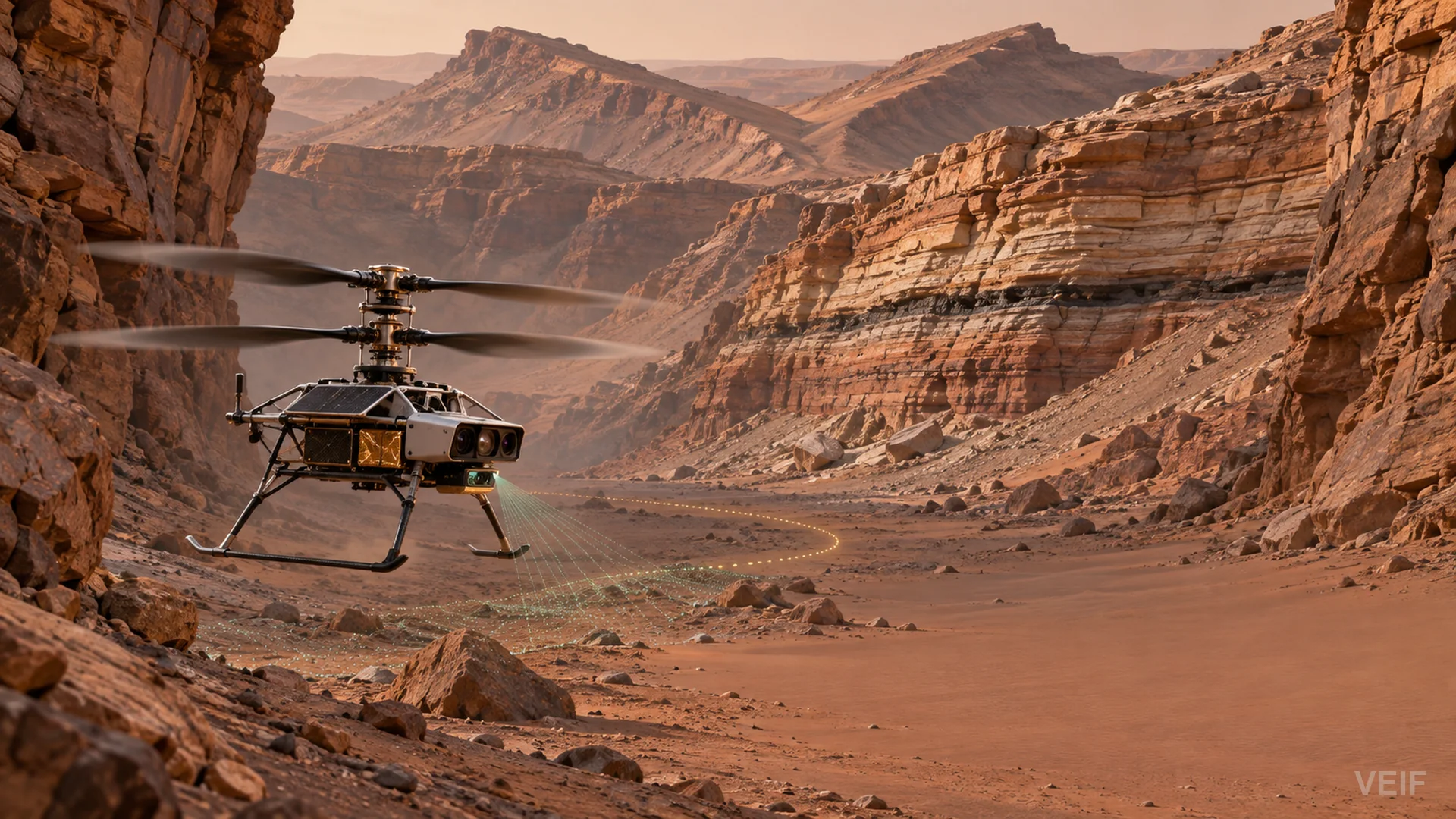
Figure 02 | Huginn: Wings of Thought. A future scout approaches rock layers awaiting verification within mission and energy limits. Hypothetical task, with illustrative sensing lines.
3. Muninn: Turning an Unfamiliar World into Accumulating Knowledge
A video from a flight over an unknown valley is insufficient to establish lasting exploratory capability.
Images need locations, terrain needs models, anomalies need checking, and mineral and environmental clues need links to earlier observations. Each flight should improve maps, risk assessments and targets for the next.
Muninn represents memory, turning observations into knowledge that can be passed on, retrieved, verified and reused.
That memory may take the form of precise terrain maps, three-dimensional models, resource-clue databases, flight-risk maps and long-term environmental records. Future orbiters, aerial scouts and ground robots may jointly maintain an evolving world model.
Such accumulation is a prerequisite for moving from isolated missions to sustained operations. Shared memory allows later explorers to build on earlier work instead of repeatedly starting their investigations.
Imagine a future canyon survey. A scout following its assigned mission detects a possible geological anomaly. Within its return-energy reserve and permitted deviation, it decides to take additional images or leave the target for another mission. Images are stored with coordinates, time, sensor calibration, positioning error and observation conditions. This local judgment corresponds to Huginn.
Ground equipment or later observations then check the anomaly. Investigators may confirm that sampling is worthwhile or find that shadows or measurement error caused the original interpretation. Verification results and original records update the map, preserve uncertainty and inform the next mission. This corresponds to Muninn. Resource clues still require investigation of composition, quantity and extraction conditions. This entire scenario remains a proposed mission process requiring step-by-step validation.
Thought and memory depend on each other. Huginn helps knowledge become action, while Muninn helps action leave a lasting contribution to civilization.
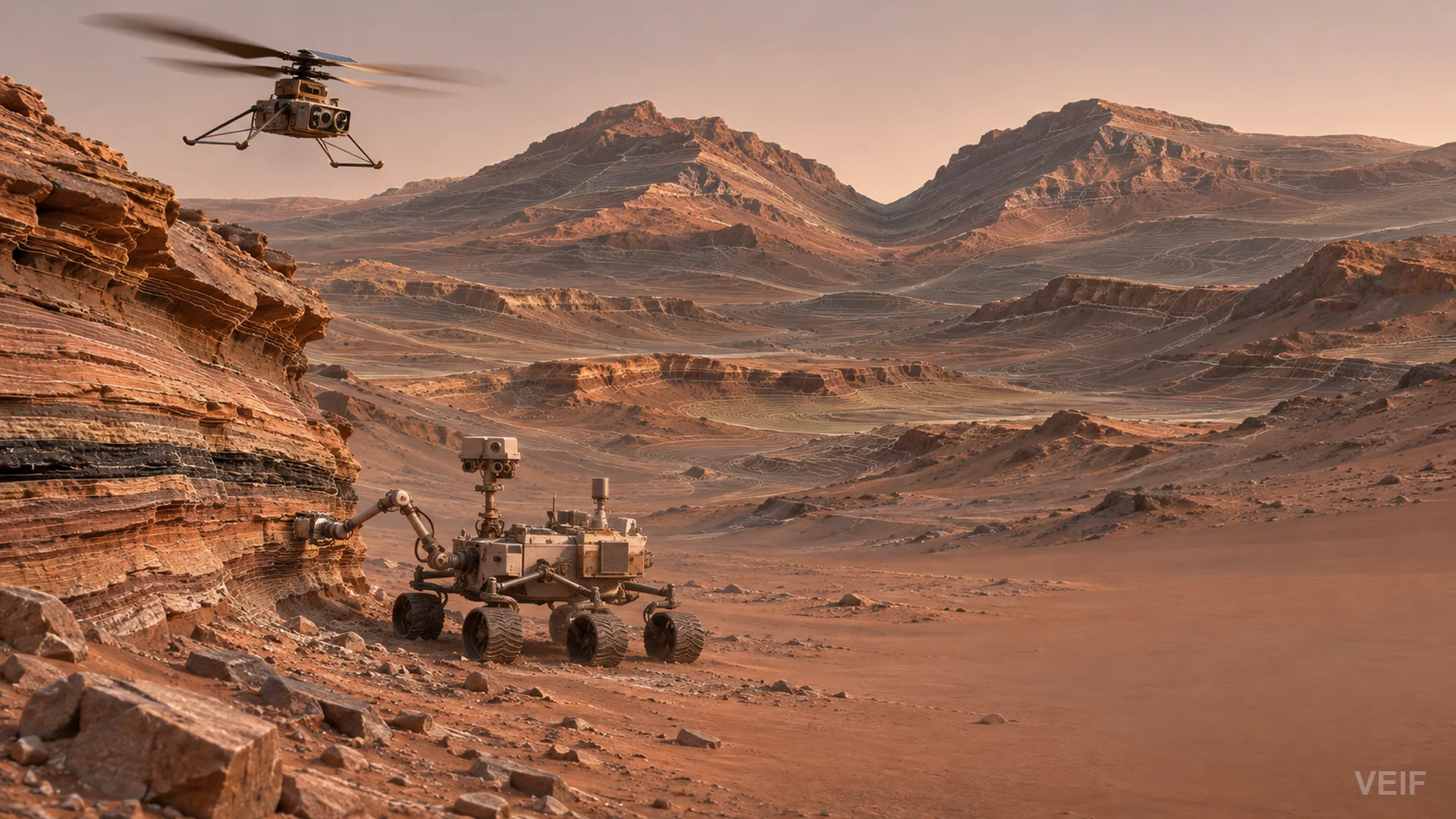
Figure 03 | Muninn: Eyes of Memory. Follow-up ground observations check clues, making terrain records useful to later missions. Hypothetical task, with contours used as an editorial metaphor.
4. The Same Spark Burns Differently on Different Worlds
Sending an Earth drone to another body does not ensure it can fly. Gravity, atmospheric density, temperature, energy and propulsion together determine feasible designs.
Mars: Demonstration in a Thin Atmosphere
Surface gravity on Mars is about 38% of Earth’s,[5] but its atmosphere is extremely thin. Lower gravity reduces lift requirements, while thin air imposes demanding rotor requirements. NASA’s Ingenuity completed 72 flights, demonstrating powered, controlled flight there.[3]
Commercial transport and large-scale operations still require further capabilities. Payload, range, energy, maintenance and reliability remain constraints.
Titan: Different Conditions for Flight
Titan has a dense atmosphere and low gravity. NASA’s Dragonfly is designed to exploit these conditions, flying between scientific sites. The mission illustrates how a shared need for aerial mobility produces different engineering solutions. It remains under development. NASA reported its first simulated flight in October 2026.[4]
The Moon: Mobility Without Aerodynamic Lift
The Moon has virtually no atmosphere, so conventional aerodynamic rotorcraft and fixed-wing aircraft cannot operate normally. Leaving the ground requires approaches such as rocket propulsion or ballistic hopping, potentially with high propellant and reuse costs.
“Extraterrestrial low-altitude operations” here denotes mobility and work in the near-surface layer of a celestial body. The concept encompasses different approaches. Mars rotorcraft and lunar propelled hopping require separate calculations of energy, propellant, payload and maintenance.
These differences reveal a principle of diffusion. Earth supplies scientific principles, control methods and engineering experience, while new environments select technological forms anew.
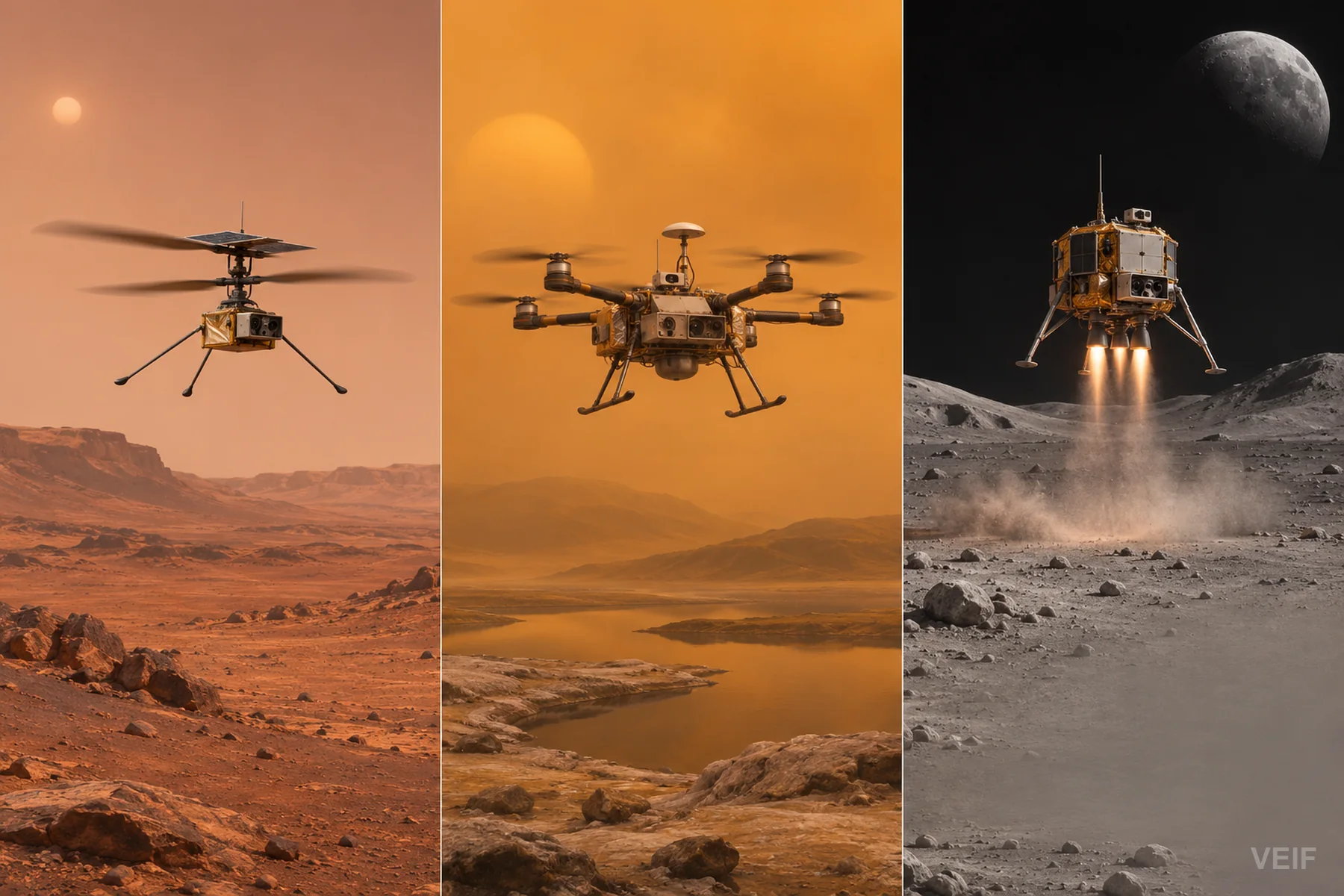
Figure 04 | Three Worlds, Three Forms of Mobility. Left: illustrative Martian rotorcraft scouting. Center: a planned Titan mission concept. Right: a lunar rocket-hopping concept. The environments are presented independently.
5. From Battlefield Capabilities to Civilizational Envoys
Sensing, navigation and coordination in uncrewed systems serve aerospace, industrial, scientific and military demands. Geological anomaly recognition needs machine vision, canyon travel needs navigation, and distributed exploration needs task allocation. Relevant terrestrial knowledge can support these tasks, but each transfer requires fresh validation.
Space missions impose radiation, temperature, mass, energy and long-term reliability requirements that may demand redesign from materials to system architecture.
The underlying transferable knowledge includes perception, computing, control, manufacturing and experience coordinating many machines.
Odin’s ravens may thus acquire a further mission as advance scouts of civilization investigating unfamiliar worlds.
6. From Flight Capability to an Extraterrestrial Low-Altitude Economy
A successful flight demonstrates technical feasibility. An economic arrangement requires sustained demand, repeatable services and affordable total costs.
One starting point is the life-cycle cost of completing an effective survey. The survey must meet specified coverage, positioning accuracy and verification requirements. Costs include transport and deployment, energy replenishment, maintenance, equipment-loss risk, data verification and subsequent replacement transport.
Aircraft must be compared with ground robots and orbital observations against the same objectives. Crossing steep terrain may save time but consumes limited flight energy. Orbital instruments cover large areas, while local investigation may require closer instruments. Mission deadlines, data quality and follow-up verification costs determine the appropriate combination.
Activity may extend from scientific exploration to repeated mapping, prospecting, inspection and communication relay. As demand grows, platforms, ground equipment and replenishment nodes may share tasks and data. Independent services depend on stable demand from several users, compatible interfaces and whether purchasing services reduces users’ costs compared with internal operation. Operators must also bear idle-capacity, failure and replacement risks.
These developments depend on demand and costs. Early off-world activity is limited, with expensive transport, maintenance, replenishment and replacement. Research institutions or major developers may keep operations in-house for a long time.
An extraterrestrial low-altitude economy is therefore a prospective form of productive organization, using near-surface mobility to support exploration, resource development and facility operation on a continuing basis.
Its value may lie in data, task execution, environmental knowledge and coordinated operations as well as aircraft sales.
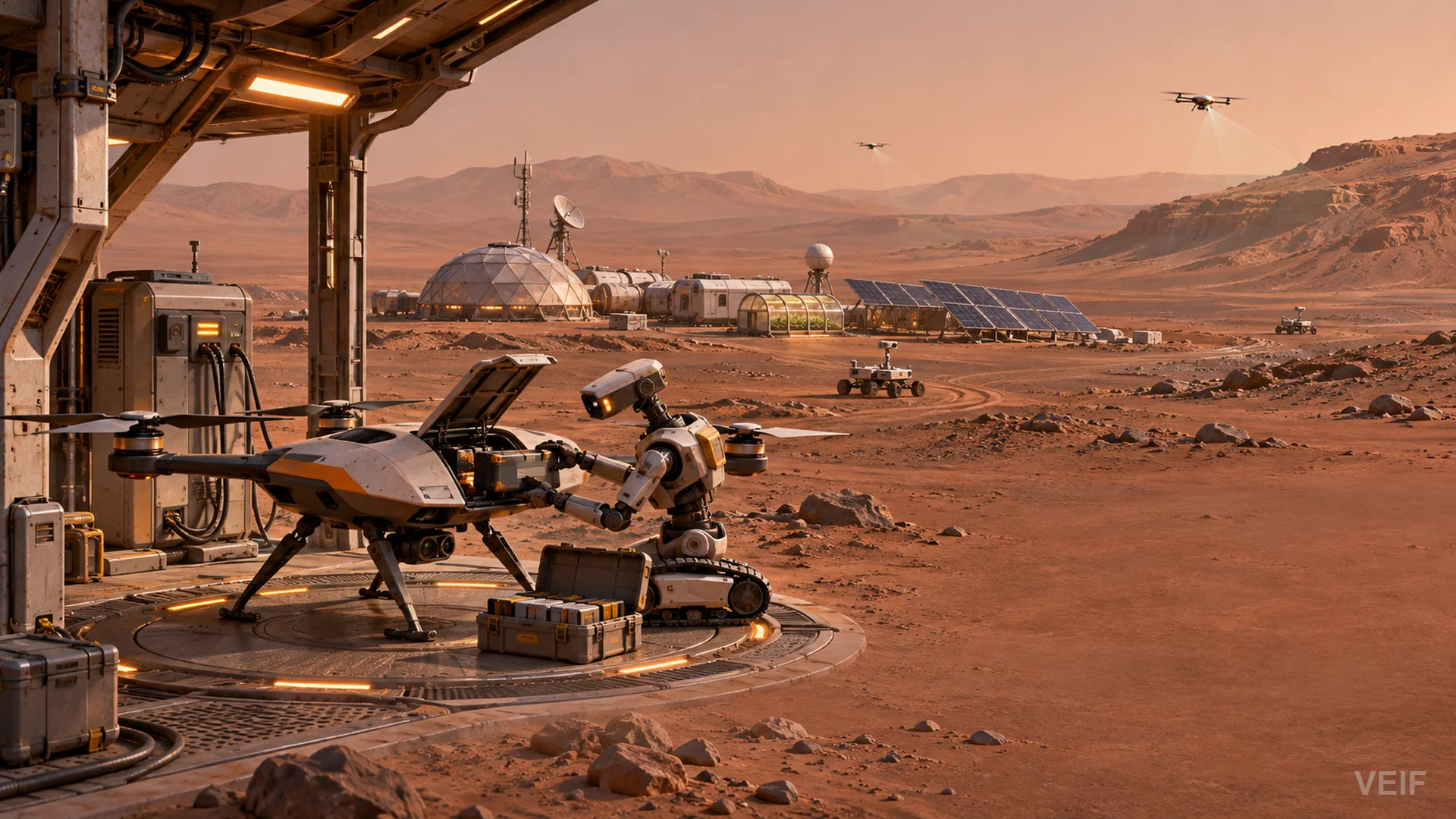
Figure 05 | The Cost of Continuing Operations. Inspection, spare parts and energy replenishment support repeated work. Future engineering and economic scenario.
7. Carrying the Spark: Reciprocal Technology Diffusion
Firebringers carry Earth’s technological spark to new worlds, where it may burn differently.
Mars’s thin air, Titan’s cold and the Moon’s near-vacuum force engineers to reconsider flight implementation. Advances in materials, control, energy management and reliability arising from adaptation may also benefit extreme-environment operations on Earth.
Technological evolution may form a cycle.
Terrestrial technological accumulation → off-world capability deployment → new environmental problems → technological redesign and breakthroughs → diffusion back to Earth and onward to other worlds.
This is also a central proposition of the overview essay on interplanetary technology diffusion. Off-world environments may become sources of innovation.
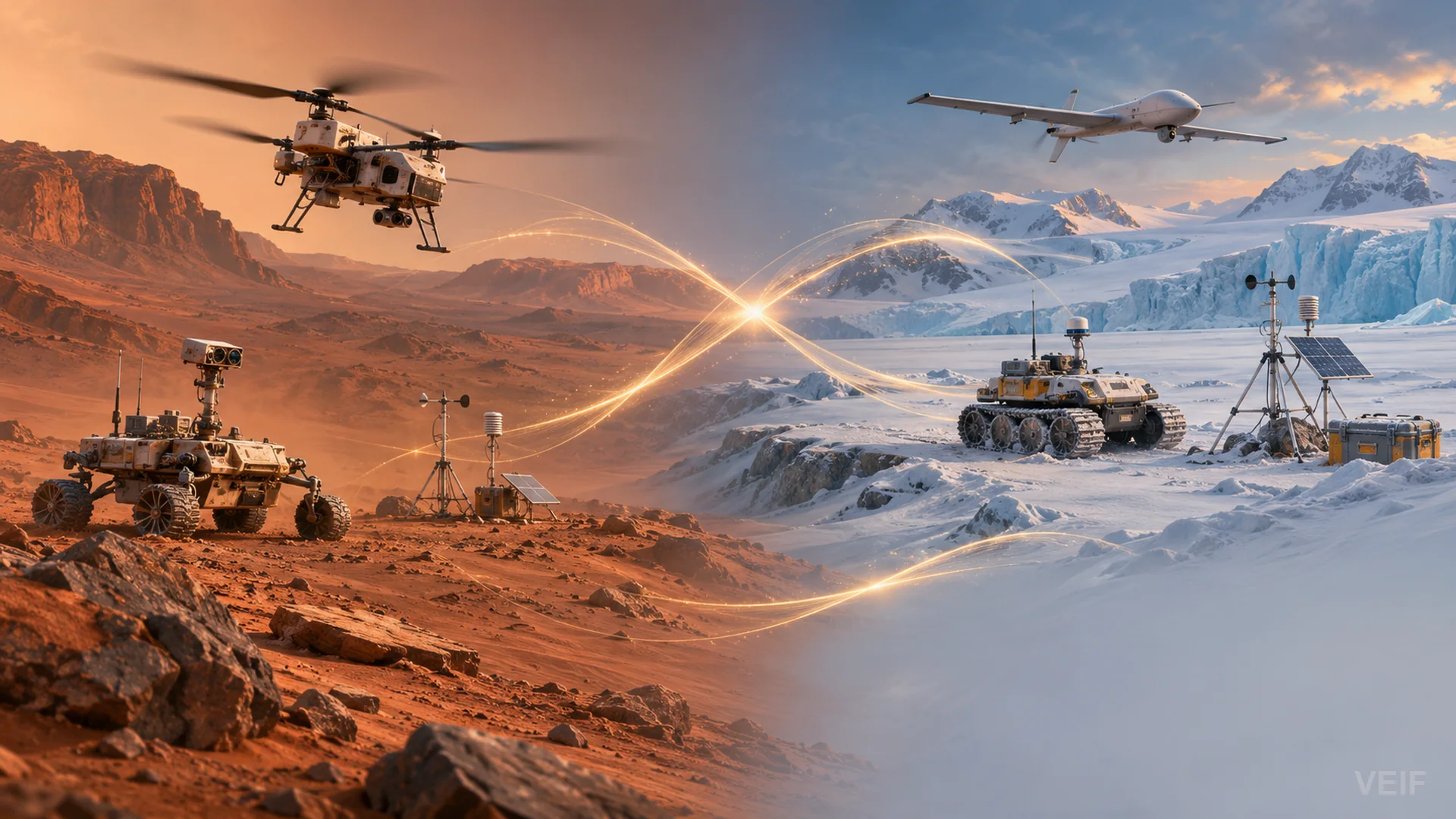
Figure 06 | The Returning Spark. Off-world research and terrestrial extreme-environment operations may exchange advances. Reciprocal feedback is speculative, and light traces symbolize knowledge transfer.
8. Civilizational Frontiers Extend Beyond Human Footsteps
Space transport addresses arrival. Off-world mobility and autonomous operations address understanding and using a place after arrival.
Humans need not physically visit every canyon, crater or ice field for preliminary mapping and exploration. Aerial agents, orbital systems and ground robots can extend perception and action ahead of human bodies.
What expands is the space within which humanity can sustain understanding, verification and organized action, alongside the operating range of machines.
The extent of civilization’s frontier depends on where people can reach and how far thought and memory can extend.
Conclusion: When the Ravens Return
Prometheus brought fire to humanity. Odin’s ravens carried thought and memory into the distance.
These images may meet in an age of interstellar firebringers. Humanity enters unfamiliar worlds with accumulated technology and sends machines capable of perception, judgment and knowledge accumulation ahead to explore.
The ravens’ return matters when later explorers can use their results. A discovery needs coordinates, a judgment needs evidence, and failure deserves a traceable record. Unknown areas and error margins matter alongside confirmed terrain. When successors can verify, revise and continue an investigation, machine activity begins to become a capability civilization can accumulate.
Perhaps machines will one day cross unfamiliar mountains and valleys, discover resources, map terrain and prepare the way for successors. They will return photographs and coordinates together with the record of a world gradually becoming understood.
Humanity gives machines the ability to fly, and the stars will give that ability new meaning.
References
These sources support mythological origins and specific engineering facts. Autonomous scientific decisions, cooperative networks and economic arrangements are the essay’s extrapolations. Sources checked in November 2026.
- Grímnismál, stanza 20 and historical translations. Textual context for the ravens.
- NASA/JPL, Ingenuity Landing Press Kit. Planned flight paths and onboard control.
- NASA, The Legacy of Ingenuity. 72 flights and aerial scouting.
- NASA, Dragonfly Completes First Simulated Flight, 2026. Development and simulated flight.
- NASA, Mars Facts. Martian environmental parameters.
Research Boundaries
- Demonstrated facts. Powered flight by Ingenuity on Mars, the influence of Martian and Titan environments on aircraft design, and the need for some autonomous control under long communication delays.
- Technical scenarios. Cooperative off-world fleets, autonomous operational networks, long-term environmental knowledge bases and routine flight services.
- Economic hypothesis. An extraterrestrial low-altitude economy may emerge as sustained demand, reuse, energy and maintenance conditions become viable. Its scale, business models and timing remain uncertain.
Read this series · Technology Diffusion · Interstellar Firebringers
- Interstellar Firebringers 1: Odin’s Ravens