The Seven Swords of Quantum Computing: All Roads Lead to Rome
Principles, Trade-offs and Engineering Difficulty Across Seven Technology Paths
Value Evolution Investing Framework · Vision · Quantum Computing Primer

A quantum computer is not a finished machine that merely needs to be manufactured at a larger scale. Humanity has not even settled on what a large-scale quantum computer should use as its qubit.
Superconducting circuits turn engineered electrical devices into “artificial atoms.” Trapped-ion systems suspend charged atoms in electromagnetic fields. Neutral-atom platforms arrange atoms with optical tweezers. Photonic systems carry information in individual particles of light. Silicon-spin approaches try to place qubits inside semiconductor structures resembling transistors. Topological proposals seek protection at the physical layer. Quantum annealing chooses a more specialized model of computation.
All seven draw on quantum mechanics, yet they face very different problems in fabrication, control, error correction and scaling. To understand the quantum-computing industry, the first question is not “Who has the most qubits?” It is:
What stores quantum information on each path, how is that information manipulated, and what becomes difficult as the system grows?
This article introduces seven major technology paths for a general audience and compares them across controllability, fidelity, connectivity, speed, fabrication, error correction and scalability.
The “seven swords” are a metaphor for competing technological approaches. “Rome” means reliable, scalable quantum capability that creates real-world value. The metaphor does not imply that all seven will converge on one universal machine. Different platforms may serve quantum simulation, gate-model computation, quantum networking and specialized optimization. Quantum annealing, in particular, is a computational model rather than simply another physical implementation of a gate-model qubit.
I. What Quantum Computing Actually Changes
1. From Bits to Qubits
A classical bit can be either 0 or 1 at a given moment. A qubit can occupy a superposition of two basis states:
The amplitudes \alpha and \beta do not mean that two readable answers are simultaneously available. They are probability amplitudes before measurement; measurement still produces a classical result. Quantum algorithms gain power by controlling amplitudes through superposition, entanglement and interference—suppressing unwanted computational paths while amplifying structure associated with useful answers. NIST offers an accessible explanation of superposition, entanglement and measurement.[^1]
The familiar claim that a quantum computer “calculates all answers at once” is therefore misleading. It cannot read out exponentially many answers in one step, nor does it automatically accelerate every program.
2. A Qubit Is Not One Fixed Device
A qubit is a unit of information, not a particular component. Any physical system that offers two distinguishable quantum states and can be initialized, manipulated, coupled and measured may serve as a qubit.
There is a historical parallel in classical computing: bits have been represented by relays, vacuum tubes and transistors. Today’s competition among quantum platforms is, at heart, a search for the physical carrier best suited to large-scale computation.
3. Noise Is the Central Adversary
The same sensitivity that gives quantum states their unusual computational properties also makes them fragile. Temperature changes, electromagnetic noise, material defects, laser drift, atom loss and readout errors can all destroy quantum information. This loss of useful quantum behaviour is commonly described as decoherence.
Most current devices remain within what John Preskill called the NISQ era: noisy intermediate-scale quantum systems. They are valuable for experiments, simulation and algorithm research, but they cannot yet run long, general-purpose algorithms reliably.[^2]
4. Physical Qubits Are Not Logical Qubits
A useful machine must encode one more reliable logical qubit across multiple error-prone physical qubits. Quantum error correction cannot simply copy an unknown quantum state as a classical computer copies data. Instead, auxiliary qubits repeatedly measure error syndromes, revealing where errors occurred without directly reading the protected logical information.
Raw physical-qubit count is therefore not enough. More important questions include:
- Is the physical error rate below an error-correction threshold?
- Does logical error fall as the code is enlarged?
- How many physical qubits and operations are required per logical qubit?
- Can decoding and feedback operate in real time?
- Can logical gates run circuits of sufficient depth?
Google Quantum AI has demonstrated below-threshold surface-code behaviour in a superconducting experiment: the logical error rate fell as the code size increased. That result does not complete a fault-tolerant computer, but it moves quantum error correction from proof of principle toward scaling experiments.[^3]
II. How Should Quantum Technology Paths Be Compared?
No single metric determines the quality of an entire platform. At least eight dimensions matter:
| Dimension | Question it answers |
|---|---|
| Physical carrier | Where are 0 and 1 encoded? |
| Coherence and fidelity | How long is information preserved, and how often does an operation fail? |
| Gate speed | How long do single- and two-qubit operations take? |
| Connectivity | Can arbitrary qubits interact directly, or only neighbouring ones? |
| Initialization and readout | Can states be prepared and measured quickly and accurately? |
| Fabrication uniformity | Can many qubits be manufactured with similar parameters? |
| Control system | Can lasers, microwaves, wiring, cryogenics and classical electronics scale with the qubit array? |
| Error-correction overhead | How many physical resources and operations are required for reliable logical computation? |
These dimensions often trade off against one another:
- Fast gates do not guarantee high fidelity.
- Long coherence does not necessarily produce more useful operations per second.
- A large qubit count does not guarantee deep executable circuits.
- All-to-all connectivity helps algorithms but may complicate control.
- Semiconductor compatibility may help fabrication without solving cryogenic control and readout.
For that reason, raw “qubit count,” “algorithmic qubits,” Quantum Volume and platform-specific benchmarks from different companies should not be placed on one undifferentiated leaderboard.
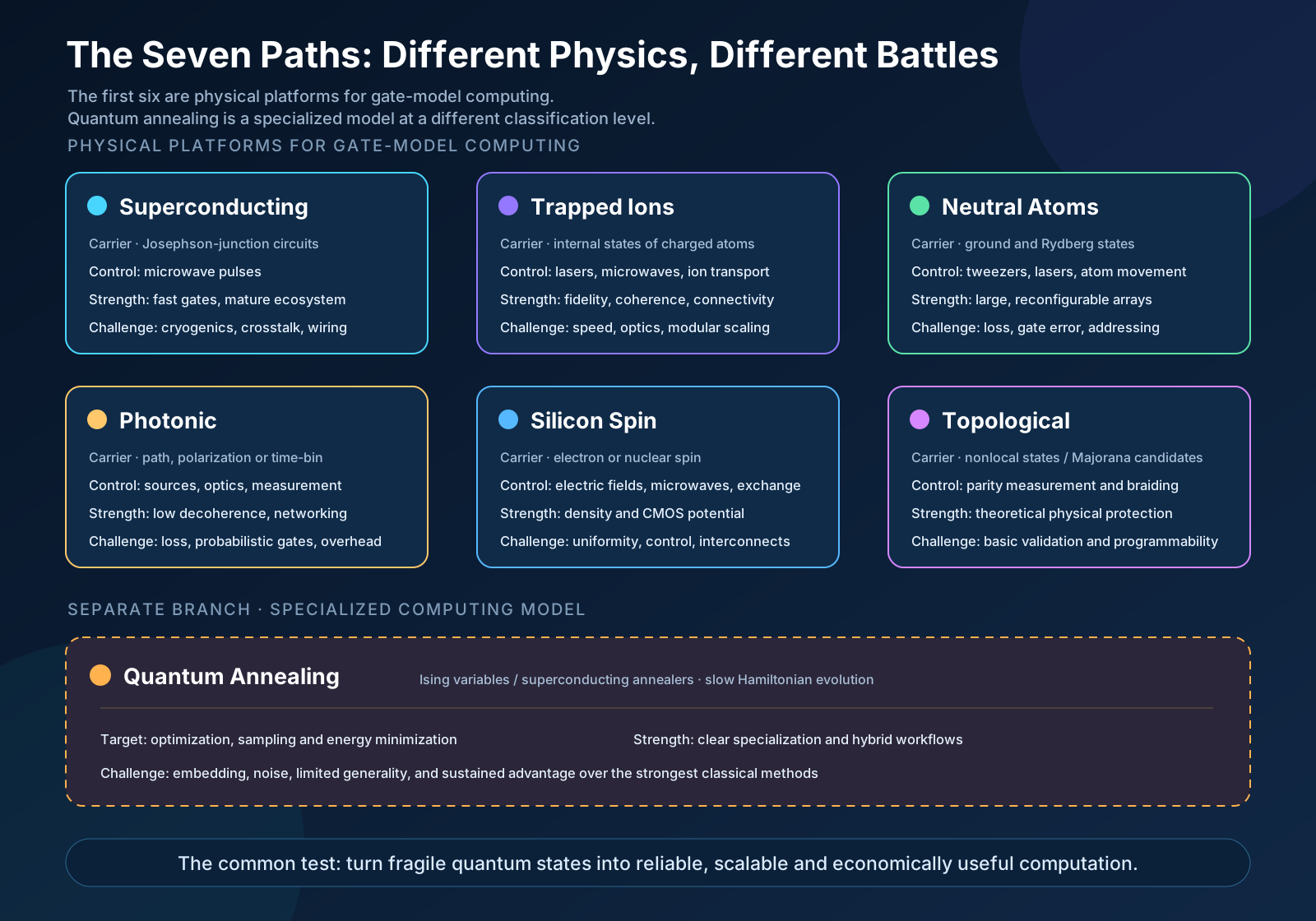
Figure 1. The first six paths mainly answer, “Which physical system should implement a gate-model quantum computer?” Quantum annealing answers, “How can a quantum system perform a specialized class of optimization calculations?” They do not occupy exactly the same taxonomic level.
III. Seven Major Technology Paths
1. Superconducting Qubits: Engineering Circuits into “Artificial Atoms”
Basic principle
Superconducting qubits generally use Josephson junctions together with capacitive and inductive elements to create a nonlinear quantum circuit. At extremely low temperature, selected energy levels represent |0\rangle and |1\rangle. Microwave pulses manipulate the state, while resonators support coupling and readout.
The platform does not place a natural atom on a chip. It engineers an “artificial atom” whose parameters can be designed.
Principal strengths
- Fast gates: operations are typically faster than those in trapped-ion and neutral-atom systems, allowing many gates within a finite coherence window.
- Established microfabrication: the platform can borrow methods from semiconductor lithography and chip production.
- Mature control ecosystem: microwave electronics, calibration, compilers and cloud access are relatively advanced.
- Leading error-correction experiments: below-threshold surface-code results are among the field’s most important engineering milestones.[^3]
Researchers are also testing industrial CMOS-style manufacturing to improve device uniformity and wafer-scale production.[^4]
Central difficulties
- Deep cryogenics: chips generally operate at millikelvin temperatures close to absolute zero.
- Device variation: each engineered qubit may have a different frequency and noise profile, requiring continuing calibration.
- Wiring and cooling load: control lines, readout lines and heat loads grow rapidly with scale.
- Crosstalk and frequency crowding: simultaneous operations can interfere with one another.
- Large correction overhead: maturity does not make fault tolerance easy; reliable logical computation remains a full-system engineering problem.
Position of the path
Superconducting technology is one of the leading gate-model approaches. It “runs fast and has a mature ecosystem,” but must control a very large number of imperfect engineered devices at millikelvin temperatures.
2. Trapped Ions: Using Highly Uniform Natural Atoms as Qubits
Basic principle
Trapped-ion systems suspend charged atoms with electromagnetic fields and typically encode qubits in two internal atomic energy levels. Lasers or microwaves initialize and control the ions; shared motional modes create entanglement among them.
Unlike fabricated superconducting circuits, atoms of the same isotope are naturally identical, giving ion qubits excellent intrinsic uniformity.
Principal strengths
- High fidelity: single-qubit gates, two-qubit gates and measurements can achieve very high accuracy.
- Long coherence: internal atomic states are relatively isolated from the environment.
- Strong connectivity: qubits in an ion chain can approach all-to-all interaction.
- High logical quality: good physical operations may reduce some correction overhead.
A 2026 Nature paper reported Helios, a 98-qubit trapped-ion QCCD processor combining high-fidelity gates with scalable ion transport.[^5]
Central difficulties
- Slower gates: entangling operations rely on ionic motion and are generally slower than superconducting microwave gates.
- Complex optics: many laser beams must remain aligned, modulated and calibrated.
- Long-chain scaling: motional spectra become crowded as ion chains grow.
- Transport and modular links: QCCD architectures must move ions between zones or connect modules photonically.
- Throughput: high precision creates industrial capability only when paired with sufficient speed and parallelism.
Position of the path
Trapped ions offer exceptionally high-quality qubits. Their central challenge is scaling that quality into machines that are large, fast and parallel enough.
3. Neutral Atoms: Reconfigurable Arrays Built with Optical Tweezers
Basic principle
Neutral-atom systems use optical tweezers to trap and arrange individual atoms. Information is typically stored in ground or hyperfine states. For two-qubit gates, atoms are excited into strongly interacting Rydberg states; Rydberg blockade creates entanglement.
Atoms can be rearranged during computation, making connectivity less rigid than in a fixed chip.
Principal strengths
- Intrinsic atomic uniformity: fabrication differences between qubits are reduced.
- Large-array potential: optical-tweezer arrays can hold many atoms.
- Reconfigurable topology: moving atoms changes their interaction graph.
- Compatibility with digital computation and quantum simulation: the same platform can support gate operations and many-body physics.
A 2024 logical processor based on reconfigurable atom arrays used up to 280 physical qubits to demonstrate encoded logical qubits and programmable logical algorithms.[^6] Later work explored repeated error correction and universal fault-tolerant architecture in arrays containing up to 448 atoms.[^7]
Central difficulties
- Atom loss: trapped atoms may leave the array during operation.
- Rydberg-gate error: laser noise, spontaneous emission and atomic motion reduce fidelity.
- Parallel addressing: large arrays require simultaneous, independent and accurate control.
- Movement and scheduling overhead: reconfiguration improves connectivity but complicates compilation and timing.
- A younger gate-model stack: digital control and full error-correction experience are less mature than in superconducting or trapped-ion systems.
Position of the path
Neutral atoms are among the fastest-advancing platforms, combining large arrays with dynamic connectivity. Their test is whether “many atoms” can become “many reliable logical operations.”
4. Photonic Quantum Computing: Transmitting Information with Light, Organizing Computation with Measurement
Basic principle
Photonic qubits may be encoded in path, polarization, time bin or other optical degrees of freedom. Photons interact weakly with the environment, making them excellent carriers of quantum information. The same weak interaction, however, makes deterministic two-qubit gates difficult.
Many photonic proposals therefore use measurement-driven or fusion-based architectures: small entangled resource states are created first, then connected into a larger computational structure through linear optics and entangling measurements.[^8]
Principal strengths
- Low decoherence in transmission: photons are well suited to moving quantum information over distance.
- Natural networking: computation, communication and modular interconnects can use related technologies.
- No requirement for the entire system to sit at millikelvin temperature: some sources and detectors may still require cooling.
- Integrated-photonics potential: silicon photonics and semiconductor processing may enable complex optical circuits.
A 2025 study presented a photonic quantum-computing platform using integrated silicon-photonic components with manufacturability in mind. A large systems gap nevertheless remains between manufacturable components and a fault-tolerant machine.[^9]
Central difficulties
- Photon loss: when a photon disappears, its quantum information is usually lost with it.
- High-quality single-photon sources: photons must be generated on demand and be mutually indistinguishable.
- Probabilistic entangling operations: multiplexing, resource states and rapid switching are required.
- Detection and feed-forward: efficient detectors must work with fast classical control.
- Resource overhead: fault-tolerant architectures may require enormous numbers of photons, optical paths and multiplexing components.
Position of the path
Photonics fits a long-term vision in which computation and networking are deeply integrated. It reduces some matter-qubit coherence problems but transfers difficulty to sources, loss, detection and resource organization.
5. Silicon-Spin Qubits: Bringing Quantum Computation into Semiconductor Manufacturing
Basic principle
Silicon-spin approaches encode information in the orientation of an electron or nuclear spin. Electrons are confined in silicon quantum dots or near donor atoms; microwaves, electric fields, exchange interactions or spin transport provide control and coupling.
The devices resemble transistors, which raises the possibility of leveraging the CMOS manufacturing base.
Principal strengths
- Small footprint: a quantum dot is far smaller than many superconducting qubits.
- Strong coherence potential: isotopically purified silicon reduces nuclear-spin noise.
- CMOS compatibility: 300 mm wafer fabrication, yield control and semiconductor packaging may eventually help scale production.
- High-density integration: many devices could fit within a relatively small chip area.
A 2025 study demonstrated silicon two-qubit unit cells fabricated and controlled using standard semiconductor equipment on a 300 mm production line, moving industrial compatibility from an idea toward device validation.[^10]
Central difficulties
- Device variation: quantum dots are extremely sensitive to nanometre-scale interfaces, impurities and charge noise.
- Cryogenic electronics: thousands or millions of control gates cannot simply be wired to room-temperature instruments.
- Local connectivity: tight packing helps density, but long-distance quantum links require new structures.
- Initialization and readout: high-accuracy spin or charge measurement is essential.
- Quantum CMOS is not ordinary CMOS: conventional transistor processing cannot be reused unchanged; interfaces and materials require quantum-specific optimization.[^11]
Position of the path
The attraction is conditional: if qubits can be manufactured in a transistor-like system, the semiconductor industry may help solve scaling. Uniformity, cryogenic control and interconnects are not automatically solved by a familiar device shape.
6. Topological Qubits: Trying to Reduce Error at the Physical Layer
Basic principle
Ordinary qubits store information in local physical states, making them directly vulnerable to local noise. Topological quantum computation seeks to encode information nonlocally in the collective topology of several quasiparticles. In theory, local disturbances that do not change the global topology should leave the encoded information intact.
Majorana zero modes are a leading candidate. If such modes can be created, exchanged and measured reliably—and shown to possess the required non-Abelian statistics—braiding operations could perform quantum gates that are intrinsically less sensitive to some noise. The appeal is the possibility of reducing error-correction overhead at the device layer.[^12]
Principal strengths
- Theoretical intrinsic fault protection: some local errors would not directly destroy the nonlocal encoding.
- Potentially lower correction overhead: strong physical protection could reduce the resources required per logical qubit.
- Solid-state integration potential: the platform may combine superconducting, semiconductor and nanowire technologies.
Central difficulties
- Basic physics remains under validation: the target topological phase and Majorana modes must first be demonstrated unambiguously.
- An observation is not a programmable qubit: parity measurements are important prerequisites, but do not by themselves constitute a braidable, programmable topological qubit.[^13]
- Demanding materials and devices: superconductors, semiconductors, magnetic fields and interfaces must all satisfy stringent conditions.
- Immature control and readout: even a working protection mechanism still requires gates, measurement, scaling and systems integration.
- The longest validation chain: this route may offer the greatest correction benefit, but it carries the deepest foundational uncertainty.
Position of the path
Topological quantum computing is not a more mature form of qubit. It is a high-upside, long-validation technological option. Its advantages begin in theory; its engineering value depends on key physics being independently and repeatedly verified.
7. Quantum Annealing: Searching for Valleys in an Energy Landscape
Basic principle
Quantum annealing is not at exactly the same classification level as the first six paths. Those paths mainly ask which physical system should implement a qubit. Quantum annealing is closer to a specialized computational model.
An optimization problem is mapped to an Ising model or QUBO, with good answers corresponding to low-energy states. The machine begins with an easy-to-prepare Hamiltonian and gradually evolves toward the problem Hamiltonian, using quantum fluctuations and tunnelling in an attempt to reach a low-energy solution. The relationship between adiabatic quantum computation and quantum annealing is reviewed by Albash and Lidar.[^14]
Principal strengths
- Clear specialization: directly targets combinatorial optimization, sampling and energy minimization.
- Large specialized systems can be built earlier: the hardware need not immediately support every operation of universal gate-model computing.
- Hybrid compatibility: annealers can be combined with classical heuristics.
Central difficulties
- Not a direct replacement for universal gate-model computing: applicable problems are constrained by the model and hardware graph.
- Embedding overhead: real-world problems must be mapped onto a limited-connectivity Ising graph.
- Small gaps, heat and noise: these effects can drive the machine away from ideal adiabatic evolution.
- Hard-to-prove advantage: comparisons must use the strongest classical algorithms and problem-specific heuristics.
- Approximate is not optimal: reaching a low-energy state does not guarantee the global optimum.
Position of the path
Quantum annealing may remain a specialized accelerator for selected optimization and sampling tasks. Accessible machines already exist, but commercial significance must be demonstrated through solution quality, end-to-end time and total cost—not raw qubit count.
IV. The Seven Paths Side by Side
1. Core characteristics
| Path | Information carrier | Typical control | Outstanding strength | Largest engineering challenge | Current position |
|---|---|---|---|---|---|
| Superconducting | Energy levels of Josephson-junction nonlinear circuits | Microwave pulses | Fast gates, mature ecosystem, leading QEC experiments | Deep cryogenics, crosstalk, wiring and uniformity | Leading gate-model path |
| Trapped ions | Internal levels of charged atoms | Lasers/microwaves and ion transport | High fidelity, long coherence, strong connectivity | Gate speed, optical complexity and modular scaling | High-quality gate-model path |
| Neutral atoms | Ground and Rydberg states | Optical tweezers, lasers and atom movement | Large arrays, uniform atoms, reconfigurable topology | Atom loss, gate error and parallel addressing | Rapidly advancing gate-model/simulation path |
| Photonic | Path, polarization or time-bin states of light | Sources, interference, measurement and feed-forward | Low decoherence, networking and integrated-photonics potential | Photon loss, probabilistic operations and resource overhead | Modular fault-tolerance and networking path |
| Silicon spin | Electron or nuclear spin | Microwaves, electric fields and exchange interaction | Small size, CMOS potential and high density | Device variation, cryogenic control, interconnects and readout | Semiconductor-industrialization candidate |
| Topological | Nonlocal topological states / Majorana candidates | Parity measurement and braiding | Theoretical physical protection and lower QEC overhead | Foundational physics and programmable qubits remain unproven | High-uncertainty long-term path |
| Quantum annealing | Ising variables / superconducting annealer | Slow Hamiltonian evolution | Specialized optimization and earlier accessibility | Embedding, noise, limited generality and advantage validation | Specialized computational model |
2. Relative engineering difficulty
“High” in the table below does not mean “inferior.” It means that the dimension still contains a large body of unresolved engineering work. Platforms differ in maturity and experimental scale; the table is not a numerical scorecard.
| Path | Basic physics validation | Physical-qubit quality | Large-scale control | Interconnect/connectivity | Error-correction system | Repeatable manufacturing |
|---|---|---|---|---|---|---|
| Superconducting | Relatively mature | Medium–high | Very high difficulty | High | Very high, with a comparatively clear path | High |
| Trapped ions | Mature | High | Very high | Medium–high; modular scaling remains open | High | High |
| Neutral atoms | Relatively mature | Medium–high | High | Medium; dynamic connectivity helps | High; rapidly being tested | High |
| Photonic | Relatively mature | Photons themselves are stable | Very high | Medium; naturally networkable | Very high; loss and resource states dominate | Very high |
| Silicon spin | Relatively mature | Medium–high | Very high | Very high | Very high | High, with possible CMOS leverage |
| Topological | Key validation incomplete | No mature common basis | Unknown | Unknown | Lower in theory, unproven in practice | Very high |
| Quantum annealing | Mature | Not directly comparable with gate-model qubits | High | Constrained by the hardware graph | Not governed by universal gate-model QEC | Medium–high |
3. The hardest gate on each path
- Superconducting: maintain calibration and real-time correction across many imperfect devices in a millikelvin environment.
- Trapped ions: increase qubit count, speed and parallel throughput without losing fidelity.
- Neutral atoms: turn array size and flexible connectivity into sustained, high-quality logical computation.
- Photonic: control loss while generating and connecting entangled photons at acceptable resource cost.
- Silicon spin: achieve uniform devices across industrial wafers while solving cryogenic control and interconnects.
- Topological: prove the target topological state and an operable qubit before scaling can be meaningfully discussed.
- Quantum annealing: outperform the strongest classical alternatives on real problems, not only selected benchmarks.
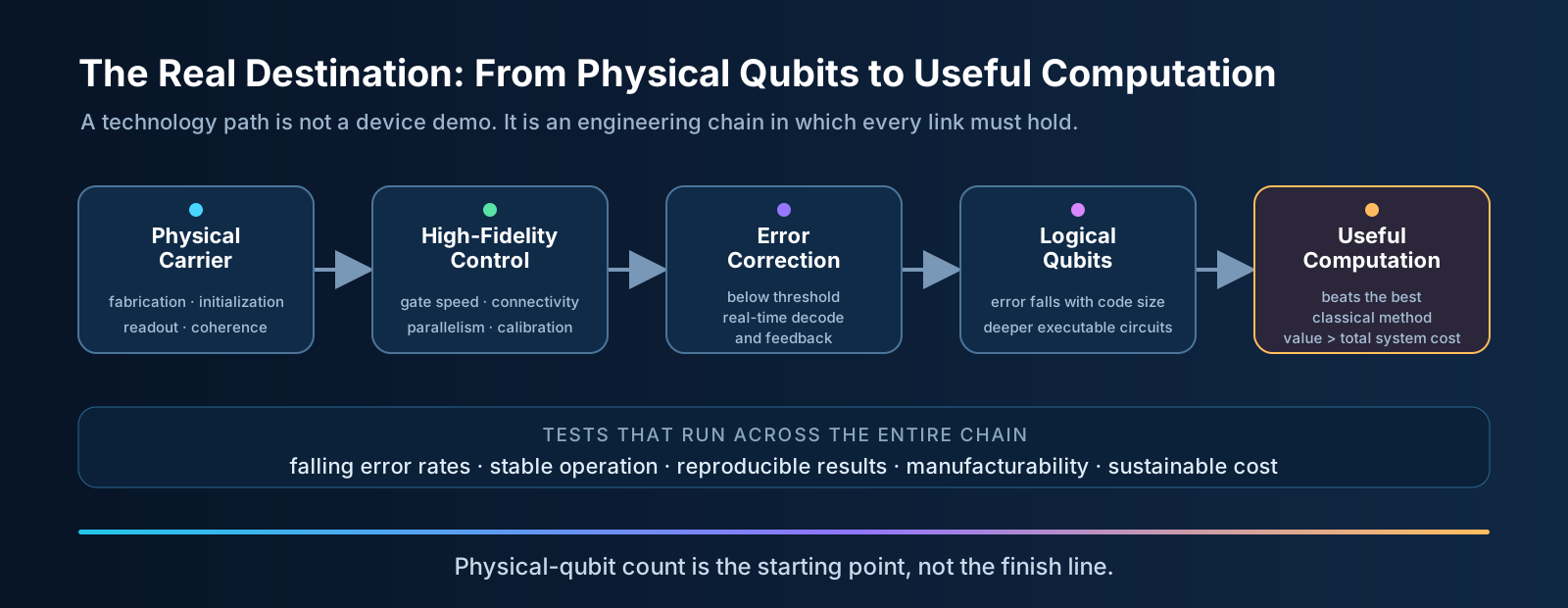
Figure 2. Physical-qubit count is only the beginning. High-fidelity control, below-threshold error correction, logical qubits and end-to-end application value must hold continuously before a path can truly reach “Rome.”
V. Why No Path Can Yet Be Declared the Winner
1. Every path optimizes a different objective
Superconducting systems emphasize gate speed and chip integration. Trapped ions emphasize fidelity. Neutral atoms emphasize array size and reconfigurability. Photonics emphasizes networking. Silicon spin emphasizes density and manufacturing. Topological systems pursue physical protection. Annealing pursues specialized optimization.
They are not racing on one track under one metric.
2. A winning platform does not guarantee a winning company
Even if one physical carrier becomes dominant, the company that proposed it first, went public first or has the highest valuation today may not capture the greatest value. Value may migrate toward:
- control electronics and cryogenic systems;
- laser, photonic and measurement equipment;
- quantum error correction and real-time decoding;
- cross-hardware compilers and software platforms;
- cloud access and CPU–GPU–QPU scheduling;
- application companies that own industry data and workflows.
3. The future may be hybrid and multi-platform
There may never be one universal quantum machine. Different QPUs may serve simulation, optimization and network-node roles. Classical CPUs, GPUs and quantum processors are also more likely to cooperate over the long term than to be replaced wholesale by quantum hardware.
4. Between “can compute” and “worth computing” lies an economic threshold
DARPA’s Quantum Benchmarking Initiative defines utility-scale performance in terms of computational value exceeding computational cost, and is testing whether any approach can reach industrial utility by 2033.[^15]
The destination is not a machine that runs. It is a machine that repeatedly solves problems worth solving at an acceptable total cost.
VI. Five Common Misconceptions
Misconception 1: A quantum computer can read all answers at once
Superposition contains multiple probability amplitudes, but measurement returns limited information. A quantum algorithm must engineer interference so that useful answers become more likely.
Misconception 2: More qubits always means a stronger computer
If error is high, connectivity poor or executable circuits shallow, more physical qubits may mean more noise. Logical error rates, executable depth and useful results matter more.
Misconception 3: The platform with the longest coherence must win
Useful power depends on how many high-fidelity operations fit inside the coherence window. Gate speed, parallelism, readout speed and connectivity all matter.
Misconception 4: CMOS compatibility means transistor-like scaling is already solved
Quantum devices are far more sensitive than ordinary transistors to interfaces, defects, charge noise and cryogenic control. A familiar device shape does not imply identical engineering laws.
Misconception 5: Quantum computers will replace CPUs and GPUs
Quantum processors are more likely to act as accelerators for specific problems. Control, data preparation, error correction, verification and most business logic will remain classical.
VII. How to Judge Whether a Path Is Making Real Progress
Instead of following one-off announcements, track evidence that answers these questions:
- Does error fall as the system grows? More physical qubits alone are not progress.
- Are logical circuits becoming deeper? Can the machine sustain more corrected operations?
- Are results reproducible? Is there peer review, third-party testing or independent replication?
- Is the system complete? Do the chip, control, cryogenics, compiler, correction and service layers work together?
- Is utilization improving? Can the machine operate reliably instead of completing one showcase experiment?
- Does a real task win end to end? Does it beat the best classical method available at the time?
- Is cost falling? Is the total system cost of a useful result lower than the value created?
IBM and other companies have begun shifting public roadmaps away from raw physical-qubit count toward logical qubits, executable gates, modular architecture and fault-tolerant systems. These roadmaps are corporate targets to be tested, not completed achievements.[^16]
VIII. Conclusion: The Competition Is to Turn Fragility into Reliability
The seven paths look radically different, but all confront the same contradiction:
Quantum capability arises from states that are exquisitely sensitive to their environment, while industry requires machines that are stable, reproducible and verifiable.
Superconducting systems place difficulty in cryogenics, calibration and wiring. Trapped ions place it in lasers, speed and modular scaling. Neutral atoms place it in atom loss and large-scale parallel control. Photonics places it in loss and resource states. Silicon spin places it in device uniformity and cryogenic interconnects. Topological systems still face foundational validation. Quantum annealing must prove specialized computational value.
No path is easy, and no single metric can declare victory.
The real breakthrough will not be a photograph containing more laboratory qubits. It will be the organization of fragile, probabilistic and difficult-to-control quantum phenomena into a system that runs continuously, produces reproducible results and solves real problems.
References
[^1]: National Institute of Standards and Technology. “Quantum Computing Explained.” 2025. https://www.nist.gov/quantum-information-science/quantum-computing-explained
[^2]: Preskill, J. “Quantum Computing in the NISQ Era and Beyond.” Quantum 2, 79 (2018). https://quantum-journal.org/papers/q-2018-08-06-79/
[^3]: Google Quantum AI and Collaborators. “Quantum Error Correction Below the Surface Code Threshold.” Nature 638, 920–926 (2025). https://www.nature.com/articles/s41586-024-08449-y
[^4]: Van Damme, J. et al. “Advanced CMOS Manufacturing of Superconducting Qubits on 300 mm Wafers.” Nature (2024). https://www.nature.com/articles/s41586-024-07941-9
[^5]: Ransford, A. et al. “A 98-Qubit Trapped-Ion Quantum Computer with All-to-All Connectivity.” Nature (2026). https://www.nature.com/articles/s41586-026-10676-4
[^6]: Bluvstein, D. et al. “Logical Quantum Processor Based on Reconfigurable Atom Arrays.” Nature 626, 58–65 (2024). https://www.nature.com/articles/s41586-023-06927-3
[^7]: Bluvstein, D. et al. “A Fault-Tolerant Neutral-Atom Architecture for Universal Quantum Computation.” Nature (2026). https://www.nature.com/articles/s41586-025-09848-5
[^8]: Bartolucci, S. et al. “Fusion-Based Quantum Computation.” Nature Communications 14, 912 (2023). https://www.nature.com/articles/s41467-023-36493-1
[^9]: PsiQuantum team. “A Manufacturable Platform for Photonic Quantum Computing.” Nature (2025). https://www.nature.com/articles/s41586-025-08820-7
[^10]: Steinacker, P. et al. “Industry-Compatible Silicon Spin-Qubit Unit Cells Exceeding 99% Fidelity.” Nature (2025). https://www.nature.com/articles/s41586-025-09531-9
[^11]: Elsayed, A. et al. “Low Charge Noise Quantum Dots with Industrial CMOS Manufacturing.” npj Quantum Information 10 (2024). https://www.nature.com/articles/s41534-024-00864-3
[^12]: Das Sarma, S., Freedman, M. & Nayak, C. “Majorana Zero Modes and Topological Quantum Computation.” npj Quantum Information 1, 15001 (2015). https://www.nature.com/articles/npjqi20151
[^13]: Microsoft Azure Quantum et al. “Interferometric Single-Shot Parity Measurement in InAs–Al Hybrid Devices.” Nature (2025). https://www.nature.com/articles/s41586-024-08445-2
[^14]: Albash, T. & Lidar, D. A. “Adiabatic Quantum Computation.” Reviews of Modern Physics 90, 015002 (2018). https://link.aps.org/doi/10.1103/RevModPhys.90.015002
[^15]: Defense Advanced Research Projects Agency. “Quantum Benchmarking Initiative.” https://www.darpa.mil/research/programs/quantum-benchmarking-initiative
[^16]: IBM Quantum. “IBM Lays Out a Clear Path to Fault-Tolerant Quantum Computing.” 2025. https://www.ibm.com/quantum/blog/large-scale-ftqc
Further Viewing: Chinese- and English-Language Video Resources
Video is useful for building intuition, but it should not replace papers and technical reports. A good sequence is to begin with universities and broadly educational channels, then use corporate channels to understand specific hardware and software. Corporate material naturally gives more attention to the company’s own approach.
Chinese-language resources accessible in China
| Channel / resource | Best for | Suggested search terms | Notes |
|---|---|---|---|
| Micius Salon / 墨子沙龙 on Bilibili | Beginner to advanced | 潘建伟, 量子计算, 量子纠错, 九章, 祖冲之 | Researcher talks and interviews that connect physical intuition with the research frontier. Episodes can be long but information-dense. |
| Institute of Physics, CAS / 二次元的中科院物理所 on Bilibili | General readers | 量子力学, 超导, 量子计算机, 低温 | The official account of the Institute of Physics, Chinese Academy of Sciences. Useful for basic physics, superconductivity, materials and low-temperature context. |
| School of Physical Sciences, USTC / 中国科大物理学院 on Bilibili | Readers approaching research-level material | 量子信息, 光量子, 超导量子计算, 学术报告 | Academic activities and lectures; accessibility varies by video. Useful for tracking Chinese photonic and superconducting research after an introductory foundation. |
| Manim-style mathematical explainers / 漫士沉思录 on Bilibili | Visual and mathematically curious learners | 量子计算, 量子算法, 线性代数, 复杂度 | An independent creator strong in visualization and mathematical explanation. Use original sources to verify claims about fast-moving research. |
| Full lecture: Superconducting Quantum Computing by Zhu Xiaobo | Hardware-focused advanced readers | Superconducting qubits, chip fabrication, quantum advantage | A single technical lecture rather than a channel; a useful extension to the superconducting section of this article. |
Suggested Chinese-language sequence: begin with 墨子沙龙 or 漫士沉思录 for intuition, use the Institute of Physics channel for physical foundations, then move to USTC lectures and researcher presentations.
English-language YouTube channels and courses
| Channel / resource | Best for | Suggested topics | Notes |
|---|---|---|---|
| Domain of Science | Visual beginners | “Map of Quantum Computing,” qubits, algorithms and the hardware landscape | Excellent for seeing the field as a whole. Use the maps for orientation rather than current benchmark comparisons. |
| Looking Glass Universe | Physical intuition | Quantum mechanics, measurement, interference and quantum-computing careers | Created by a physicist and particularly strong on conceptual caveats; less focused on commercial hardware roadmaps. |
| MIT OpenCourseWare | Systematic academic study | Quantum computation, quantum information and algorithms | More mathematical and university-level. The Quantum Computing playlist is a useful entry point. |
| QuTech Academy | Hardware and architecture | Superconducting qubits, spin qubits, quantum internet, control layers and topological concepts | Especially useful for understanding the layers of a quantum computer and comparing device architectures. |
| Qiskit | Hands-on programming | Circuits, algorithms, error correction and practical Qiskit | IBM-backed and practical. Excellent for software work, while naturally emphasizing the superconducting IBM ecosystem. |
| IBM Research | Industry engineering and roadmaps | Fault tolerance, cryogenics, modular systems and IBM Quantum | A primary source for IBM’s plans rather than a neutral industry survey. Compare roadmap claims with peer-reviewed results and independent benchmarks. |
Suggested English sequence: start with Domain of Science or Looking Glass Universe, continue with MIT OpenCourseWare or QuTech Academy, then use Qiskit for hands-on experiments. Vendor channels become most useful after the viewer can distinguish measured results from forward-looking roadmaps.
Scope note: This article explains technical principles and engineering difficulty. Corporate roadmaps and vendor performance figures are treated as claims that require continuing validation. Metrics, test circuits and hardware scales differ across platforms and should not be reduced to a single-number ranking. Sources updated through August 2026.