From the Abacus to Quantum Computing: The Quantum Singularity in the Evolution of Human Computing Tools
Abstract
Quantum computing is often described as a new technology capable of operating far faster than classical computers. Yet viewing it only through the lens of speed obscures its deeper place in the evolution of human computing tools. Throughout history, each change in the physical substrate of computation has done more than shorten the time needed to solve a problem: it has expanded the portion of the world that humans can describe, process, and understand. Manual calculation and counting tools helped us handle quantities; mechanical devices embodied rules in machines; electronic computers made models of the world programmable and, through networks, cloud computing, and artificial intelligence, extended computation into massive datasets and cognitive information. Quantum computing now seeks to address complex state spaces that classical systems cannot efficiently unfold.
This article defines the quantum singularity as the transition through which quantum computing develops from an experimental physical capability into a socialized computing capability able to solve meaningful problems reliably, repeatedly, and economically. This singularity is not a single machine, a particular qubit count, or one benchmark result. It is a historical interval formed by the convergence of scientific, engineering, application, and economic conditions.
Keywords: quantum computing; computing tools; quantum singularity; computing civilization; technological evolution
Terminological note: “Quantum singularity” is used here as an analytical concept for discussing technological evolution. It is not an established academic term with a universally accepted definition.
1. The History of Computing Tools Is Also a History of Expanding Cognitive Boundaries
The earliest human computing tool was not a machine. It was the body.
Fingers, stones, knotted cords, and tally marks transformed an imprecise sense of “how many” into quantities that could be preserved and compared. Computation depended primarily on human memory and experience, and its objects were immediate concerns such as population, livestock, grain, time, and distance. Computing ability was concentrated among the relatively few people who understood numbers, calendars, measurement, and recordkeeping.
With counting rods, the abacus, and mechanical calculators, part of the computational process moved into external tools. These devices still required human operation, but they could preserve intermediate states, repeat procedures more consistently, and reduce error. Calculation gradually changed from a skill highly dependent on individual cognition into an operational system that could be taught and reproduced.
Electronic computers brought a more fundamental transformation. Vacuum tubes, transistors, and integrated circuits converted computation into rapid changes of electronic state. Machines no longer merely assisted people with arithmetic; they began solving equations, simulating climate, designing aircraft, analyzing genomes, and managing global financial systems. The objects of computation expanded from visible quantities to formal models of the world.
Electronic computing then underwent several internal expansions: mainframes, personal computers, the internet, cloud computing, GPU acceleration, and artificial intelligence. Computing power was no longer confined to a small number of research institutions and large corporations. Through personal computers, smartphones, and cloud services, it entered everyday life. With the rise of AI, text, images, sound, knowledge, and even parts of the decision-making process became computational objects.
These developments, however, must be distinguished by level. Cloud computing changed how classical computing resources are organized, scheduled, and delivered. Artificial intelligence changed how models are learned from data and how cognitive information is processed. Both dramatically expanded the scale and uses of electronic computing, but neither replaced its physical foundation of transistors, classical bits, and electronic circuits. In the physical evolution of computing tools, they are expansions within the electronic era rather than substrate-level revolutions comparable to the transition from mechanical to electronic computing.
The evolution of computing tools therefore cannot be reduced to the statement that “computers keep getting faster.” A more accurate formulation is:
Every computing revolution transforms another part of the previously intractable world into something that can be represented, manipulated, and tested.
Manual calculation and counting tools handled quantity. Mechanical computing executed rules. Electronic computing simulated systems and gradually absorbed massive datasets and cognitive information. Quantum computing confronts complex state spaces that classical tools struggle to expand efficiently.
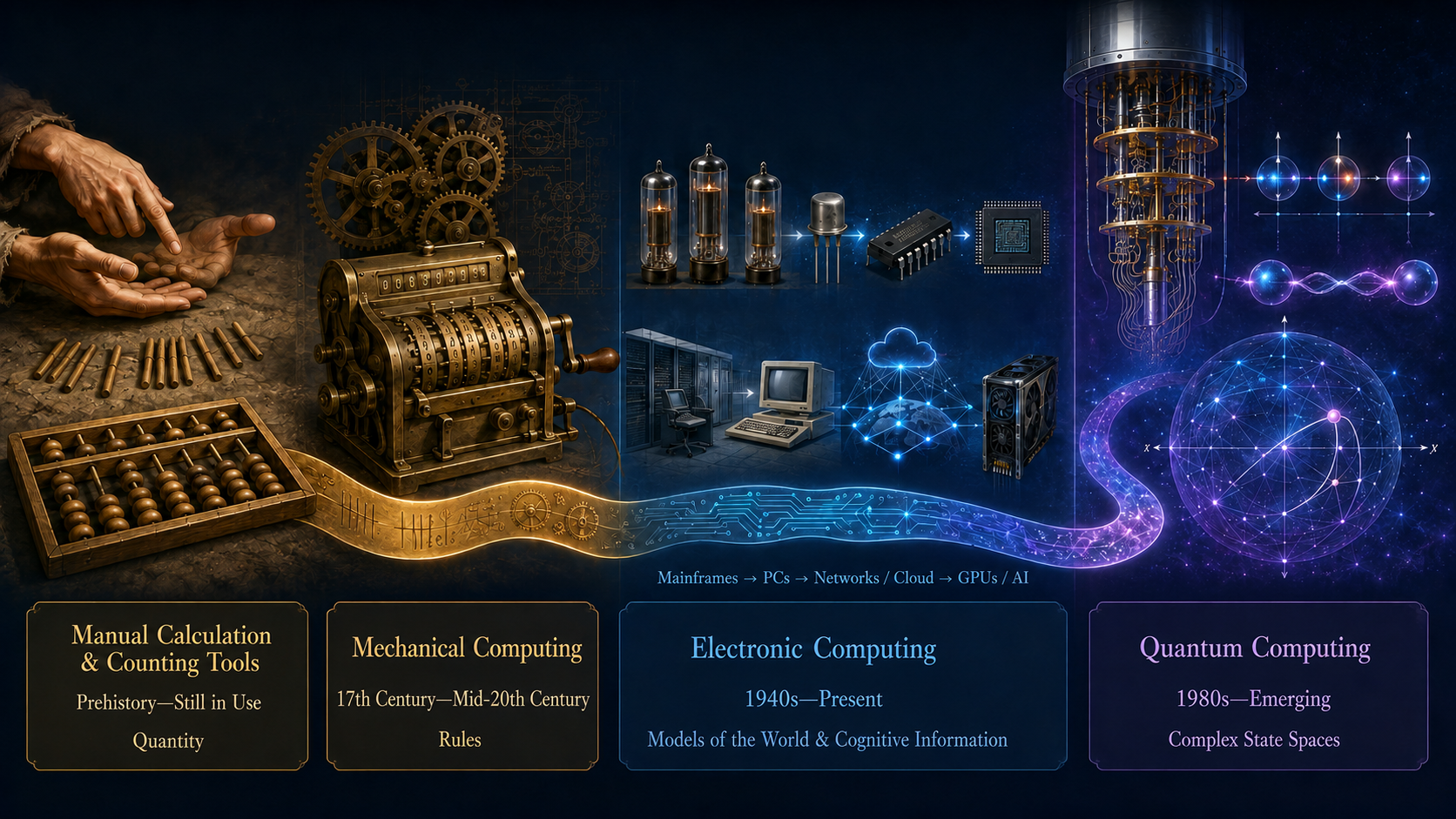
Figure 1 | From counting tools to quantum systems: the evolution of the physical substrate of human computation. Mainframes, personal computers, networks and cloud platforms, and GPUs and AI are shown as scale and capability expansions within electronic computing. The historical periods overlap; a later tool does not immediately replace an earlier one.
2. Quantum Computing Is Not Simply “Calculating All Answers at Once”
Classical computers represent information using bits. Once measured, each bit can hold either 0 or 1. At any given moment, a system of n classical bits occupies one of 2n possible configurations.
A qubit, by contrast, can exist in a superposition of basis states. The complete state of a multi-qubit system is described by an amplitude space whose size grows exponentially with the number of qubits. This does not mean that a quantum computer simply “calculates every answer at once” and then reads them all out. Measurement still yields only limited classical information.
Quantum algorithms derive their power from superposition, entanglement, and interference. They shape the evolution of quantum states so that unhelpful computational paths cancel one another while structures associated with useful answers are amplified, increasing the probability of obtaining a meaningful result.
This distinction matters. A quantum computer is not an infinitely parallel classical computer, nor will it automatically accelerate every problem. Quantum advantages can arise only for problems with suitable structure, such as quantum-system simulation, certain algebraic problems, search, sampling, and some forms of optimization.
The most natural object for quantum computing may be the quantum world itself. When a classical computer simulates a many-particle quantum system, it must use classical storage and operations to describe a state space that expands rapidly. A quantum computer instead attempts to use one controllable quantum system to simulate another. This is not merely a stronger machine approximating nature. It is an attempt to make nature's own quantum laws participate in computation.
3. What Is a “Quantum Singularity”?
A technological singularity is often imagined as a sudden and irreversible moment. The development of quantum computing is more likely to resemble a gradually forming critical interval.
In this article, the quantum singularity means:
The transition through which quantum computing moves from demonstrated physical feasibility to the stable, repeatable, and economically reasonable solution of real problems, becoming an irreplaceable layer of the human computing system.
This definition contains four interdependent thresholds.
3.1 Scientific threshold: Is quantum computation physically realizable?
Humanity must first demonstrate that qubits can be prepared, controlled, entangled, and measured, and that quantum processors can complete certain tasks whose results are difficult for classical computers to reproduce. This stage answers the question: Can quantum computing exist at all?
In this limited sense, part of the scientific threshold has already been crossed. Quantum processors have completed a range of experimental tasks, and the field's focus is gradually shifting from proving that quantum effects can be used for computation to controlling error and scaling systems.
3.2 Engineering threshold: Does the system remain reliable as it scales?
Quantum states are extraordinarily fragile. Environmental noise, control errors, and decoherence can all destroy a computation. If adding qubits merely introduces more errors, a larger system may become less—not more—capable of performing useful work.
The decisive measure is therefore not the raw number of physical qubits. It is whether quantum error correction can construct stable logical qubits and whether logical error rates continue to fall as the code grows. Experiments published by Google Quantum AI have demonstrated logical qubits operating below the surface-code error-correction threshold, indicating that larger error-correcting codes can reduce logical error rates instead of simply producing more uncontrolled error. Nature research paper
This does not mean that a universal fault-tolerant quantum computer has been completed. It does mean that the engineering question is beginning to shift from “Is scaling possible?” to “Can scaling become practical?”
3.3 Application threshold: Does it solve a problem that genuinely matters?
Quantum advantage in an experimental benchmark is not the same as quantum value in the real world.
A benchmark may be designed to expose the difference between quantum and classical systems without corresponding to an important task in materials design, drug discovery, financial risk, or industrial optimization. A genuine application threshold requires an end-to-end task with real value, performed better than the best available classical alternative in time, accuracy, or resource use.
The comparison cannot be made against an ordinary computer or an obsolete algorithm. The relevant baseline is the best classical hardware, software, approximation method, and hybrid workflow available at the time.
A useful quantum advantage must therefore satisfy at least the following condition:
The cost includes not only the quantum processor but also refrigeration, control systems, error correction, data preparation, result validation, and classical-computing support.
3.4 Economic threshold: Can the capability be converted into sustained social value?
Even if quantum computing can solve certain classically difficult problems, it may remain confined to national laboratories and very large corporations if every useful computation requires prohibitively expensive equipment, energy, and expertise.
The economic threshold is crossed when quantum capability can be invoked reliably and the value it produces can cover its full cost. This does not require every person to own a quantum computer. A more plausible model is that a limited number of quantum-computing centers provide services to researchers, companies, and developers through the cloud—much as people today use the results of supercomputers and large AI clusters without owning those systems.
IBM has stated an objective of building Starling, a fault-tolerant system with 200 logical qubits capable of executing 100 million quantum gates, by 2029. This is a corporate roadmap rather than an accomplished fact, but it illustrates the industry's shift from raw physical-qubit counts toward logical qubits, executable circuit depth, and complete system capability. IBM quantum roadmap
4. The Quantum Singularity Is Not a Point but a Convergence of Conditions
The quantum singularity can be expressed as a conceptual formula:
where:
- C = Controllability
- S = Scalability
- A = Applicability
- E = Economic viability
This is not an empirical measurement equation. It illustrates the multiplicative structure of the quantum singularity: if any one factor approaches zero, the overall capability remains weak.
A scientific breakthrough without engineering leaves quantum computing as a laboratory apparatus. Hardware scale without useful algorithms produces expensive infrastructure. Theoretical algorithms without stable logical qubits remain trapped in papers. Even if all three exist, a system whose full operating cost persistently exceeds the value of its results will not become a broad industrial capability.
We should therefore stop asking only, “In what year will the quantum singularity arrive?” More useful questions include:
- Do logical error rates continue to fall as systems grow?
- Is the number of executable fault-tolerant quantum gates increasing substantially?
- Are real tasks emerging for which classical methods are not credible substitutes?
- Is the total cost per useful result declining?
- Is quantum capability entering stable industrial workflows?
When these indicators improve together, the quantum singularity will not arrive as a single news event. It will be a transition that people enter gradually and that history recognizes only in retrospect.
5. Its Earliest Effects Will Not Be Evenly Distributed Across Industries
Quantum computing will not transform every field at the same rate. It is most likely to affect first those domains whose computational objects naturally resemble quantum systems or very large state spaces.
Materials science and chemistry are among the most direct candidates. Molecular structures, electronic interactions, and material properties are themselves quantum phenomena. If reaction pathways, ground-state energies, and material characteristics can be calculated more accurately, the way humanity searches for catalysts, medicines, battery materials, and new compounds may change.
Cryptography demonstrates a different kind of impact. A sufficiently capable fault-tolerant quantum computer could threaten some of the public-key cryptographic systems widely used today. Although no quantum computer currently has practical cryptanalytic capability at that scale, the U.S. National Institute of Standards and Technology finalized its first three post-quantum cryptography standards in 2024 and has encouraged organizations to begin migration in advance. NIST post-quantum cryptography standards
This shows that a technology can alter social behavior before it becomes fully mature. Once a future capability becomes sufficiently credible, standards, investment, and security strategy begin to move in anticipation.
Finance, logistics, machine learning, and general business optimization present both promise and uncertainty. Their ability to obtain a practical quantum advantage depends not only on quantum algorithms but also on data loading, result extraction, error tolerance, and the continued improvement of classical algorithms.
6. Whose Computing Power Will Quantum Computing Expand?
The evolution of computing tools contains another often-overlooked question: Who controls the ability to compute?
Early calculation depended on a small number of people trained in numbers and writing. Mechanical devices expanded the capabilities of specialists. Electronic computers initially belonged to governments, militaries, universities, and large corporations. Personal computing and the internet eventually gave billions of people direct access to computation, while AI further lowered the barriers to programming, language processing, and knowledge work.
Quantum computing may initially appear to reverse this trend. Its equipment is expensive, its operating environment complex, and its resources concentrated among a limited number of states, universities, and technology companies. Yet cloud access and hybrid architectures may eventually distribute the right to use quantum capability. Most people may never need to understand quantum gates or write quantum circuits directly, but they could still benefit from quantum-generated results embedded in materials, medicine, energy, and information-security systems.
The expansion of computational agency therefore need not mean that “everyone owns a quantum computer.” It may instead mean that increasing numbers of people can invoke computational capabilities derived from the quantum world.
7. From Computing Technology to Computing Civilization
Fingers, abacus beads, gears, transistors, and qubits belong to radically different technological eras, but they play the same historical role: they transform problems once approached only through intuition, experience, or trial and error into objects that can be represented, explored, and tested.
From this perspective, the larger significance of quantum computing is not that it may produce a faster machine. It is that it may change what can be computed.
Classical computing converts the world into models built from 0s and 1s. Artificial intelligence, as an algorithmic capability running on classical electronic systems, extracts linguistic and cognitive structures from enormous bodies of information. Quantum computing attempts to use nature's quantum behavior directly and to enter state spaces that classical tools cannot efficiently unfold.
If this transition succeeds, humanity will acquire more than a stronger machine. It will gain something resembling a new cognitive organ. Materials, molecules, and system configurations that once required long sequences of physical experiments may first be filtered, combined, and tested in computational space. Experimentation will not disappear, but the division of labor between experiment and computation will be reorganized.
The quantum singularity is therefore not the moment when quantum computers defeat classical computers. Classical computing, AI, and quantum computing are more likely to coexist in hybrid systems for a long time: classical computers handling control, storage, and general-purpose tasks; AI identifying patterns, organizing knowledge, and translating human needs; and quantum processors addressing the narrower classes of problems that match their structure.
The decisive question is:
Can humanity reliably transform previously inaccessible possibility spaces into practical domains that can be explored, filtered, and used?
If the answer eventually becomes yes, quantum computing will be more than a new industry or a collection of investment targets. It will become another foundational layer in the evolution of human computing tools.
The essence of the singularity is not that machines suddenly become omnipotent. It is that the world humanity can understand and alter expands once again.